

Does Your Carpet Install Quote Include Old Carpet Removal?
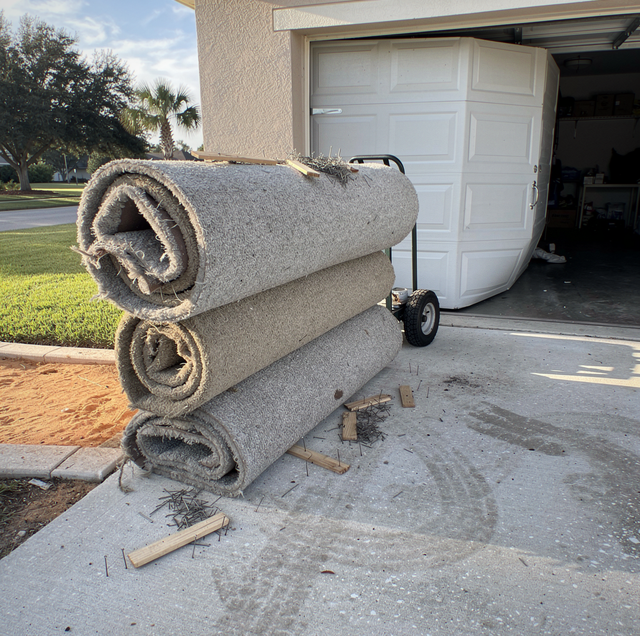
The quote is printed on the kitchen counter, or sitting open in a browser tab, and somewhere in the middle of it is a line about the old carpet. Maybe it reads removal of existing floor covering. Maybe it just says removal included. Either way you're reading it a second time, because it doesn't tell you what will still be sitting in your house at five o'clock on install day. That single line is where most carpet projects develop a gap. It's worth closing before anyone is in your driveway.
"Removal" Is a Word, Not a Scope
Removal in a flooring quote isn't a defined term with a single fixed meaning. One quote covers pulling the old carpet, the padding under it, the tack strip along the walls, the staples, and getting every bit of that material off your property. On another quote, the same word covers the carpet and nothing else. Both documents are accurate. They're describing different jobs.
The reason sits in who wrote the thing. A flooring quote is written from the installer's perspective: it describes what has to happen for the new floor to go down correctly, which isn't the same list as what has to happen for your house to be back in order. Those two lists overlap heavily. They aren't identical, and the space between them is where old material tends to stay.
So read the line for its verbs and nouns rather than for the general impression it gives. The verbs tell you what happens in the room. Pull, take up, strip out, cut, and remove all describe actions performed within four walls. The nouns tell you what the sentence is willing to account for: carpet, pad, tack strip, staples, debris. A line with a firm verb and one noun has described one material. A line with a vaguer verb and four nouns has described four, and the second line is worth more to you than the first.
What a Removal Line Might Not Reach
Under a stretched-in carpet there are several separate materials, each fastened its own way, and each one is its own piece of labor once the carpet itself is up. Start from the carpet as the baseline, since it is plainly what the sentence is about: the top surface, held under tension across the room and hooked onto tack strip around the perimeter. Everything else sits behind the carpet on the document as much as it does on the floor, and any of it can be inside or outside that line without the wording looking much different either way.
Furniture and stairs are the two most worth naming out loud, because a quote either treats them as their own lines or doesn't mention them at all. Neither one reads as a separate job while you're scanning the page, which is exactly why they're the two that get discovered late.
| What sits behind the carpet | Why it's a separate question on the quote |
|---|---|
| The padding | A second sheet with its own fasteners, pulled after the carpet is clear |
| Tack strip | Nailed to the deck along every wall; whether it comes out depends on what's going down next, and that call belongs to your installer |
| Staples | Pulled by hand, one at a time, across the whole perimeter |
| Haul-off | Happens off your property, so it's a different scope from anything done inside the room |
| Furniture | Either a line of its own on the document or an unwritten assumption about who lifts what |
| Stairs | Scoped and counted differently from open floor, so a room-based line can pass straight over a carpeted flight |
Removal and Haul-Off Sit on the Page as Two Separate Lines
This is the split the word removal hides best, and it is easy to check in a document. Taking the material out of the room and taking it off the address are two scopes, and a quote can carry either one without the other.
Read the line for a destination. Pull, take up, strip out, and remove all stop at the doorway; none of them say anything about where the material spends the night. Haul, dispose, debris removal, and off-site describe the second half, and those words are either printed on the page, or they aren't. A removal line can be honored exactly as written and still leave old material stacked on your property, because the sentence never claimed the second half in the first place.
It runs the other direction too. A document that promises haul away without describing any pulling has committed to moving material that somebody still has to get off the floor first. Both halves are ordinary, and neither one implies the other. What you're looking for isn't generosity in the wording; it's whether both halves are actually written down.
What a Short Removal Line Leaves Unstated
A line reading removal, whether included or free, is doing something real. What it isn't doing is publishing an inventory.
The carpet itself is the fastest layer to release; everything slower comes afterward: the padding's staples, the nailed strip along every wall, the sweep, and then the load-out. A short line tends to describe the visible half of that work, which is the half that finishes early and looks finished from the doorway.
There's a second thing a short line leaves open, and it has to do with what the offer is attached to. A removal line printed beside the new carpet can be scoped to that swap and to nothing else, which is worth asking about by room name. Carpet elsewhere in the house, or a room you've decided to leave alone this round, may sit outside that line even though it's the same material under the same roof.
Ask where the old carpet ends up after it leaves the room rather than asking whether removal is included. The first question can only be answered with a destination, and a destination is the part the ambiguous line leaves out.
Room Names and Quantities Are Where the Scope Actually Lives
Most of the argument about what removal means gets settled by two things on the page that aren't sentences at all: the room names and the quantity column.
A removal line with a quantity beside it is a scoped line. A removal line with no quantity is a phrase. If the document lists square footage or square yards against the removal, compare that figure against the rooms you want cleared rather than against the rooms getting new carpet. Frequently those are the same list. When they aren't, the difference shows up as a number rather than a disagreement, and it appears while everything is still on paper.
Stairs are the case where the number stops helping. A staircase isn't measured by open floor area, since a flight gets counted step by step, and a removal quantity written for the bedrooms can pass over a carpeted flight without anybody intending it to. If you have carpeted stairs, look for the word stairs on the page. If it isn't printed anywhere, the stairs aren't in the line, whatever the total square footage says.
Closets, hallways, and landings belong in the same category for a smaller reason: they're part of the floor, and they're easy to leave off a list written from memory at the end of a walk-through. A room-by-room breakdown on the document, each space named, turns the whole question into something you can check line by line instead of something you have to remember correctly.
A Revised Quote Is a New Document
Orders change between the first version of a quote and the day work starts. A room gets added. A room comes off. The material changes. Each of those produces a new version of the document, and the removal line doesn't always travel with the rest of it.
Read the removal line on the revision the same way you read it on the original, and check it against the new room list rather than the one you started with. Adding a room to the install side of an order and adding it to the removal side are two separate edits made in two separate places, so a revision can show a new room getting carpet while the removal line still describes the original set. The same thing happens in reverse: a room dropped from the order can leave a removal quantity still carrying square footage nobody is going to touch.
One kind of change is worth flagging early. Choosing a different pile height, color, or grade of carpet doesn't change what has to come off the floor first. Switching to a different flooring type can, because what the installer wants left behind, the tack strip in particular, is tied to what's going down next. If that decision is still open while the quote is being written, say so early so the removal line is written to cover the possibility rather than a single version of it.
Four Questions to Put to Whoever Wrote the Quote
All of this settles in one short conversation with whoever wrote the document, and the answers need to come from them directly rather than be inferred from the wording. Four questions do most of the work, and not one of them can be answered with the word yes.
Which rooms does this line cover, by name? A list is an answer; a nod is not. If there are carpeted stairs in the house, the second question is whether the stairs appear on the document as a line of their own, since a flight scoped inside a room count is the easiest thing on the page to miss. Third comes furniture: who is moving it, and when, so that it isn't discovered by two sets of people standing in the same room on the same morning. The last question is about geography rather than labor. Where does the old material end up once the truck pulls out of the driveway?
Answered by room name and by destination, those four turn four assumptions into four sentences you can both work from.
When the Quote Really Does Cover Everything
Plenty of install contracts do cover the whole thing: the pull, the strip, the staples and the haul. When yours is one of them, the right move is to book nothing and let them work. That answer needs to come directly from your flooring installer, not be inferred from the shape of the document.
A quote that covers everything usually reads specifically rather than generously. It names the materials instead of gesturing at them. It says something about disposal, haul-off, or debris leaving the site rather than stopping at the edge of the room. It addresses stairs if you have stairs. It says who moves what, and it doesn't leave the sentence hanging on the word removal.
The partial gap is the outcome actually worth planning for. Everything covered except the stairs. Everything covered except the bedroom that isn't getting new carpet this round. Everything covered except the haul. A partial gap is harder to catch than a total one, because most of the line is true and only one piece of it isn't.
A removal line that reaches the carpet and stops leaves nailed tack strip and loose staples in a room that reads finished from the doorway. Treat that room as unfinished, and keep it closed, until the second scope is settled.
Reading the quote closely doesn't mean assuming your installer left something out. It means knowing which version of removal your quote describes, well before the day the difference shows up in your driveway.
Frequently Asked Questions
Silence isn't the same as included. A quote that describes only the new material and its installation doesn't make a claim about the old floor in either direction, so ask whoever wrote it whether the existing carpet is in scope, then ask for that answer to be added to the document instead of left in a phone call. A missing line is much easier to settle before the order is placed than after.
Ask whoever's name is on the quote, since the document is what sets the scope. If a retailer wrote it, the retailer answers, even when a subcontracted crew does the actual work. Putting the question to the crew on install morning tends to produce an answer about what they're able to do that day, which is a different question from what the document describes.
Not on its own. Adding a room to the install side of an order and adding it to the removal side are two separate edits, so a revised quote can show the new room getting carpet while the removal line still describes the original list. Read that line again on every revision and check it against the current room list rather than the one it started with.
Usually not, unless they're named. A removal line written for wall-to-wall carpet describes wall-to-wall carpet, so a loose area rug, a pad under that rug, or another floor covering beneath the carpet are separate items with separate answers. If you want any of them gone, say so while the quote is still being written.
Almost nothing, and that's normal. A quote is written from what someone has seen, and nobody has seen under your carpet yet, so a finding on the bare deck is a separate question with its own answer. Knowing that ahead of time is what keeps a discovery on install morning from reading like a broken promise; instead, it reads as a new decision that needs an answer of its own.
Treat those as two different halves and ask which one you've actually got. Haul away can describe taking material that has already been pulled and staged, which leaves the pulling itself unaccounted for. The fix is the same in both directions: ask for the physical steps in order, from the first cut in the carpet to the material leaving the address.
The removal line names the carpet and stops there — the padding, the strip, and the staples can leave the property on their own booking. Polk Services LLC serves Lakeland, Highland City, and Mulberry. Call (863) 344-5806.
