

Stabilizing a Gravel Driveway on a Steep Slope: 4 Fixes
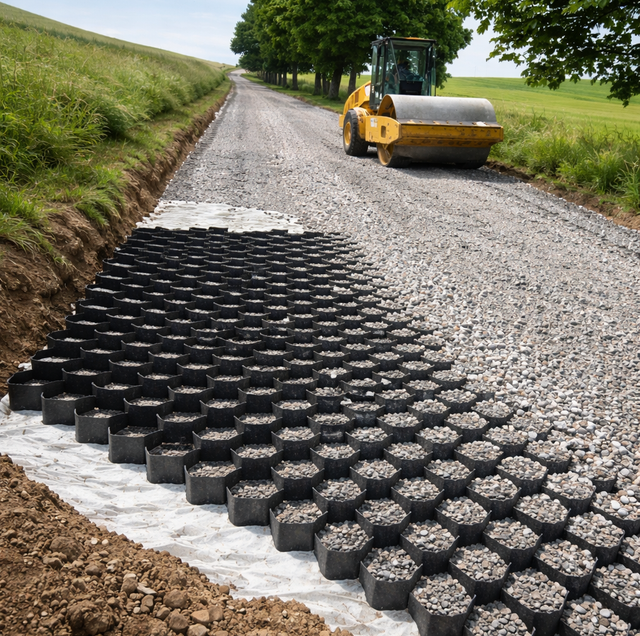
A driveway corridor graded within a normal fall range still responds to routine grading and drainage work, the kind of upkeep that keeps a gently sloped gravel drive holding its shape year after year. A truly steep driveway is a different situation. Past the roughly 12 to 15 percent ceiling that marks where ordinary regrading stops being enough for a sustained stretch, the grade itself becomes the problem: loose stone sitting on a slope steep enough that gravity does more work against it than friction can resist. On a run like that, gravel doesn't just wander downhill under tire traffic; it can migrate under nothing but rain and its own weight between visits. Past that same ceiling, a fixed surface is often the more honest recommendation for a property owner who isn't set on gravel specifically; what follows here is what makes a gravel surface viable on that grade for an owner who wants to stay with stone rather than switch materials.
Locking Stone in Place With Geogrid or Cellular Confinement
Geogrid: a grid-like layer, usually a stiff synthetic mesh, placed within or under the stone so the aggregate interlocks through its openings instead of resting loose on top of the base. As stone settles into the grid, the grid spreads the load sideways and resists the stone's tendency to creep downhill as one shifting mass.
Cellular confinement: a honeycomb-style panel that divides the stone layer into small individual pockets, often just a few inches across. Stone inside each cell is boxed in on all sides, so a downhill nudge from tire traffic or runoff moves the stone within its cell rather than dragging a whole section of the surface down the slope.
Both products serve a different purpose than the geotextile fabric used on a standard gravel driveway, which separates the subgrade from the base course so that fine soil particles don't pump up into the stone. Geogrid and cellular confinement work above that separation layer, holding the stone itself against gravity rather than keeping the layers below it clean. On a steep run, both are typically worked in during base construction rather than added as an afterthought under the finish layer alone.
Compaction equipment can lose traction and roll on a grade steeper than about 15 percent, so a ride-on roller has no business on a slope that steep. That work calls for a walk-behind compactor guided across the grade by someone experienced running one there, not straight up and down it.
Breaking a Continuous Grade Into Terraces or Switchbacks
A single, uninterrupted steep run gives water and loose stone the whole length of the driveway to build momentum. Terracing breaks that run into a series of shorter, flatter segments connected by brief steeper transitions, so nothing on the surface has room to gather speed before the grade eases again. Where the lot has sufficient width and length, a switchback bends the driveway's path across the slope at an angle rather than running it straight up, which lengthens the distance a vehicle actually travels and reduces the grade it has to climb at any one point.
Neither approach is free of tradeoffs. Terracing and switchbacks both require more lot area than a straight run, and a terrace with any real elevation change between segments usually needs a retaining wall or similar edge structure to hold the shoulder of each flatter section in place. On a narrow lot without room to bend the path or step it down, confinement and drainage work carry more of the load on their own.
Cutting Water Off Before It Gathers Speed
Water on a gentle grade sheds off a driveway's crown gradually, moving slowly enough that it rarely carries much stone with it. Water on a steep grade behaves differently: it accelerates fast, and by the time it reaches the bottom of a long run it's moving with enough force to wash finer stone downhill ahead of it. Cross-drains, shallow channels cut across the driveway at intervals along the slope, intercept that flow and route it off to the side before it has covered the whole run. Diagonal ditches set along the shoulder do a similar job, angled to carry water short, controlled distances instead of letting it run parallel to the drive for the entire length.
Both work by shortening the distance any single stream of water is allowed to gain speed. A single drainage point at the bottom of a steep run asks that one location handle everything the whole slope sheds; several smaller interception points spread that same volume of water across the run instead, and each one is carrying far less by the time it gets there.
Why Stone Size and Shape Matter Even More on a Steep Grade
Angular, sharp-faced crushed stone interlocks and compacts tighter than rounded stone, which shifts and rolls more under load. That difference matters on any gravel driveway, but it matters more on a steep one, because gravity adds a constant downhill force that a flat run's stone never has to resist. A larger, more angular crushed stone locks against its neighbors, and against the openings in a geogrid or the walls of a confinement cell, in a way that finer screenings or rounded pea gravel simply can't. A smaller or rounder stone doesn't wait for traffic to move it on a steep grade; it rolls or washes downhill under its own weight before a vehicle ever crosses it.
That makes material choice a functional decision on a steep driveway rather than a cosmetic one. The same stone that looks fine and performs adequately on a flat or gently sloped run can be the wrong pick entirely once the grade steepens beyond what its shape and size can support on their own.
When a Slope Is Too Steep for Gravel at All
Confinement, terracing, drainage, and the right stone all raise the maximum steepness a gravel surface can reach and still stay put, but that limit isn't indefinite. At some point, the grade exceeds what a loose granular material can hold under repeated vehicle loading, no matter how the stone is confined or drained, and a fixed-surface material, poured concrete, asphalt, or a paver system set in a solid matrix, becomes the more honest answer instead of another layer of stabilization. Exactly where that threshold sits depends on the specific grade, the soil underneath it, and how the site drains, so it's worth walking the actual slope with someone rather than guessing from a percentage on paper.
Frequently Asked Questions
No. Both products work within the base construction, most often placed within the lower or middle lift rather than the top one, so the compactor still has full-depth material to work against above and below the grid or cells. The base course, built in its usual lifts, still has to go down and compact correctly; the confinement product locks the stone within that structure; it doesn't substitute for it.
Retrofitting is usually possible without a full rebuild down to the subgrade. The existing surface stone is typically pulled back, the confinement product is laid over the already compacted base, and the stone is redistributed on top of it, which is a rework of the top layers rather than starting the corridor over from the ground up.
Cross-drains can clog with sediment and fine stone washed down off the driveway surface itself, not just with leaves or debris. Checking them a few times a year, rather than treating installation as a one-time task, keeps them carrying water instead of silting shut and forcing runoff back onto the driving surface.
Not always, though a graded transition alone only really covers a grade break of a foot or so, which is a smaller change than most terracing between full segments involves. Once a wall is called for, it needs its own drainage behind it, typically a gravel backfill zone or weep holes through the wall face, so water doesn't build up behind the structure and add pressure the wall wasn't built to hold.
Often, yes. Confinement holds stone within the driving surface itself, but it doesn't stop stone from creeping off the downhill shoulder over time. Edge restraints, timber, paver, or steel edging set along the low side of the run, handle that separately by giving the stone a physical boundary it can't migrate past.
Yes. Braking and accelerating on a grade puts more shear force on the surface than the same driving does on flat ground, and that force tends to concentrate in the wheel paths first. It's one more reason a confined, angular-stone surface holds up better under regular traffic on a steep run than loose stone would on its own.
Schedule a steep-slope driveway assessment — we'll walk the grade and recommend confinement, drainage, or an entirely different surface. Polk Services LLC serves Lakeland, Highland City, and Mulberry. Call (863) 344-5806.
