

Why Furniture Removal Access Depends on Doorway Width, Not Size
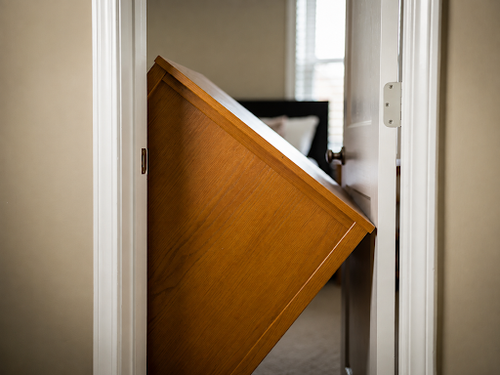
Standard interior door leaves run roughly 24 to 36 inches wide, and the 28- and 30-inch doors common on bedrooms and bathrooms are the ones most likely to be the tight fit. That number describes the door leaf, not the space your furniture actually has to travel through. Once the door stop, the hinge-side jamb, and the open door leaf are factored in, the clear opening, the usable gap between one side of the frame and the other, typically runs narrower than the nominal figure suggests. That clear opening, not the doorway's listed size, is the first measurement your furniture pickup depends on. It changes only a little from house to house, but enough to be the whole difference between a load that exits easily and one that stalls at the frame.
The Doorway Opening: Clear Width vs Nominal Size
Every doorway in your home has two numbers worth knowing, and they rarely match. The nominal size is the door's rated width, the figure used on floor plans and door schedules, referred to as "a 32-inch door" or "a 36-inch door." The clear opening is what remains once the frame, the stop molding, and the swung-open door leaf have taken up their share of the space, often an inch or two less than the nominal number would imply. On a piece with square corners and no give, that difference is what separates a pickup that goes through cleanly from one that stops the crew at your threshold. For furniture, the clear opening is the starting number, not the deciding one — the deciding number comes next.
The Diagonal a Piece Can Be Turned Through
A dresser or a sofa arm rarely travels through your doorway squared up flat with the wall. It goes through at an angle, walked and rotated until the widest point of the piece clears the narrowest point of the opening. That means the working measurement isn't the item's height or width in isolation; it's the diagonal, the corner-to-corner distance across the piece's largest face, matched against how much angled clearance the opening and the approach in front of it actually allow. That's also why a dresser measuring 34 inches across its face can sometimes pass through a 30-inch doorway when its depth is shallow enough to keep that diagonal within the arc the opening allows, and why a piece with the opposite proportions can refuse to turn even though it looks smaller on paper.
The same geometry shows up anywhere a rigid, flat object has to travel around a corner it doesn't fit through straight on. A full sheet of plywood carried around a tight hallway turn doesn't clear because of its width; it clears because there's enough swept space to walk the sheet through at an angle, tipping and rotating it until the long edge slides past the corner. A dresser, a headboard, or a table top works the same way: it isn't the flat, squared-up measurements that decide the outcome; it's whether the diagonal has room to swing through the turn.
Turning a bulky piece through a tight opening puts hands and fingers between the frame and the load at the pinch point. Crews watch that gap deliberately; it's the only spot where a rushed turn can cause an injury.
Hallway and Corner Pinch Points
A doorway can measure generously and still fail the job if the hallway leading to it doesn't give the diagonal room to develop. A 90-degree turn positioned right before your doorway shrinks the usable angle to almost nothing, since the piece has to straighten out for the doorway at nearly the same moment it's still rotating out of the turn behind it. Narrow hallways compound the same problem along their length: a piece that would pass through an open room without trouble can jam in a hallway barely wider than the piece itself, because there's no space left to angle it as it moves.
This is the pinch point crews check for before they ever measure the doorway on its own. A single tight corner close to an opening can matter more than the opening's own width, since it removes the angle the diagonal depends on, and it's the kind of constraint that a photo of your doorway alone won't reveal.
The Stair Landing and Turn
A landing that lets a piece be reoriented partway down gives more usable space than a straight run with no reset point, and a low header or sloped ceiling at that landing can crowd out the same pivot room even when your stairs look wide enough at floor level. Handrails and newel posts narrow that swept path further, which is why crews read the landing and the rail line together rather than judging stair width on its own.
Why Access Photos Matter More than Photos of the Furniture
Photos you send ahead of a pickup are useful in direct proportion to what they actually show. A picture of the sofa itself confirms what's being picked up, but it says almost nothing about whether that sofa can leave the building. A picture of your doorway, the hallway it opens onto, and the stairwell or turn beyond it tells a crew whether the route works before a truck is ever loaded or a piece is carried anywhere at all.
That's why the exit path is photographed as carefully as the item. When you send access photos ahead of time, a piece that isn't going to clear intact gets flagged in advance, and a plan gets made before anyone is standing in the doorway with the piece halfway through it and no good option left.
A photo of your doorway is more useful when you include something for scale in the frame, like a tape measure clipped open or a hand against the frame. A photo of a bare doorway alone is hard to judge for width.
When a Piece Won't Clear: Disassembly, Alternate Routes, or Cutting Down
When a piece won't pass through the measured opening intact, there are three ways forward, and each carries a different amount of labor. Disassembly breaks the piece into components small enough to clear the opening, useful for furniture built with removable legs, arms, or a detachable top. Removal through a different opening, a sliding door, a garage entry, or a window opening built for it, sometimes solves an interior access problem that the front door alone can't. As a last resort, a crew will cut the piece down on-site when it won't come out intact any other way and isn't being kept.
The interior route matters as much as the exterior one on a job like this. The crew comes inside for the piece rather than staging everything at a curb, which means your interior doorway, hallway, and stairs get the same scrutiny as the exterior route out to the truck. Once the piece is out, the pickup area gets a broom-clean before the crew leaves, closing out the job in the same space where the access assessment started.
Frequently Asked Questions
Taking the door off its hinges entirely removes both the leaf and the stop molding from the opening, which usually yields a greater clearance gain than pulling the trim alone. On a marginal opening, it's often the first thing worth checking before anything else changes.
Not always. Many double doors have one active leaf and one leaf secured by flush bolts at the top and bottom that rarely gets opened. Unless both leaves are unlatched ahead of time, the usable width is just the width of the active leaf, not the combined total, so it's worth confirming before assuming the wider number applies.
Sometimes, but it's not automatically the win it looks like. Taking off the legs shifts where the piece gets gripped during the carry, and a lower, less predictable grip point can make the piece harder to control through a turn even as it makes the opening itself easier to clear.
A storm or screen door adds a second frame in front of the main doorway, and its opening is sometimes narrower than the interior door behind it. When that's the case, the storm door, not the door you'd normally think of as "the doorway," is the true limiting width.
Winder stairs use pie-shaped treads to turn a corner without a flat landing, which leaves less usable turning space than an L-shaped or U-shaped stair with a square landing, even when both have a similar overall width. The lack of a flat pivot point is what makes winders harder to work with.
An out-swing exterior door needs open space outside the threshold for staging a piece mid-move, while an in-swing door needs that same space inside the room instead. Swing direction doesn't change the opening's width, but it changes where the piece can be set down along the way.
Not sure the piece will clear the door? — send photos of the route and find out before pickup day, not during it. Polk Services LLC serves Lakeland, Highland City, and Mulberry. Call (863) 344-5806.
