

Why Cribs and Bunk Beds Get Refused Even in Good Shape
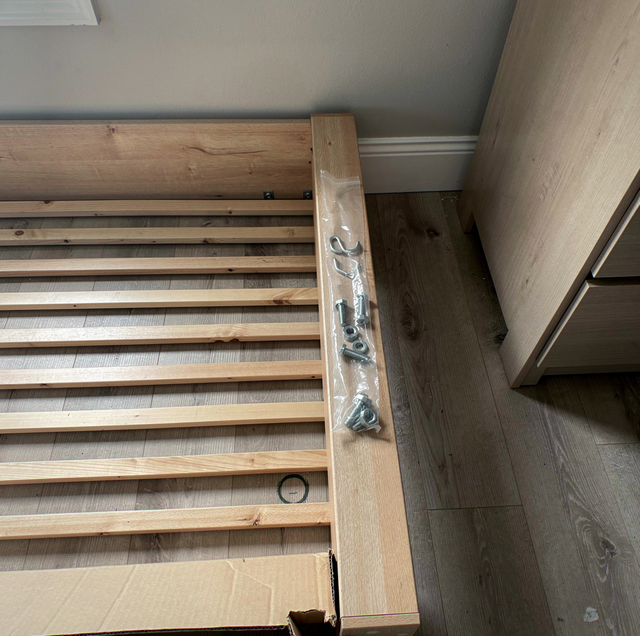
The crib comes out of the nursery in better shape than most of what you own. The finish is clean, the joints are tight, the rails do not wobble, and you kept it that way on purpose because you always meant for it to go to somebody else. Then the donation intake says no. Nothing about the piece is wrong. What it is missing is the paperwork and the parts that let a resale floor prove what it is.
Why Children's Furniture Faces a Second Bar
A resale floor runs on one test: can this piece go out on the sales floor and sell as the thing it claims to be? Most furniture answers that on sight. A dresser is a dresser, and a table is a table; once it clears the usual condition pass, it is finished being examined.
Children's furniture answers it differently. A crib, a bunk bed, a high chair, and a changing table are assemblies, not objects. They reach an intake that's knocked down or half-knocked down, and what the intake is actually being handed is a stack of parts plus a claim about which piece those parts belong to. If the claim cannot be checked, the intake has nothing it can put out. That is why a children's piece in better condition than the sofa beside it gets waved off while the sofa goes through.
A signed print with no certificate of authenticity hangs exactly like one that has its paperwork, and the paperwork is the whole of the difference the moment the two reach a buyer.
The condition never moved. What moved is everything around the piece: the label, the hardware bag, the paper sheet, the matching rails, the mattress it was sized against. The sections below take those one at a time, and they are not the whole list. Any one of them on its own is usually enough for an intake to decline.
Missing Original Hardware and Why Substitutes Fail
Crib and bunk hardware is not a bag of bolts. The fasteners are cut for that model. Barrel nuts are sized to a bore drilled crosswise through the post, and the threaded hole running through the barrel has to sit square to the path the bolt travels; a barrel a shade undersized for its bore rolls where it lies and turns those threads off that line, so the bolt binds before it is anywhere near tight. Bolts are cut to reach the nut and stop. Mattress-support hooks are bent to sit in the bracket they hang from. Put something from a household hardware drawer in their place, and the frame still goes together and still looks assembled, which is exactly the problem. An intake cannot look at a bolt in a finished joint and say it is the bolt that belongs.
So the hardware travels with the frame or the frame does not travel. A crib that turns up with its own bagged fasteners taped to a rail is a piece an intake can accept and shelve. The same crib with a coffee can of assorted screws is a frame plus a guess, and the guess is the part nobody wants to own.
The mattress-support hooks make the point most plainly. A hook is bent to one bracket geometry: the drop of the bend, the width of its throat, and the angle it hangs at are all formed for the slot it drops into. A hook off another crib can be worked into that slot and will sit there, hanging at its own angle and carrying the deck at its own height, so one corner of the support rides above the other three. No bolt anywhere fixes that, which is why a crib that turns up without its own hooks is a frame rather than a crib.
When the Model and Batch Marking Has Worn Off
Children's items are identified by a model and batch marking applied at the time of manufacture. It usually sits on a printed or foil label on an inner rail, the underside of the mattress support, or the inside face of a footboard, and it is the one thing tying the piece in front of you to the piece that left the factory.
That label lives a hard life. It sits where a mattress rubs against it night after night. It gets scrubbed off during a cleanup. It gets rolled over when the nursery gets repainted, and the crib never leaves the room. Owners peel it away because it looks ugly on an otherwise clean rail. By the time the piece is ready to be passed on, the marking is often a ghost outline, a torn corner, or nothing at all.
An intake with no marking does not have a crib. It has a crib-shaped object. An adult bookcase sells generically, because a buyer walking the floor is buying a bookcase. A children's piece is listed as a specific piece, and an intake that cannot name which one this is has nothing to write on the tag. The intakes that turn cribs away most often turn on the marking.
Assembly Instructions That No Longer Exist
A crib or bunk bed arrives in pieces and has to be reassembled by whoever takes it. The sheet that came in the carton is what makes that possible, and it is written for exactly one model: which bolt goes in which bore, which way up the mattress support hangs, which rail is the head and which is the foot, how a guardrail indexes to the top bunk.
Most of those sheets go out with the carton the same week the piece was first built. That is normal, and for a nightstand it is harmless. For a children's assembly, it is a refusal. A frame that arrives without the sheet leaves the rebuild to whoever takes it next, and in practice that is where most of these get turned down rather than tagged for the floor.
Some manufacturers print a diagram directly on an inner rail or stamp it into the mattress support, and where that survives it does part of the same work. Where it does not, the paper is the only copy, and the box it came in is long gone.
If the hardware bag, the instruction sheet, and the conversion rails are in the attic or closet, tape them to the frame before the piece leaves, so it goes to an intake complete rather than as a frame plus a promise.
Repairs and Modifications an Intake Cannot Verify
The moment a piece is altered, it ceases to be the piece the marking describes. A dowel replaced, a slat re-seated with glue, a cracked rail sistered from behind, a bracket screwed in where none was drilled, a rail cut down to fit a tight corner, even a full coat of fresh paint over the frame. The work can be excellent, and the result can look better than new. What tends to decide it at intake is whether the object still matches a known model, and an altered piece is harder to place against one.
Paint is the quiet version of this. A repainted crib usually fails twice over: the coat covers the markings that would have identified it, and the coat itself is a modification. So the piece arrives unidentifiable and altered at the same time, and there is no order of operations that gets it back.
The awkward case is a piece that was already repaired before it reached you. Secondhand cribs and bunks change hands quietly, and a joint glued by an earlier owner does not announce itself. An intake that spots it treats the piece the same way, and an intake that cannot rule it out on an unmarked frame does as well.
A Mattress or Part That No Longer Matches the Frame
A crib mattress is sized to its frame. Not to a category and not to a shelf label, to that frame. The check an intake makes is the fit between the two, whether the mattress drops into the deck and meets the rails without a gap along any side. A mattress bought later to replace the original can sit close and still leave a gap along one side, and the pair then reads at intake as a mattress and a frame rather than a matched piece.
The same matching logic runs through everything bolted to a bunk bed. Guardrails and ladders are model-specific parts, cut and drilled for one frame. A guardrail from another set can usually be bolted on, but it still is not the guardrail for that bed. An intake handed a bunk whose rail does not index to its own bolt pattern is being handed two pieces from two beds, not one bed.
Trundles, under-bed drawers, and stair units follow the frame the same way. Separated from the bed they shipped with, they become loose parts, and the bed becomes incomplete. An intake has no interest in reuniting the halves.
None of this is what a cleanout walk-through looks for. That pass flags donation-eligible pieces on the condition of the frame, staining, odor, and any sign of pest history. It runs the same on a crib as it does on a couch in the next room. The children's checks in this article sit outside it, because they turn on paperwork and parts: the marking, the bagged fasteners, the instruction sheet, the conversion rails. Those are yours to find, and the closet they went into is one only you know about, so run the checks before the truck arrives rather than after.
What you learn from running them is which way to send each piece. A crib that still has its marking, its own fasteners, and its matching parts is worth carrying to an intake yourself. One that does not, you can hold back and try anyway, or route it out with the rest of the load. Name the crib mattress separately when you book, since the sizes a dedicated mattress run covers start at twin, and a crib mattress usually leaves with the load as its own item rather than buried in a container of mixed debris.
Frequently Asked Questions
The clear plastic teething rail capping a top rail is model-specific trim, not a generic strip. Once it is gouged, cracked, or peeled away, an intake counts the crib as missing a part rather than as cosmetically worn, and a replacement pulled off another crib does not close the gap.
Only if it was built to split, and only with the parts that let each half stand alone. A convertible bunk ships with the extra legs, rails, and end panels the two frames need once they are no longer stacked, and those go missing just like a hardware bag does. An intake also reads a split bunk as one item carrying one marking, so the halves travel together or they do not travel.
It does. Convertible cribs ship with a toddler guardrail and full-size side rails as a separate kit, often boxed and stored separately from the crib itself. An intake looking at the frame alone sees a piece described as convertible that cannot convert, and it will more often turn it down than list it as something it is not.
Both get the same second look. A high chair tray latches to its own arms and will not latch to another maker's, so a chair without its tray is short a part. A changing table is checked for its pad rails and strap anchors, and a pad from a different maker sits proud of the rails, which reads as a mismatched pairing.
Usually not. A dresser, a glider, or a bookcase sold as part of a nursery set is handled as ordinary casegoods or seating, so it clears on condition alone like any other room's furniture. The pieces that draw the extra look are the sleeping and seating assemblies built specifically for a child.
A play yard is judged as one folding unit, so its mattress pad, its fabric floor, and the carry bag it stows in all count as parts of the piece. Missing any one of them, or a top rail that no longer clicks into its open position, and an intake treats the unit as incomplete rather than simply used.
If the crib is in good shape and still has nowhere to go — the crew flags what an intake might take, you decide where it goes, and everything else leaves with the load. Polk Services LLC serves Lakeland, Highland City, and Mulberry. Call (863) 344-5806.
