

Will Pool Demolition Damage the Lawn, Fence, or Planting?
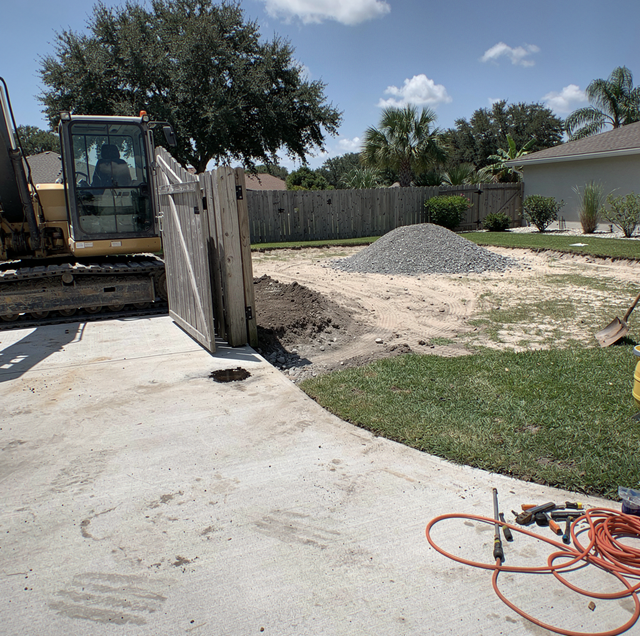
A tracked machine crossing turf leaves marks, and on soft ground those marks turn into ruts. That is the honest answer, and it is expected rather than a failure. It is the visible edge of a routing decision made before the machine ever entered the yard, and it only marks the ground the job actually needs to use. Which parts get marked and which parts should come through untouched are worth knowing before you book anything.
The Route and the Work Area Are the Whole Story
Every removal job has two zones. The work area is the pool's footprint, plus any staging space the crew needs around it. The route is the path the machine takes from the gate or driveway to that footprint and back again, load after load. Both zones are deliberately disturbed, and both come back as part of the job: graded, rake-cleaned, and left level. Everything outside those two zones: The far side of the yard, the patio that is not in the path, the beds nowhere near either, is protected ground and should come through untouched, with the two edge cases covered further down. The work itself is loud and dusty while it is running, and it stays inside the marked area.
A track mark in wet turf looks different from one in dry: a shallow, glossy furrow where the tread pressed the blades flat, instead of a light scuff across the surface, and it is the clearest sign of exactly where the route ran that day.
The Route Is a Decision You Get a Say In
Why one route covers less ground than another is covered on the crew's side in what happens during a pool demolition, step by step, and which machine can use it at all determines the size of a pool demolition job. What matters from your side is simpler: the route is a decision; it is made before the first pass, and it is the one part of this you can influence.
On most jobs it gets walked and agreed at the walk-through, and on some it gets marked out with paint or flags so nobody is guessing on the morning. If it runs somewhere you would rather it did not, that conversation is worth having while it is still grass lines. Once a machine has started using a path, moving it means marking a second strip of yard on top of the first.
Worth knowing too: the route does not stop at the pool. The machine needs somewhere to turn and somewhere to stage material, and both are part of the disturbed zone, even though neither is on the way to anything.
On a wet week, crews sometimes lay plywood or mats along the planned route to spread the machine's weight and limit rutting, though how much ground still shows track marks depends on how saturated the soil already is.
The Fence: What Comes Out, and What Goes Back
If the machine cannot clear the gate as it stands, a fence panel or a gate leaf will be removed for access. It does not stay off for the duration. The opening is closed again at the end of each working day and reopened the next morning while the machine still needs it, and the last reset puts the panel back on the posts it came off of. That is a temporary measure to address an access issue, and it says nothing about the fence itself. Fence removal is also its own service when the fence is coming out anyway, whether it is being replaced, relocated, or no longer needed once the pool is gone. In that case, taking it down alongside the pool work is one trip instead of two, but it is a separate decision from the temporary panel-pull that access sometimes requires.
Planting Inside the Line, and What Stays Untouched
A machine cannot thread a flower bed the way a person with a shovel can. Anything within the work area or along the route is removed rather than worked around, because steering a tracked machine between a shrub and a retaining wall risks tearing out more than just the plant. That includes turf, mulch beds, small ornamentals, and any hardscape sitting directly in the path. Anything outside the line- the tree that is not near the route, the bed on the far side of the house- is left alone. Irrigation heads and shallow lines inside the work area do not survive the pass. That is a known outcome of clearing the footprint, and it is priced into the scope as one.
A tracked machine crossing a yard is quiet at idle and has poor sight lines behind it. Keep children and pets indoors while it is moving between the gate and the pool, not only while it is breaking concrete.
What Gets Marked, What's Restored, and What You Decide
The short version, laid out plainly:
| What's in the Path | Restored as Part of the Job | What You Decide |
|---|---|---|
| Grass along the machine route | Yes, graded and rake-cleaned | New sod, if you want it |
| The pool footprint itself | Yes, graded once cavity fill and compaction wrap up | Sod over the footprint |
| Plant beds inside the work area | Removed, not worked around | Replanting, and where |
| A fence panel or gate leaf blocking the route | Reset once equipment is clear | Full fence removal, if it is coming out anyway |
| Hardscape sitting directly in the path | Cleared if it is in the way | New hardscape, if any |
| Irrigation heads or lines inside the work area | No, not expected to survive | What replaces them, and when |
The pattern holds across every row: the crew restores the ground itself, the grading and cleanup that make the yard walkable and level again. What grows back or gets rebuilt on top of that ground- new sod, new beds, a new gate- is yours to plan on your own timeline.
The Edges, and What Protected Actually Means
Protected does not mean fenced off. It means the route was drawn to avoid it and the crew works to that line, so on a narrow lot the protected zone can be a strip only a few feet wide. That is worth knowing before you assume a bed along the property line is safely out of the way.
Two edges deserve a specific look. The property line is one: a machine working close to it swings over ground that is not yours, so the swing stays inside the line, and a bed sitting right at that boundary is working with less margin than a bed in the middle of the yard. The other is any planting at the edge of the route itself, which can be damaged by an overhang or a wide turn, even though it was never inside the marked line. Give both some room when the route is agreed.
Ground moisture does the rest. Dry, established turf compacts under a machine without much visible change, and the same yard after a wet stretch marks easily, which is weather and soil rather than a choice anyone makes about how carefully to drive. It is also why what to move before a pool demolition crew arrives asks you to leave the irrigation off beforehand, and why how heavy equipment ruts are repaired exists as its own subject.
Frequently Asked Questions
Not necessarily. A route that runs across an existing hard surface, a driveway, a parking pad, or a concrete side yard can carry the machine with little or no mark at all, since there is no turf to compress in the first place. The amount of marking scales with the amount of open ground the route has to cross.
It depends entirely on what is underneath. Pavers set in mortar over a concrete slab come out with the slab because the bond does not withstand lifting, and the slab is what the machine is actually removing. A sand-set walkway is the salvageable case, and what happens to sand-set pavers is covered in the step-by-step process of a pool demolition.
A gate on pin hinges lifts straight off and goes back on the same pins, which is the quickest case. A leaf on bolted-strap hinges is unbolted from the frame, and the hardware is bagged with it. A panel is different again: a wood panel is unscrewed at the rails, while an aluminum or vinyl one slides back out of the routed post it was fitted into, which is why neither needs new fixings to go back.
The zone that lost a head or a lateral will not hold pressure, so running the system afterward pushes water out at the break rather than through the remaining heads in that zone. Shutting that one zone off at the controller until it is repaired keeps the rest of the yard watering normally.
That changes the machine, not the route, because there is no second path to move to. Ground over a tank or a field carries weight differently from ordinary yard, so the crossing is either matted to spread the load or made with the smallest machine that can still do the work. It is one of the few site facts worth raising unprompted, since a tank lid is rarely visible from the surface.
It changes the odds considerably. Two approaches mean the crew picks the one with the widest swing and the firmest ground rather than taking the only one available, and the disturbed strip ends up wherever the yard can best afford it.
Some weeks after the crew leaves, the yard reads as what the route decided it would be. Level, rake-cleaned bare soil across the footprint and along the strip the machine drove, waiting on whatever you decide to put over it. A gate back on its own posts. The beds set well back from the route exactly as they were, and the one at the turn showing where the boom swung over it.
Schedule your pool demolition — talk through the route and what it means for your yard before the crew arrives. Polk Services LLC serves Lakeland, Highland City, and Mulberry. Call (863) 344-5806.
