

Aging Lakefront Dock Removal: What the Access Decides
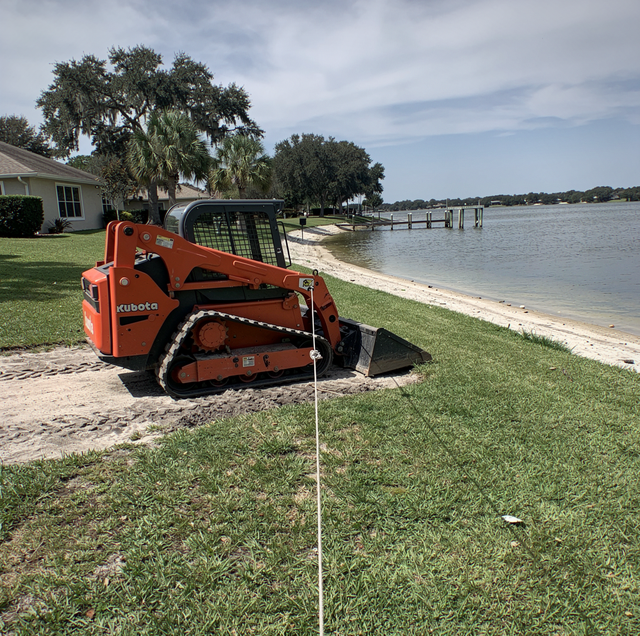
A demolition truck can only get so close to a lake. It stops at the driveway, the gate, or the edge of the lawn, and everything past that point- the grass, the slope, the last stretch of your yard down to the water- has to be crossed by the equipment itself before a single piling comes out. That gap between where the truck parks and where the dock sits is the first thing worth sizing up on any waterfront removal: it decides more about the job than the dock's age or its size ever will.
Many aging lakefront docks were built decades ago, in the 1970s and 80s, and many of them are now past the point where their original materials will carry. Others come down after a storm tears them loose, rather than wearing out on a normal schedule. Either way, once a structure over open water is failing, it is a fall and entrapment hazard, not a repair project, and the question that drives the removal is not how old the dock is but how the crew and the machine get to it.
A dock at the end of its life is a fall and entrapment hazard, especially where boards have softened or pilings have shifted. Treat it as off-limits until a crew has assessed and secured the structure.
How Far the Equipment Has to Travel
On some lots, the water sits right off the back patio, a flat run of thirty or forty feet with nothing in the way. On others, the dock sits at the bottom of a slope that drops away from the house, or behind a stretch of lawn that has to be crossed around a pool cage, a shed, or a stand of oak trees.
Distance alone does not determine difficulty; it sets the baseline for how much of the job is spent traveling instead of working, and how much of that travel occurs on ground that was never built to carry heavy equipment.
The staging area matters as much as the distance itself. Eventually, pilings, decking, and hardware pulled from your dock move back toward the road, onto a truck parked in the driveway or on the street. A short, direct route between the water and that staging point keeps a job on schedule. A route that has to double back, cross a fence line twice, or squeeze between a pool enclosure and a property line adds hours that have nothing to do with the dock itself. On a narrow lot, that staging point sometimes has to shift partway through the job as debris piles up, which is one more reason the initial walk of the property matters before equipment ever arrives.
Photos or a short video of the path from the road to the water, taken before the site visit, let a crew plan equipment and staging faster and can shorten the estimate itself.
What the Ground Between Them Has to Carry
Lakefront lawns rarely have the load-bearing strength of an ordinary yard. Sandy soil and a high water table, common near open water, keep the ground softer and wetter than it looks from the porch, and equipment that would leave no mark on a dry, compacted yard can rut a saturated one badly enough to require its own repair. Ground pressure: that is the number that predicts this, not the machine's overall weight.
The Kubota SCL1000 is used on these jobs specifically because it exerts about 4 psi of ground pressure and fits through gates and side-yard gaps as narrow as 36 inches. That combination lets it reach a soft, fenced-in shoreline that a wheeled machine or a full-size one would either sink into or simply not fit through. Where your ground is firmer, and the approach is wide enough, a larger machine can take over and move faster, but the decision starts with what the lawn between the road and the water will hold, not with which machine happens to be on the trailer that day.
The Shoreline Itself: Bank, Wall, or Drop
Not every shoreline lets equipment get close to the water the same way. A walkable bank, grass that slopes gradually into the lake with no retaining structure, is the easiest case: the mini skid steer or a full-size machine can work from solid ground within a few feet of the shoreline.
A retaining wall changes that. The wall is holding back soil, and running heavy equipment right at its edge risks undermining the wallis work, so the crew works from farther back and reaches over or around it instead of crawling up to the top.
A steep drop, the kind cut by years of wave action or a bank that has eroded past what the original landscaping intended, is largely a footing question. Loose, undercut soil at the top of a drop will not reliably hold a machine's tracks any better than it holds a person's weight, so the approach has to account for where solid ground ends before the drop starts.
A seawall, a vertical concrete or rock edge built to hold the shoreline in place, provides the most stable footing of the four, but its height and thickness determine how a structure is lifted clear of it, not whether the ground will carry the machine. Most lakefront lots land somewhere between these four categories rather than matching one exactly, and sorting that out is part of the same site visit that sizes up distance and ground.
Where the Machine's Reach Ends
Even with the right machine on solid ground, a few conditions sit outside what land-based equipment can do. Fences and tree trunks close to the shoreline can block the straight approach a machine needs, forcing a wider swing or a different point of entry than the shortest path would suggest.
For the dock itself, once the machine can reach the water's edge, a full-size machine with a lifting attachment can pull pilings straight out of the lake bottom from the shoreline rather than cutting them off at the waterline. Pilings generally come out as part of the same job as the dock above them.
Boat-assisted hauling: This is the middle ground, cases where a machine can reach the shoreline but not safely cross open water to a section of dock built further out. Decking, framing, and smaller debris are floated or ferried back to a point the equipment can reach, rather than being carried across water that does not support foot traffic.
The Compliance Check Before a Quote Goes Out
Compliance status gets confirmed before a quote goes out, and it is stated on the written quote. That check happens on every job with a structure over or touching the water, whether the dock is being removed as part of routine maintenance or storm damage that needs to come out quickly.
Putting it in writing, in plain terms, before anything gets scheduled is what keeps it from becoming a surprise later. The estimate you receive already accounts for your property's status rather than assuming every lake, or every lot on the same lake, works the same way.
This step is separate from the demolition plan itself. Where the equipment can travel, what the ground will carry, and how the shoreline is shaped are all worked out during the same site visit, but the compliance check is confirmed on its own, not folded into the estimate as an assumption.
When a Marine Specialist Is the Right Call
Some shorelines will not take a land approach at all, and saying so plainly is more useful than stretching one to fit. The condition never changes: land-based equipment needs a solid surface to stand on within working reach of the structure. Where that ground does not exist, no amount of machine selection creates it.
Four shapes account for most of those sites. A frontage with no walkable bank, where the lawn stops at a drop into the water instead of sloping into it. A seawall or retaining wall running the whole width with no gap to work through or around. A bank steep enough, or soft enough, that it will not carry a machine whatever its ground pressure. And a dock reachable only by water, either because the structure sits well off a frontage nothing can approach or because the only land route crosses ground that is not the owner's to cross.
In any of those cases, the right answer is a marine contractor working from a barge, with the equipment set up on the water rather than on the bank. That is a different trade and a different quote, and it is worth hearing at the site visit rather than after a land crew has already tried and lost a day to it.
The site visit is where a waterfront removal gets settled: the ground a machine has to cross, the shape of the shoreline it stops at, and whatever stands in the path between the two. Working all of that out before anything goes on a trailer is what keeps the job from turning into guesswork with the equipment already unloaded.
Frequently Asked Questions
Yes. The same access variables apply to fixed piling-supported docks, boat ramps, boat-lift structures, older wooden boat houses and covered docks, and damaged or storm-torn sections of an otherwise active dock. Anything built over or into the water gets evaluated the same way, starting with how equipment reaches it.
Yes, and it gets overlooked because access is often pictured at ground level. Mature tree limbs, a pergola or arbor over a walkway, a low utility drop crossing the side yard, and the headroom under a gate arch all put a ceiling on the route. A path that measures wide enough at the ground can still be closed by what hangs over it, so the overhead gets walked at the same time as the width.
A floating dock is not set into the lake bottom at all. It is held in place by cables or chains anchored to the shore or the bottom, so removal starts by freeing the anchor hardware rather than pulling or cutting the pilings, and the dock itself is floated to a point where equipment can reach it before it comes apart. Without a lifting-from-the-bottom step involved, a floating dock removal often moves faster than a piling-supported one of a similar size.
Most waterfront jobs run one to two workdays, with the exact time driven by how many pilings have to come out and how much the shoreline and ground conditions slowed getting equipment in. A short, walkable bank job with a handful of pilings sits at the low end; a longer dock with a difficult approach runs closer to two full days.
Storm-damaged docks come with their own wrinkle: the structure may already be partly separated from its pilings, or, on a floating dock, shifted off its anchor entirely. Hurricane Milton in 2024 did exactly that to many docks, tearing some loose from their pilings and moving floating docks away from where they were anchored. That is why storm-damaged structures are assessed on how they are sitting now, not how they were originally built.
Then it becomes a conversation the owner needs to have with the neighbor before a date goes on the calendar, not something a crew can settle on the morning of the job. The answer also changes the plan rather than only the schedule: with that route open, a machine may be able to reach solid ground close to the shoreline; without it, the job falls back on a longer approach from your own side, a boat-assisted section, or a barge-based contractor. Raising it at the site visit leaves time for the conversation to happen.
Waterfront removals start at the shoreline — book a site visit before anything else, whether that is deck and dock removal in Winter Haven or anywhere else on the chain. Polk Services LLC serves Lakeland, Highland City, and Mulberry. Call (863) 344-5806.
