

Dock Piling Removal: Pulled, Cut, or Left in the Lake
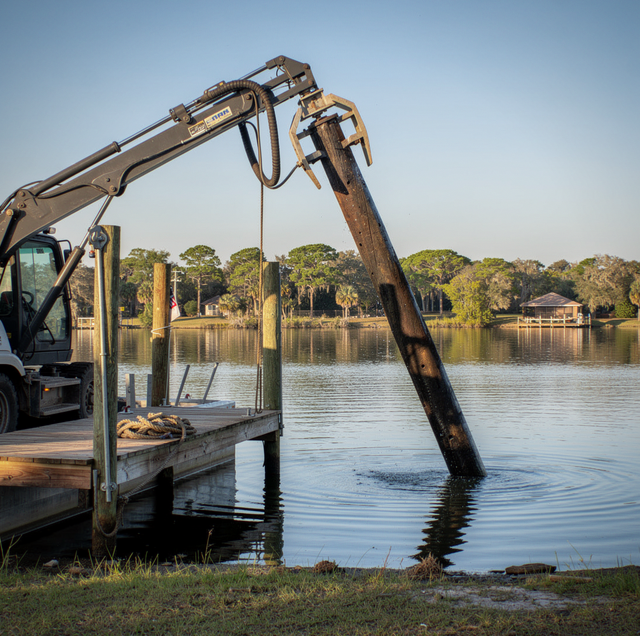
Quick Answer: Old dock pilings end one of three ways: pulled whole out of the bottom, cut off down at the bottom with the buried length left there, or left standing after the dock above them comes off.
Three things can happen to the pilings under an old dock, and each one leaves the water looking different afterward.
Pulled whole means the piling comes up out of the bottom in one piece, buried end and all, and the water closes over the spot where it stood. Cut at the bottom means the piling is severed down at the bottom and the driven length stays where it is, out of sight. Left in place means the dock structure comes off and the pilings stay standing, a row of bare posts in the water with nothing on top of them.
Those are three different jobs, with three different machines behind them and three different things the next owner of that shoreline inherits. The real question is not which one sounds cleanest from the yard. It is which one the shoreline, the pilings themselves, and the confirmed scope of the work will support.
Pulled Whole: Nothing Left in the Bottom
Pulling a piling whole is the outcome most people picture when they say they want the dock gone. The piling is gripped and drawn straight up until the driven length clears the bottom, and what is left behind is water and bottom, with no post, no stub, and nothing under the surface for a future dock builder to work around.
In the marine trade, that job normally runs from the water: a barge sets up alongside the dock, and a barge-mounted piling puller does the lifting, which is one reason full extraction reads as a specialty proposition. It does not have to be. Where shore access lets a machine get close enough, a full-size Cat with a lifting attachment can pull the pilings from the shoreline instead, which takes the barge, the launch, and the water-based staging out of the job.
The condition on that is shore access. From land, the limit is reach. Lifting capacity only comes into it once a machine is close enough to use it, and where the reach is there, pulling whole leaves nothing to explain later.
Cut Off at the Bottom: What Stays Down
Cutting is the middle outcome. The piling is severed, the top length is hauled away, and the portion driven into the bottom stays down there.
Where the cut is made is most of the story. A cut taken at the waterline leaves a stub standing in the water column, under the surface at higher water and sometimes showing at lower water, which is the worst possible outcome for anyone who swims or runs a boat off that shoreline. A cut taken down at the bottom leaves nothing standing above it. That is a better result and a harder one to achieve, because the cut has to be made at the bottom rather than up where the piling is easy to reach.
A piling cut off underwater is invisible from the surface and stays a strike risk for boats and swimmers for as long as it is down there. That consequence belongs in the decision before the cut, not after.
Even a cut taken flush at the bottom leaves the driven length in place, and that length still occupies the footprint. Anything a later contractor wants to put in the same spots has to work around it, which is why cut-versus-pull belongs to the owner and the site rather than to whatever is quicker on removal day.
Left in Place: Pilings That Stay Standing
The third outcome changes the least. The dock structure comes off, and the pilings stay exactly where they are, standing out of the water in the pattern the dock used to follow.
What that hand forwards is a set of standing posts, still doing what they were doing before: marking the footprint, aging where they stand, and standing in the way of anything a future dock would want to put in the same water. Bare pilings also read as an unfinished job from the water in a way a cleared backyard never does.
Whether pilings stay standing at a given lakefront address is a compliance question, and it is not one a contractor or a homeowner settles by preference. The process is the same on every waterfront job: compliance status is confirmed before a quote goes out, and what it means for the pilings is stated on the written quote, so the outcome for each piling is settled in writing before a machine comes to the shoreline. What is possible on a specific lake gets answered at that stage, not argued about on removal day.
When One Dock Ends with Mixed Outcomes
The three outcomes are not picked once and applied across a whole dock. They get settled piling by piling. What a machine can reach from shore is worked out separately, before any of this begins; once the reach is there, the pilings themselves decide the rest, and they rarely all say the same thing.
A pull is where that shows up most plainly. A piling that has lost enough section can part partway up instead of coming free whole, and the crew then has a decision on that one piling and no other: re-grip lower and try again, or convert it to a cut and take the cut down at the bottom. Nothing about the plan changed. That piling did.
Seating varies along a single dock line as well, and so does condition, with some structures finished, some pilings pulled, some cut, and some left standing. It is also why the outcome written against each piling on a quote is confirmed at the shoreline rather than assumed from the plan. The plan says what is intended. The dock says what it will give.
What the Pilings Themselves Decide
Shore access sets the ceiling. The pilings set everything under it.
Size: Waterfront pilings come in 4x4, 6x6, and larger. A 6x6 is not simply a bigger version of the same pull; it holds more of the bottom around it and asks more of the machine on the way up, and larger sections ask more again.
Depth: Dock pilings sit 4 to 8 feet into the lake bottom. That is the part nobody sees and the part that decides the pull. Two docks with identical posts showing above the water can be seated at opposite ends of that range, and the shallower one is not the same job as the deeper one.
Condition: A piling that has lost section somewhere along its length may not survive being gripped and drawn upward. The length that settles that question is the driven part, and it sits below anything a person can look at from the dock, so a piling's appearance above the water is a poor guide to whether it will come up whole.
What a piling is not: Under a land deck, the equivalent parts are footings, concrete piers, or sonotubes set into a hole. Pilings are the waterfront version of that idea and a different job entirely, driven rather than poured, seated in a saturated bottom rather than in soil, and reached across water rather than across a lawn.
Handling Pilings After They Leave the Bottom
A pulled piling comes out longer than it looked, because the driven length was never part of what anyone was looking at. Extraction is sequenced deliberately. The pilings are sectioned for hauling once they are on shore, loaded out with the rest of the dock material, and gone on the truck when the crew leaves.
Pilings are also the part most likely to be left out of a scope written from a photograph, and the part a homeowner notices was skipped, since unlike the deck above them they are still there to look at.
Frequently Asked Questions
The three outcomes stay the same, but the assessment in front of them changes. A piling that is not timber gives none of the condition signals a wood piling gives, so it cannot be judged the same way, and identifying what each piling is becomes its own confirmation step before removal day.
Often, yes. Re-decking a dock or replacing its framing is a much smaller undertaking than replacing what is driven into the bottom, so a walking surface that looks nearly new can be sitting on the pilings it started with. The age of the part you walk on says nothing about the age of the part in the bottom, so the pilings get assessed on their own rather than by the dock's apparent age.
They get looked at individually. Lift pilings carry a concentrated, moving load rather than foot traffic, and the lift's brackets, cradle arms, and cable hardware are bolted through them, so all of that has to come off before the piling underneath can be gripped at all. On a dock with a lift, the walkway piling outcome does not carry over automatically, and the two can end up settled differently on the same structure.
It happens on older lakefront lots. A dock that was replaced rather than removed can leave its pilings behind, with the newer dock built beside or around them. Anyone counting the posts under the dock there now is counting one dock's pilings and may be looking at two docks' worth of timber on the bottom.
It changes how much of each piling is out of the water and available for work. Higher water leaves less exposed length above the surface and more of the piling's weight shedding water as it comes free; lower water exposes more length, including more of the band that sits at the surface. Water levels move both directions through the year, so the level on the day is part of what the crew reads before starting.
After. The framing ties the pilings together, so the structure has to come off before any single piling can be gripped and worked on its own, which puts the pilings at the end of the sequence rather than the start. One useful consequence: each piling stands fully exposed by the time its turn arrives, so a call made in general terms at the quoting stage can be confirmed piling by piling once they are standing alone.
Pilings are the part most crews leave behind — ask what yours will take. Polk Services LLC serves Lakeland, Highland City, and Mulberry. Call (863) 344-5806.
