

How Long a Wooden Dock Lasts on a Freshwater Lake Before It Fails
A wooden dock does not fail as one piece of wood aging together. The few inches of decking at the waterline can already be through several cycles of decay by the time the railing overhead has lost nothing worse than its color, and the length of piling that stays fully submerged may be sounder than either one. Wood above the water ages on a sun-and-air clock. Wood in the water ages on a wet-and-dry clock, or in some spots barely ages at all. A dock's real condition is several different clocks running side by side, not one number.
That distinction matters because wooden waterfront structures come in several forms that all follow this same pattern: fixed piling-supported docks, floating docks anchored with cables or chains, boat ramps, boat-lift structures, and wooden boathouses or covered docks. Each one puts different amounts of wood into each zone, which is why two docks built in the same year can be in very different condition when you look closely at the connections and the surface wood.
Why the Splash Zone Fails Before the Rest of the Dock
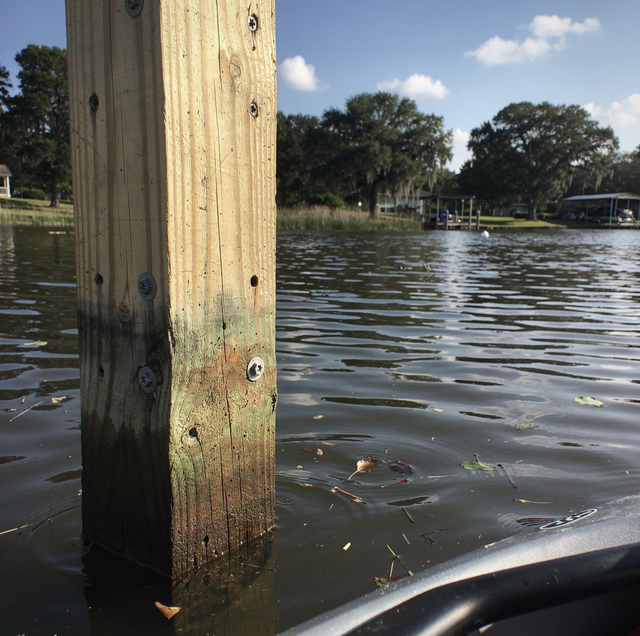
The band of wood at the waterline gets wet with every wake and every shift in lake level, then dries out in the air between soakings. That cycle never lets the fibers settle into either a fully saturated or fully dry state, and wet-dry cycling combined with steady oxygen exposure is exactly what wood-decay fungi need to establish and spread. Fully dry wood does not rot. Fully saturated wood, cut off from oxygen, resists rot far longer. The splash zone gets both ingredients on a loop, which is why visible decay so often starts there first: on pilings, on the underside of a fixed dock's frame, on any horizontal member that sits close to normal water level.
Pilings are one of the structures most exposed to this pattern. It is the wood right at the waterline, not the wood at the top of the piling or the wood driven deep into the lake bottom, that decays first.
The Submerged Section Ages on a Slower Clock
Below the waterline band, wood that stays continuously underwater is starved of the oxygen decay fungi need, so it can outlast the splash zone just above it even though it has been wet far longer by any simple measure. It is common for the buried, fully submerged length of a piling to be in better structural condition than the band right where it crosses the surface.
The part of a dock a person can see and walk on has the least to tell you. Sun and air let that wood dry between wettings, while the band where the piling meets the surface never gets the same relief.
That is counterintuitive to most people, since the part of a dock that never sees sun or air looks like it should be the most vulnerable. The opposite is closer to the truth: oxygen starvation protects submerged wood, and the real weak point lies at the boundary where water meets air, not below it.
Deck Boards and Railings Age in the Open Sun
The decking and railing sit entirely above the splash zone, and they respond to a different set of stressors: direct sun, heat, and open wind rather than repeated soaking. Ultraviolet light breaks down the surface fibers of exposed wood over time, graying it and roughening its texture even where moisture was never the main driver. Pressure-treated decking is usually credited with somewhere between 15 and 25 years of service in areas where heat and humidity are high, and it is surface breakdown and ordinary wear that close that window. Cedar and redwood have nothing pressed into them and depend on the wood's own resistance, so in full sun they tend to give out sooner.
On a dock specifically, that sun exposure comes from two directions instead of one: straight down from overhead and back up off the water's surface as reflected glare. A railing face or a joist that would stay shaded on a covered porch or a land deck often takes UV exposure from below as well as above out over open water, which is a stressor most decking never has to answer to at all.
Fasteners and Hardware Corrode Faster than the Wood Around Them
Metal fails on its own schedule, and that schedule often runs ahead of the wood it holds together. Bolts, joist hangers, and deck screws sitting in or near the splash zone go through the same wet-dry cycling as the wood there, and that cycling accelerates corrosion the same way it accelerates decay. Galvanized coatings wear thin faster in that band than anywhere fully dry or fully submerged, and wherever two dissimilar metals touch, aluminum boat-lift hardware bolted into steel brackets, for instance, galvanic corrosion adds a second failure path on top of ordinary rust. Freshwater corrodes metal more slowly than saltwater, but the wet-dry cycle at the surface still outpaces fasteners that stay consistently dry or consistently underwater.
The 1970s and 80s Generation of Docks Is Reaching the End
A large share of today's lakefront docks were built on treated-wood pilings during the 1970s and 80s, when lakefront development in many areas was at its heaviest. That generation is reaching the end of its useful life now, and because so many of those docks went in during the same narrow stretch of decades, a large share of them are approaching the natural limit of their original piling material at close to the same time rather than trickling in one at a time. The markers described in this article- waterline decay, failing connections, decking loss- are showing up on more of these older structures at once for that reason: the calendar caught up with an entire generation together, not because anything unusual happened to any one dock in particular.
Signs a Dock Is at the End, Not the Middle, of Its Life
Every dock moves through the zones above at its own pace, but three markers tend to show up together once a structure has crossed from ordinary aging into genuine end-of-life territory: pilings visibly rotted at the waterline rather than just discolored, decking that has failed outright in sections rather than simply showing surface wear, and a ramp that has gone unsafe rather than merely worn. Any one of these alone can sometimes be a localized repair. All three together, or a piling failure paired with widespread decking loss, usually means the structure as a whole has reached the end of what its original materials can support.
A dock, ramp, or boathouse floor showing visible rot, sagging, or failed sections is a fall and entrapment hazard. Do not walk out onto it, test how solid it feels, or enter the water to inspect a piling.
A dock built decades ago on the materials that were standard then arrives, zone by zone, at the point every wooden structure standing in water eventually reaches. Reading which zone shows trouble first is what separates a structure aging on its normal schedule from one that has quietly crossed into a safety problem.
Frequently Asked Questions
Freshwater lacks the marine borers, mainly shipworms and gribbles, that tunnel through submerged timber in saltwater environments and can hollow a piling from the inside while the outer wood still looks sound. A freshwater dock's submerged wood faces essentially no threat from these organisms, so decay in freshwater is driven almost entirely by fungal rot at the wet-dry boundary rather than anything eating through the wood below the surface.
Yes. A dock with open, unobstructed exposure to the west or south takes far more direct UV across its full length each day than one shaded by trees along the bank or shielded by a neighboring structure. Two docks built the same year on the same lake can show noticeably different surface wear on their decking for no reason other than which direction the open water sits relative to the sun.
A horizontal timber called a cap, or wale, bolts across the tops of a run of pilings, and the deck framing sits on top of that member rather than directly on the pilings themselves. Because the cap sits low, close to normal water level and to spray, its bolted connections are usually among the first hardware on the whole structure to show corrosion, ahead of fasteners higher up in the railing or decking.
Yes. Algae and slime that coat a piling at and just above the waterline can mask surface discoloration for a long time, so a piling can be losing wood fiber underneath that greenish coating well before anyone standing on the dock sees bare, obviously decayed wood. The coating itself is not the problem; it is simply what grows on wood that stays wet long enough to be at risk.
No. A floating dock adds flotation billets, sealed foam, or air-filled drums under the deck that run on their own separate clock: over years, those billets can absorb water or lose buoyancy even while the decking on top of them still looks fine, and the cable or chain anchors holding the dock in place wear at their own connection points independent of anything happening to the wood.
Yes. Repeated wake action and the impact of docking loosen bolted connections faster than static water exposure alone would, and a boat lift bolted into pilings adds a load path and a stress point that a dock built without one never carries. Two otherwise identical docks age differently once only one of them handles regular boat traffic.
An aging dock doesn't get any safer with another season on the water — let's talk about the takedown. Polk Services LLC serves Lakeland, Highland City, and Mulberry. Call (863) 344-5806.
