

Basketball Court Removal: What Comes Out With the Slab
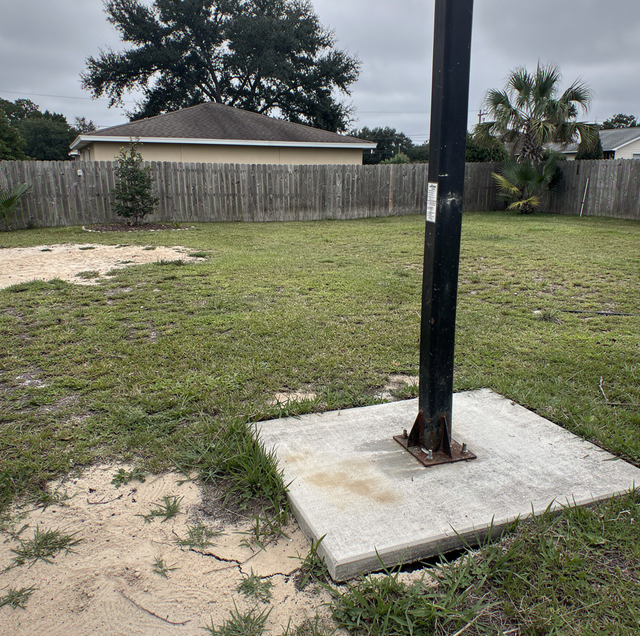
A backyard court consists of several installations that arrived on different days: a pad, a goal and the footing beneath it, a fence line, sometimes a light pole, and a coating laid over it all. Removing one means dealing with every one of those parts. Each piece puts something into the ground and leaves something behind when it goes.
The gap between what an owner pictures coming out and what is actually attached to it is what surprises people who call about basketball court removal. The slab is the biggest piece and the easiest to picture, so it is the piece the whole job gets sized against in someone's head. The parts that shape the real work are set into the dirt beside and under the slab, because they determine the amount of digging and how the yard reads once the machines pull out.
Here is what is out there, in the order it comes off.
The Surface Layer on Top of the Concrete
Many courts have something laid over the concrete rather than poured as part of it.
Coated surfaces: Home courts often have an acrylic or rubberized coating rolled over cured concrete, then striped. It is bonded, so it leaves with the concrete rather than ahead of it. What matters is knowing it is there before the break starts, because it shows up in the debris.
Interlocking sport tiles: Modular plastic tiles clip together and float on the slab rather than stick to it. These come up by hand before anything mechanical starts, and pulling them first shows whether the pad is one clean pour or a patched surface.
Then the vertical parts come down.
Goal Posts, Standards and the Concrete under Them
This is the piece that decides how big the job gets. A basketball goal is held up in one of two ways, and the difference is entirely below your feet.
Direct-set posts: A direct-set standard was set in a hole and had concrete poured around it, usually before the court slab went in and often deeper than the slab is thick. That footing is a separate mass of concrete with the steel buried inside. Taking the goal out means taking the footing out, which means digging beside or under the slab edge to free it. The void left behind runs deeper than the rest of the pad and gets backfilled before anything grows there.
Sleeve-set posts: A sleeve-set standard drops into a steel or plastic ground sleeve cast into its own footing. The post pulls straight up and the sleeve stays put. That gives you a choice: pull the sleeve and its footing with everything else, or cap it and leave it. Leaving it means a piece of pipe sits below your finished grade permanently, which is fine under gravel and a nuisance under sod when someone puts a shovel in later.
Portable and weighted bases: A rolling base filled with sand or water is anchored to nothing. Drain it, tip it, load it. All it leaves is a rectangle of dead grass or a stained patch of slab.
A goal standard becomes top-heavy and unstable the moment its footing is broken loose. The post is secured or laid down before the footing is worked, and it is never left standing on a cracked base while a crew moves around it.
Shuffleboard courts skip this section entirely. They carry no vertical hardware, which is why their surprises are hidden elsewhere.
Fencing, Netting and the Footings They Leave
Courts collect fence. Chain link across the ends to stop balls, a run of ball netting on poles, a windscreen panel, sometimes a full enclosure. Every post in that line went into the ground the way a fence post does, and comes out the same way.
Some posts are set in dirt and pulled with a machine. Some sit in a concrete plug, and the plug comes up with the post or gets dug out separately. Either way, the count matters: a court enclosure can carry more posts than the fence along your whole property line, and each one is a hole to fill.
Netting poles are the ones people forget. They stand tall, often set deeper because of the pull a loaded net puts on them, and they frequently sit outside the slab in open lawn. Walk the perimeter and count everything upright before work starts. Fabric, rails, and posts all leave as scrap metal.
Light Poles and the Conduit That Feeds Them
If the court was lit, there would be a pole with a fixture on top, a base holding the pole down, and a conduit running to it from somewhere. The pole and the base are removal work. The wiring is electrician or utility work.
Power gets disconnected and confirmed dead first. After that, the fixture and pole come down, and the base gets pulled the same way a goal footing does. The buried conduit between the panel and the pole is the piece that needs attention because it runs wherever the installer decided, and that route is rarely obvious on the surface. It has to be found before a bucket is placed in that ground.
Find out where the light circuit starts and ends before the first dig. A private conduit run out to a court pole can take an odd path across a yard, and it needs to be traced rather than guessed at.
Shuffleboard Edging, Inlays and Scoring Triangles
A shuffleboard court is a long narrow slab, and the length catches people out. It reads as a walkway until you hold it up against the yard you are trying to get back.
The details sit in the concrete itself. Many courts carry metal edging set flush along both long sides, either as trim or as a channel for the return gutters. That steel is embedded, so it leaves with the concrete it was cast into rather than being stripped off first. At each end, you often find a scoring triangle inlaid into the surface, made of a different material from the surrounding slab. Both features change what the debris load holds, and both are worth pointing out early so nobody is surprised by steel in the middle of a break.
Breaking the Slab Apart
Now the concrete. A sport court pad is usually a heavier pour than a patio, and it often has steel mesh or bar embedded, which is why it holds together in large sheets rather than crumbling.
The slab comes apart into pieces sized for what the machine can lift and what the truck can carry, and the steel is separated as the load comes out. A full-size skid steer with a hydraulic breaker does the breaking, and a compact mini skid steer carries the material out where the route into the backyard is tight.
Under the pad there is usually a base of rock or sand. Whether it stays or goes depends on what you want the space to become.
The Ground under a Court and What the Space Becomes
A court was graded to shed water off the playing surface rather than to match the lawn around it, and that shaping is set into the ground under the pad. Pull the concrete off, and it is still sitting there, pitched in a direction that made sense for a court and makes none for a yard.
The footprint is also the one rectangle on the lot with nothing living under it, because the topsoil came off before the pad went in and never came back. A sport pad is usually given a deeper base course than a patio, so the rock under the concrete is a larger part of the hole than owners expect, and what has to go back into that footprint once the concrete and the rock leave is more than the slab itself would suggest.
From there, the space becomes what the property needs. Sod gives you lawn that meets the existing turf at the same level. Gravel gives you parking, a work area, or somewhere to put a trailer. Bare dirt is fine if there are plans for planting beds later. All three start from a footprint that reads as part of the yard instead of ground that still remembers a court.
Frequently Asked Questions
Interlocking sport tiles are the best candidate. If they unclip intact rather than cracking, they can be stacked, cleaned, and passed to someone building a court or a garage floor. Backboards and rims in good shape find takers too. Say so before a debris pile gets built.
A permit applies to some removals but not others, depending on the location and what is being removed. We help coordinate that step, and we never pull or issue a permit ourselves. If your property sits in a neighborhood with its own review process, that is worth checking before a date is set, since it can sit in front of the schedule.
This one catches people. When the court went in, irrigation was often rerouted around the slab, capped off, or run underneath it, so the zone on that side of the yard may already be dead or looping through ground you are about to open. Run each zone beforehand and watch the heads.
A dry stretch helps more than the calendar month does. Equipment travels from the street or driveway to the backyard, and saturated ground ruts under that traffic, leaving you to repair the path as well as the court footprint. Mats or plywood over the route protect the lawn you are keeping.
Often yes, but the court decides where. Court slabs are usually jointed on a grid tied to the playing lines rather than to anything about your yard, so the boundary gets chosen from the joints that exist rather than from the shape you drew. Where the nearest joint sits well inside or outside the line you wanted, the difference is made up in what goes back on the ground beside it.
Half courts poured against a driveway are common, and the two slabs are rarely the same age. The courtside usually goes in later and thinner than the driveway it abuts, so the two sides break at different rates. The seam between them behaves as a cold joint rather than a control joint, which is why that line gets treated as the edge of two separate pours rather than as a joint running through one.
Walk the court with us before a date goes on the schedule — you get a scope covering every piece attached to it, surface, posts, footings, slab, and the ground left behind. Polk Services LLC serves Lakeland, Highland City, and Mulberry. Call (863) 344-5806.
