

Can You Break Up Concrete Yourself? Four Things Stop People
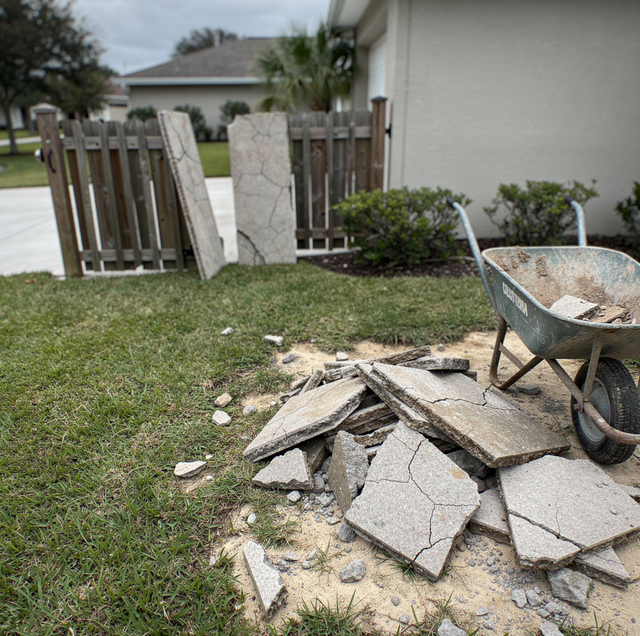
The plan is usually finished before anyone asks a question about it. Saturday is blocked off. The breaker is reserved at the rental counter, picked up Friday, back Sunday morning. A friend has agreed to come by. The old patio slab, the pad the shed used to sit on, the cracked square of walk by the side gate: it comes out this weekend, and by Sunday evening the yard looks different.
It is a reasonable plan. It is also built on five assumptions, and only one of them reliably holds.
The one that holds is the breaking itself. Given a rented breaker, a decent back, and a stubborn streak, a person really can break concrete. Nobody should pretend otherwise. What ends these weekends is everything the plan treats as trivial: what the pieces weigh, what holds them together, what runs underneath them, and where all of it goes on Monday.
The Tool Is the Whole Job
Every version of this plan starts in the same place: deciding what to rent. That decision is easy, the counter is helpful, and the tool goes in the truck. It feels like the project has been solved, because the only obstacle anybody pictured has just been handled.
The tool solves the problem that was never really the problem. It addresses one stretch of a job with several parts, but it does nothing about the four obstacles waiting in the yard. Renting is the part people can complete in advance, which is why it gets the attention and why everything after it arrives as a surprise.
The tool also brings a hazard the rental counter has no reason to walk you through. Breaking concrete releases fine crystalline silica dust into the air you are standing in and breathing, and that dust is a real respiratory hazard, taken seriously on work sites for good reason. It is one more reason the job asks more of a Saturday than it looks from the driveway.
Once It's Broken, It Is Easy to Move
Once the slab is in pieces, the thinking goes, the hard part is behind you. Pieces get moved. Pieces are just cleanup. That belief undoes more weekends than any other.
Concrete is heavier than any of us expect, every single time. A chunk small enough for one person to lift with both hands is a smaller chunk than you are imagining right now, and a slab produces a great many pieces that are bigger than that. A wheelbarrow stops steering long before it looks full, and once it tips on soft grass it has to be reloaded by hand. Every piece gets handled more than once: lifted off the ground, carried, lifted again into whatever is taking it, and shifted around in there so the next piece fits.
Then there is the route. The pieces have to travel from the slab to whatever will haul them away, and that vehicle sits wherever it can sit: past a gate narrower than the load, down a step off the patio, across lawn that softens with every trip. The break is the easy part of the day. The load-out is where the weekend quietly dies.
Before you commit a Saturday, walk the route the pieces have to travel: from the slab, across the yard, to whatever will carry them away. That walk answers the question faster than the slab itself does.
Concrete Comes Apart in Pieces
Sometimes it does. Plenty of old walkways and thin utility pads are unreinforced, and those break into pieces that separate cleanly.
Plenty of others are reinforced, and reinforcement changes the character of the whole job. A reinforced slab does not produce loose pieces, so there is nothing for two people to carry away, and that is discovered after the tool is already in the yard.
What matters for the decision in front of you is simpler: you often cannot tell from standing on it which kind of slab you have, and that difference decides the whole day.
There Is Nothing under a Patio Slab
Nobody actively believes this. It is simply assumed, because a slab looks solid and final and the yard has looked that way for years.
A slab is a convenient thing to run a line beneath. Whatever a previous owner ran under it, and there is usually something, they knew where it was, and that person may be several owners gone. The tool has no idea any of it exists, and neither does the person swinging it until something gives way. A utility locate must be requested before anyone breaks ground, and it takes time to get a response, which means this is not a decision you can make on Friday for a job on Saturday.
Live lines can run beneath a slab, and nothing on the surface shows where they are. That is not something a weekend plan can work around, and it is the hazard least likely to be considered before the first swing.
The Broken Concrete Can Go out with the Trash
It cannot, and this is the obstacle that turns a finished demolition into an unfinished project.
Household waste collection is not set up to accept broken concrete, and the pile will still be sitting there after the next several collection days. Broken concrete needs a facility that accepts it, and it needs a vehicle rated to carry that weight to get there, which is a second problem stacked on the first. A rented breaker does not come with a way to move the material.
Meanwhile, the pile lives in the yard. It does not settle, shrink, or get lighter. It kills the grass under it, becomes the thing you mow around, and turns into the reason the backyard is off-limits. A slab in the ground is at least tidy. A slab in a heap by the fence is a job that has been converted into a chore, and the chore is now yours indefinitely.
Some Slabs Really Are a Weekend Job
They are, and it would be dishonest to pretend otherwise. The conditions are specific, but they are real.
A small pad, poured thin, with no reinforcement in it. Sitting out in an open yard with nothing running underneath it that anyone can find. A short, flat, direct carry to a vehicle or container already parked close by, with no steps and no gate to thread. Somewhere arranged in advance that will take the material. A second person who is definitely coming.
If that describes your slab, take the Saturday. You will be sore, and you will finish.
If a couple of those are missing, the picture changes. The day runs long, the pile outgrows the plan, and the project that was supposed to be finished by Sunday is still visible from the kitchen window in October. At that point it stops being a question about your ability to break concrete, which was never in doubt.
Done as a service, the day looks different because the equipment carries the load rather than a person. The machine that breaks the slab is the same machine that loads it, and the material is loaded into a dump trailer on the same visit. The yard is walkable that evening. If a permit is part of the picture, it gets coordinated with the issuing office before anything starts.
Frequently Asked Questions
Less than it looks. A visible crack is often just the top face separating, while below it the concrete remains locked together by aggregate interlock, with the stone on each side keyed into the stone opposite. A slab that reads as broken from above can behave as one solid piece the moment you test it.
It matters a great deal. A patio poured tight against the foundation, or a pad carrying a post, a step, or a wall above it, means something is bearing on the concrete you are planning to remove. That turns a removal into a different kind of work, and it is a call to make before anything gets swung.
No. A breaker fractures concrete, and it does not cut steel. Rental counters do not rent a way to. Once the concrete is off the steel, the steel is still holding the pieces together, and that is the point where a rented tool stops being useful to you.
More power than the outside of a house usually offers. An electric breaker draws heavily enough that an ordinary household outdoor outlet may not carry it, and the tool needs rest intervals rather than continuous running, so the working day is shorter than the rental day.
Only the breaking. Two people can trade off the tool, but concrete does not get lighter with a second person on site. The pieces that need two sets of hands still need both of them at once, so a two-person carry moves one piece where a one-person carry moves one piece. What a second person buys you is the ability to lift what a single person would have had to break down further.
A stall leaves a hazard sitting in the yard, and the tool is due back on the rental's calendar rather than on your progress. A partly broken slab has lifted edges and unstable footing across the whole area; the yard cannot be used or mowed while it is like that, and it stays that way until somebody finishes it.
Skip the rental counter — the pieces leave with the crew rather than remain in your yard, whether that is concrete demolition in Lithia or Plant City. Polk Services LLC serves Lakeland, Highland City, and Mulberry. Call (863) 344-5806.
