

Concrete Resurfacing vs Replacement: Three Fixes Compared
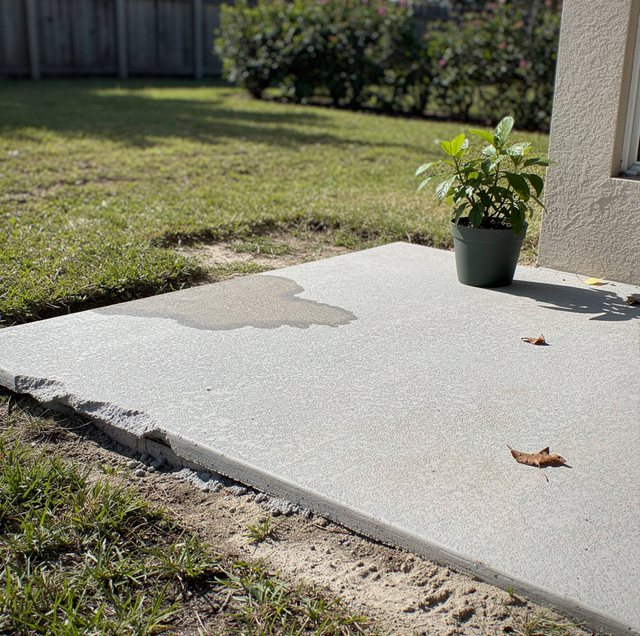
You showed the same patio to three contractors and got three different answers. The first said the top can be coated and it will look new again. The second said the sunken corner can be raised back up to meet the rest. The third said the whole thing should come out.
All three can be honest answers. Each contractor was answering a different question about the same piece of concrete, and each sells the fix that answers their own question. Resurfacing answers a question about the surface. Slab lifting addresses questions about the ground beneath. Removal answers a question about the concrete itself. Once you work out which of those three your slab is asking, the disagreement mostly settles on its own.
We perform one of the three: removal. We do not resurface, lift, or mudjack slabs, and nothing on this site offers any of those services. That is worth saying up front: the sections below have nothing to gain from talking you into a breakout you do not need.
Resurfacing: What a New Wearing Surface Fixes
An overlay is a fresh layer of cementitious material bonded over the concrete you already have. The old slab stays put and keeps carrying the load. The new layer becomes the part you walk on, and it can carry a texture or color the original never had.
What that fixes is real: a slab gone dull and tired underfoot comes back with a surface you are happy to look at. Whether the old top is sound enough to hold a bonded layer is the resurfacing contractor's call to make on-site, not something to settle based on a photo.
What an overlay leaves alone: everything structural. It takes on the shape and the behavior of whatever sits under it. A slab that moves under load keeps moving with a new coat on top. A section sitting lower than its neighbors is still lower, only freshly finished. Nothing about the ground underneath changes.
The height question: an overlay adds thickness, and that thickness has to go somewhere. Where concrete meets a door threshold, a garage opening, a step or a pool coping, the new surface arrives higher than it was. Sometimes there is room. Sometimes the door stops swinging clear, and the top step ends up shorter than the ones below.
Slab Lifting: What Raising a Settled Section Corrects
Slab lifting gets sold under several names, mudjacking, slabjacking, and foam lifting among them, depending on what gets pumped underneath. The method has the same shape either way: material is injected beneath the concrete, fills the space down there, and the pressure pushes the section back up toward its starting height.
What that addresses is settlement and space under a slab that is otherwise in one piece. The part that matters here is narrow: lifting fixes what is under the concrete, and it hands the concrete back to you in exactly the condition it found it.
What lifting cannot reach: the slab. It does not knit a crack, restore a worn surface, or make failing material sound again. Concrete already broken into independently moving pieces cannot be raised as a single unit, because each piece responds to pressure differently and goes its own way. You end up with the same broken slab at new and less predictable heights.
Removal and Replacement: When the Concrete Itself Has Failed
Removal is the answer when the material has reached the end of its service life, when the ground beneath it needs to be corrected, or when the slab is at the wrong height or in the wrong place.
The signals are usually underfoot before they are visible. A section that rocks or shifts when you step on it has separated from its support. A slab you can see daylight through at a separation is no longer behaving as a single slab, and no fix that treats it as such will hold. Edges that crumble when you press them say the material near the surface has given up.
A second family of reasons has nothing to do with failure. A pad left by a shed, a hot tub, or an old carport is sound concrete serving no purpose. A slab that sends water toward the house holds the grade in a direction you need changed. A patio that has to grow, shrink, or move is in the way, whatever its condition.
Removal is also the only one of the three that opens the ground. In sandy subgrade under heavy seasonal rain, the ground is often the thing that needs attention, and it stays out of reach until the concrete above it is gone.
Concrete, Ground or Surface: Which Problem Do You Have
Each fix solves exactly one of those three problems. Line them up and the overlaps disappear.
| Fix | The problem it addresses | What it does not touch | Right call when |
|---|---|---|---|
| Resurfacing / overlay | The wearing surface | Structure, position, and the ground under it | Concrete is sound, and at the right height, and appearance or wear is the complaint |
| Slab lifting (mudjacking, slabjacking, foam) | Settlement and empty space beneath an intact slab | The concrete itself and its surface condition | One whole section has dropped, and the height it left was the right one |
| Removal and replacement | The concrete itself, plus the ground once it is exposed | Nothing stays fixed; height, footprint and base are all open again | The slab moves in pieces, the base needs correcting, or the height or footprint has to change |
Three checks sort most slabs. Walk it, feeling for any section that rocks or drops under your weight. Then crouch and look across the surface with your eye low, watching for a section that has sunk while staying whole. Then press a thumb along an exposed edge, checking whether the material crumbles rather than holding. If nothing moves and nothing has sunk, and your complaint is how the surface looks and feels, you are in overlay country.
Ask each contractor which of the three questions their fix answers: the surface, the ground, or the concrete. A contractor who can name the question and what their fix leaves untouched is worth listening to.
Where Each Fix Tends to Fail Early
The failures are predictable, and they all trace back to pointing a fix at a problem it was never built for.
An overlay over a slab that is still moving inherits the movement, and the new surface starts reporting the old problem sooner than anyone expected. Laid where the height had nowhere to go, it leaves you a threshold or a step you fight with for as long as you own the place.
A lift on concrete already in pieces buys a short window of better alignment and then gives it back, because nothing was done about the pieces. A lift on a slab that has failed at the surface leaves the same failed surface, only level.
Replacement has its own classic failure: new concrete poured over ground nobody corrected while it was open. That is the one moment the base is reachable, and skipping it puts the new slab on the footing that ended the old one.
What Removal Involves on Site
The slab is reduced at the machine to sizes that can be handled and loaded as the work goes. Reinforcing steel bound through the slab comes up with it and gets separated as the material loads out. What leaves the property is the concrete, the steel, and the broken base that came up with them.
What remains is bare ground at roughly the depth the slab occupied, open to whoever works there next.
Permits are required for some removals and not others, depending on the location and the structure involved. We help you coordinate that step while the work is being planned, and we never pull or issue a permit ourselves.
An overlay buries the slab edge under a new layer, so the perimeter no longer reads true. Nobody looking at it later can judge how thick the original concrete is, which matters on the day it has to come out.
Frequently Asked Questions
Not cleanly. A bonded overlay has to be ground off or broken off, and the slab underneath usually takes damage while that happens, because the bond holds right up until the layer lets go. A failed overlay turns a one-layer removal into a two-layer one.
Yes. The material has to get underneath, so injection ports are drilled through the slab across the settled section and patched once the lift is finished. Those patches stay visible as small plugs of a slightly different color. On plain gray concrete they fade in. On a stained, stamped, or decorative finish, they stay noticeable.
It is one of the things that set the three fixes apart. An overlay never opens the ground, so nothing under there is disturbed. A lift works down through the slab and reaches only the space immediately beneath it. Removal opens the entire footprint, and it is the only option of the three in which what is buried under the concrete must be settled before a date is set.
Raw. The broken face on the concrete that stays never had a finished edge, so it reads differently from the troweled surface next to it, rougher and duller across that band. It is usually left as the boundary of whatever goes in beside it rather than dressed to match.
An overlay never touches the ground at all, and a lift only fills the space it can reach through a port. Removal is the one that exposes the whole footprint, which is why a base that has been washing out for years is correctable on that day and on no other.
No. We break out the concrete and haul it off; the pour belongs to a concrete contractor. Line that trade up before removal day, so the open ground isn't sitting exposed during a stretch of heavy rain while waiting on a schedule.
Bring us the third opinion — we tell you plainly whether the concrete has to come out, and we break out only what does. Polk Services LLC serves Lakeland, Highland City, and Mulberry. Call (863) 344-5806.
