

Deck Out, Patio In: Why a Hard Surface Outlasts Wood
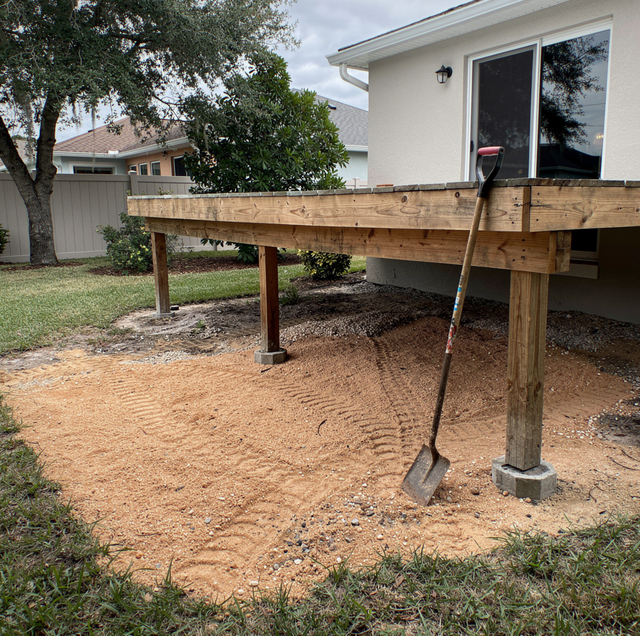
Quick Answer: A deck and a hard surface reach the end by different routes and ask different things of the ground below. Getting from one to the other starts with the wood and its footings coming out. The replacement is another trade's work.
Wood and hard surfaces reach the end of their service lives by two different routes, and the routes have almost nothing in common. Wood starts losing an argument with moisture the day it is exposed to weather: water gets into the fibers, fungi work on anything that stays damp, and insects find whatever softens. A hard surface, poured or set, has no fiber to lose, so what catches up to it is the ground underneath rather than the material itself. The two failure paths look nothing alike from the day either one is finished.
That difference is the reason so many owners eventually swap one for the other. What almost nobody explains is what has to happen in between: what comes out, what stays in the ground, and where the work of getting from one surface to the next changes hands. That gap is what this covers, not which surface wins in the abstract.
Two Ways an Outdoor Surface Reaches the End
Wood gives out from inside the material. Moisture cycling in and out of the boards, fungal growth in anything that stays damp, and insects working the softened wood all progress faster in a hot, humid climate than they would in a drier one. That is a property of the material rather than a season, so it continues in every month of the year, quicker through wet, humid stretches and slower through dry ones. A wood deck eventually reaches the point where enough of it has gone soft, spongy, or structurally unreliable that patching individual boards no longer makes sense and the whole structure needs to come out.
A hard surface ends a completely different way. Concrete, stone, and pavers have no organic fiber for moisture or insects to work on, so there is nothing in them to rot in the first place. What eventually catches up to a hard surface, instead, is movement in whatever lies beneath it: settling, shifting, or ground conditions changing gradually over years rather than in a single storm. Neither surface is exempt from time passing. They give out from opposite directions, one from the material itself breaking down, the other from what is beneath it moving. Which of those two an owner is watching is part of what determines when maintaining a deck ends and looking at a replacement begins.
The Upkeep Each One Asks of an Owner
While a wood deck is standing, it asks for ongoing attention to slow the breakdown. That means refinishing, resealing, and watching for the first soft boards before soft spots spread into the framing underneath them. Skip that upkeep and the process does not pause. It keeps going with nobody watching it.
A hard surface requires comparatively little while in service. There is no finish to renew regularly, and no exposed fiber that needs protection from moisture, so ongoing upkeep of the surface itself is mostly occasional cleaning rather than a standing maintenance routine. That gap in effort is a real part of why owners make the swap. A hard surface still needs attention once it is down, and what it asks for is smaller and less urgent than the standing commitment a wood deck carries year after year. Owners weighing the change are usually weighing years of that recurring attention against a surface that mostly sits there.
Why the Ground Underneath Carries the Load Differently
A wood deck rests on a handful of concentrated points: footings and posts spaced across the yard, each carrying its own share of the structure's weight straight down into the soil below. Everywhere between those points, the ground underneath the deck is doing nothing structural at all. It's simply there, unloaded and mostly untouched by the deck sitting above it.
A hard surface asks something completely different of that same ground. Instead of a few loaded points doing all the work, the entire footprint has to support the surface evenly and continuously across its whole area, not just at a handful of posts. That's a real shift in what the site is being asked to do, and it's a large part of why removal has to leave the ground in a different condition than a deck simply lifting off would. What that next surface specifically needs from the ground below it, in terms of depth, base material, or grade, is the next trade's call to make, not something this covers.
Point loads versus continuous support: That single distinction decides more about the transition between the two surfaces than almost anything else about the site.
That's also why removing a deck is a different scope of ground work than most people expect. Taking the structure away is the visible part. Leaving the footprint in a condition that can support a continuous surface, rather than just a few loaded points, is the factor that determines what happens next.
What a Deck Leaves Behind in the Footprint
Pulling the boards and the frame off a deck doesn't empty the footprint underneath it. There are footings holding the posts down in the ground, and sometimes what sits directly below the old decking isn't bare dirt at all; it's already a hard surface that the deck was simply built over at some point. Either way, something remains once the deck's visible structure is gone.
What goes on top decides whether those footings come out. That answer belongs to the replacement plan rather than to the demolition.
Settle the footing question with whoever is building the replacement before the removal is scheduled. A footing is simple to pull while the crew and equipment are already on the footprint, and much harder to reach afterward.
The ground between those points is the other half of what gets handed over. It carried nothing while the deck stood, so it has never been loaded, worked, or graded for anything at all, and it reaches the next trade in whatever condition years spent under a structure left it in.
Where This Job Ends, and the Next One Begins
The boundary sits in one place. This company removes the wood, removes what needs to be removed below ground, and grades and clears the site until it's ready to build on. What goes into that cleared footprint next, whether that's a hard surface or something else entirely, is a different trade's scope from start to finish. This company does not lay pavers, pour concrete, or build a patio, and nothing here should be read as guidance on how to build any of those.
That boundary exists because the two halves of this project require different skills and equipment entirely. Removal and site prep involve taking a structure apart safely, dealing with whatever's buried beneath it, and leaving the ground in a known, workable condition. What happens after that, shaping and finishing a new hard surface on top of that graded ground, belongs entirely to whoever handles that part of the work. Handing over a clean, graded footprint is this company's stopping point, not a step past it. An owner who has a hard surface planned still benefits from a clean handoff between the two crews, even though the two scopes of work never overlap.
Frequently Asked Questions
No. The board material determines what comes off the top, not what the change below it involves, because the part that meets the ground is concrete either way. The real variation sits lower down: a low platform set on precast pier blocks leaves almost nothing below grade to deal with, while a raised deck on poured footings leaves a set of buried items at fixed positions across the footprint.
That is the one version of this where the change is already half done. The hard surface the next trade needs is often sitting under the boards, put down before anyone framed a deck over it. What determines whether it stays is its condition, not its presence, and that call belongs to whoever is building the replacement rather than to the removal.
Often not, and it can move in either direction. A deck can cantilever past its posts and carry a walking surface out over a grade change, while a surface set on the ground has to sit on ground that carries it the whole way across. Usable area can shrink where the ground falls away past the old outline, or grow where the deck was kept narrow to limit framing.
Yes. Separate from deck removal, concrete demolition, ground grading and leveling, and fill dirt delivery are all services this company offers, and that groundwork is often useful regardless of what a property owner eventually puts into the cleared footprint.
That's fine. Footing removal doesn't have to happen the same day as the rest of the demolition work. An owner can choose to leave footings in place and make that call later, once the next step for the property is settled.
The design of whatever is going on top does. With nothing planned but open ground, a buried footing is a matter of preference and can be left where it is. Once a hard surface is going into the same rectangle, that answer moves out of preference and into the next trade's design, which is why the question is worth putting to whoever is laying out the replacement rather than settling it during the teardown.
Clear the wood and prep the ground — we hand the site over ready for what comes next. Polk Services LLC serves Lakeland, Highland City, and Mulberry. Call (863) 344-5806.
