

Does Your Flat Florida Lot Need a Gravel Driveway Crown?
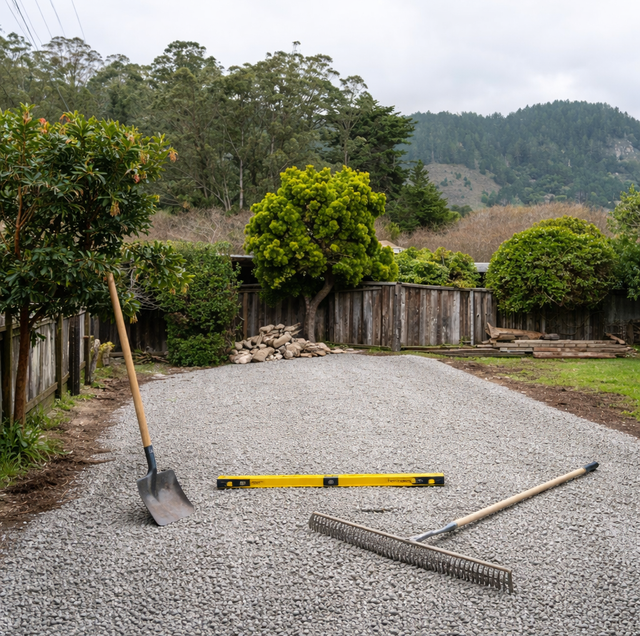
A gravel driveway sheds water one of two ways: it runs off to the sides, or it sits on the surface until it soaks in or evaporates. Which one happens on your driveway comes down almost entirely to grading, and grading is where flat Central Florida lots run into a problem that a lot with natural fall never has to deal with.
What a Crown Does for a Gravel Driveway
A crown is a slight ridge built along the centerline of a driveway, higher in the middle than at either edge. Water that lands on the surface rolls down and off to both sides instead of pooling where tires travel. Most crowned driveways are built with a grade of roughly 2 to 4 percent from the centerline to each edge, which works out to between a quarter-inch and a half-inch of fall for every foot of width. It's a small enough grade that you'd never notice it by eye, but it's enough to keep water moving instead of sitting still.
The crown does one job: it gives water somewhere to go. On a lot with even a modest natural slope, that "somewhere to go" is whatever lower ground already exists nearby, and the crown is really just steering water toward a drainage path that's already there. The trouble starts when there isn't one.
Why a Flat Lot Can't Lean on a Standard Crown
Central Florida is flat in a lot of neighborhoods around us, and the soil underneath is often deep sand with almost no natural grade change from one side of the property to the other. A traditional centerline crown assumes the water rolling off each shoulder has a low point to reach, a ditch, a swale, a slope toward the back of the lot, something. On a truly flat parcel, water rolls off the crown and just meets more flat ground on both sides. It doesn't drain; it relocates, and often it relocates right back toward the driveway edges or the yard next to it.
This is the part that trips people up: building a crown on a lot with nowhere for the water to go doesn't fix the puddling problem; it just moves the puddle from the middle of the driveway to the shoulders. The fix isn't a bigger crown. It's a different grading approach built around where the water can actually end up.
A Shallow Cross-Slope Instead of a Full Crown
On truly flat ground, we typically don't build a full centerline crown at all. Instead, the whole driveway is graded as a single continuous cross-slope, gently tilted from one side to the other rather than peaked in the middle. The advantage is that all the water moves in a single direction toward one collection point, instead of splitting toward two shoulders that both dead-end into a flat yard.
A cross-slope can be built shallower than a full crown and still do the job, often close to the widely cited minimum of around 1 percent, or an eighth of an inch per foot, since the goal here isn't steep drainage, it's just enough consistent fall to keep water from standing. Getting that consistent grade right matters more on flat ground than it does anywhere else, because there's no natural fall to compensate for a low spot or a soft dip in the base. A mini skid steer with a box blade or grading attachment is the right tool for cutting and holding that kind of even, shallow grade across the full width and length of a driveway, since hand tools tend to leave small high and low spots that a flat lot can't absorb the way a sloped one can.
Tying the Low End Into a Swale or Drainage Path
A cross-slope only works if the low side actually leads somewhere. On a flat lot, that usually means grading the low edge into a shallow swale, a broad, gently dished channel that carries water along the property line or out toward the street rather than letting it collect against the driveway edge. Where a swale already exists on the property, or where there's an established drainage path from a neighboring lot or roadside ditch, tying the driveway's low edge into that existing route is usually the simplest fix. Where nothing like that exists yet, one has to be built as part of the regrading, even if it's shallow. On the rare lot where there's truly no direction left for a swale to run and no outlet to tie into, subsurface drainage becomes the more realistic option rather than surface grading alone.
This is really the core difference between grading a flat lot and grading one with natural fall: on a sloped lot, gravity does most of the work once the crown points water in the right direction. On a flat lot, the swale or drainage path has to be built with intention, because there's no existing grade doing that work for free.
Sandy Soil Helps, But It Doesn't Solve Everything
Central Florida's sandy soil percolates faster than clay-heavy soil, and that's a real advantage. A lot of the water that lands on a flat lot soaks straight down before it ever becomes a surface problem. That's part of why some flat driveways get away without much grading at all for years.
But percolation has a ceiling. During a heavy rain event, when water is falling faster than sandy soil can absorb it, the surface still needs somewhere for the excess to go, and this isn't a rainy-season-only concern. Central Florida gets heavy downpours scattered through the year, not confined to one stretch of months, so a driveway that only gets tested once or twice a year during a predictable wet spell is still getting tested. Fast-draining soil buys time during a storm; it doesn't eliminate the need for surface shedding once the ground beneath is saturated and rain is still falling. That's the situation cross-slope grading and a swale tie-in are built to handle.
Getting the Grade Right the First Time
A driveway base matters here too. Crushed asphalt millings, crushed concrete, and angular crushed stone, like limerock or limestone screenings, compact and lock together far better than loose, rounded material, and a well-compacted base holds a grade longer under vehicle weight, rather than rutting back to flat within a season. But base material only holds the grade that was cut into it. On flat ground, that grade has to be planned first, cut evenly across the whole surface, and tied into a real low point before any stone goes down, or the driveway ends up back where it started the first time it rains hard.
Frequently Asked Questions
Fresh stone won't fix a grading problem. If water is still standing 24 to 48 hours after a storm, or you're seeing ruts deeper than about an inch forming in the wheel paths, the base underneath has lost its shape and needs to be recut before any new material goes on top of it.
Yes, in most cases the existing stone can be pulled back, the base regraded to the new slope with a box blade or grading attachment, and the same material redistributed on top, topped off with additional limerock or crushed stone only where the base has thinned out over time.
A swale is an open, shallow, usually grass-lined channel that moves surface water by gravity alone, and it's generally enough for sheet flow coming off a driveway. A buried perforated drain line under gravel backfill is a step up used mainly where space is too tight for an open channel or where water needs to move underground rather than across the yard.
Eyeballing it isn't reliable at that shallow a slope, so we check it with a line level stretched between stakes or a laser level on a longer run, confirming the fall holds steady from one end of the driveway to the other rather than trusting a single spot check. A 10-foot straightedge laid across the surface is a quick way to catch a low dip or high spot that a level line alone might not reveal between stakes.
Yes. Angular material like crushed concrete, milled asphalt, or crushed limerock interlocks and stays put under tire weight, while rounded, smooth material like river or pea gravel tends to shift and roll, and on flat ground those shifted spots become the low points where water collects since there's no natural grade to carry it off before it pools.
Plan a visual check after any unusually heavy rain event in the first year, since a newly cut base is still settling under traffic and weather conditions. After the first year, twice-a-year spot checks for new low spots or edge rutting are usually enough to catch a grading problem before it turns into standing water.
Get your driveway graded right — schedule a flat-lot drainage assessment. Polk Services LLC serves Lakeland, Highland City, and Mulberry. Call (863) 344-5806.
