

Does Your Gravel Driveway Need a French Drain? Probably Not
Somewhere in your research about the puddle at the end of your driveway, someone mentioned a French drain, and now that phrase is stuck in your head as the fix. Before you start pricing trenches and pipe, it helps to ask a more basic question first: is the water sitting on top of your gravel because it has nowhere to run, or because the ground underneath is actually saturated? Only one of those calls for a French drain.
What a French Drain Actually Fixes
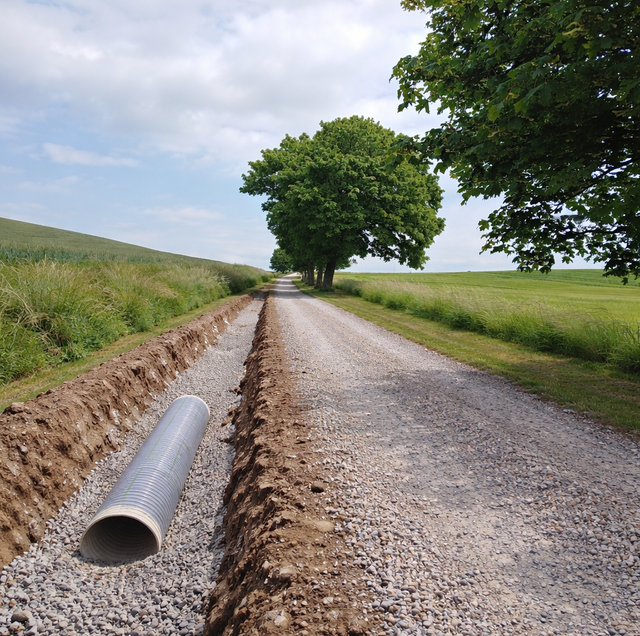
A French drain is a trench dug below the surface, backfilled with gravel, around a perforated pipe, and usually wrapped in filter fabric to prevent soil from clogging the pipe over time. Water sitting in the surrounding soil seeps through the gravel, enters the pipe, and travels to a lower discharge point: daylighting at a slope, entering a dry well, or tying into a storm system. It's built for water that's already in the ground, a high water table, a pocket of soil that stays perpetually saturated, or a seep that keeps feeding moisture into one spot no matter how dry the surface looks.
That's a narrow job, and it's not the same as the job most driveways actually need done. A French drain does nothing for water that's simply running across the top of your gravel because the surface has no slope to send it anywhere — confusing that with a groundwater problem is the single most common reason people spend money on a drain that doesn't fix the puddle.
Most Gravel Driveway Drainage Problems Are Surface Problems
A gravel driveway sheds water by shape, not by magic. Underneath the surface stone, there should be a compacted base of larger crushed rock, and the finished grade should carry a slight crown down the center or a consistent cross-slope to one side, so that rain runs off before it has time to soak in and soften the base. When that shape is missing, wrong, or has worn away, water does exactly what flat or dished ground always does: it sits.
Ruts from tires, a low spot where fill settled, a driveway that was never crowned to begin with, or a crown that's flattened out after a few years of traffic all create the same result: rain with no path off the surface, not water rising from below. That's why most driveways that "need drainage help" actually just need reshaping.
Signs Grading Alone Will Likely Fix It
Water sits only in ruts or one low stretch, not the whole driveway: A localized dip usually means a settled or worn section that lost its shape, not a saturated water table under the entire lot.
The middle of the driveway is flat or dips Rather than maintaining a slight crown; without that shape, water has no reason to move toward the edges, so it just collects wherever the surface is lowest.
Puddles clear within a few hours after the rain stops: Water that drains off fairly quickly once the rain ends is behaving like surface runoff, which is exactly what a proper grade is built to handle.
There's somewhere for the water to go once it leaves the gravel: A ditch, a swale, or lower ground nearby means regrading has a destination to shed toward; the water just isn't reaching it yet because the current slope isn't directing it there.
A shallow test hole stays dry between storms: On a dry day, dig down about a foot in the wet spot. If it's dry down there, the ground itself isn't holding water; the surface just isn't shedding it.
Signs You May Actually Need a French Drain
A test hole fills with water on its own, even without recent rain: That points to a water table sitting close to the surface rather than runoff, since nothing above ground is putting water into that hole.
A spot stays soft or muddy for days after a correct regrade with a real crown and a working outlet: If the shape and the destination are both right and the ground still won't clear, something below is feeding it.
The lot is essentially flat, with nowhere downhill for shed water to go. Grading moves water somewhere; if there's no lower point nearby to send it to, cross-slope and crowning run out of options, and subsurface drainage becomes the more realistic route.
Water appears to rise from the ground rather than run across it: A bubbling or seeping patch, especially one that stays wet in dry weather, behaves differently from rainfall runoff and points to a spring-fed or high-water-table condition.
An uphill slope or a neighboring lot feeds water into the soil year-round, not just during storms: If the moisture shows up even between rain events, it's likely traveling underground into your soil, not just running across your surface after a downpour.
Why Grading Comes First
Reshaping the surface is almost always the more limited, less invasive step, and it's the step that fixes most gravel driveway drainage complaints on its own. It also isn't wasted work in the cases that turn out to need more: a French drain still needs the ground around it to shed surface water correctly, or runoff keeps saturating the topsoil and overworking the drain from above. Correct the crown and cross-slope first, then reassess, rather than guessing and paying for a trench that might not have been the issue.
Check your downspouts before you touch a shovel. Downspouts discharging directly onto or near the driveway are a common cause of what appears to be a drainage failure but is actually just concentrated roof runoff hitting one spot. Extending a downspout a few feet toward a swale or lower ground can clear the problem before any grading is needed.
What Proper Grading and Crowning Involve
A correctly built gravel driveway starts with a compacted sub-base of larger crushed stone, not surface gravel dumped straight onto bare soil. On top of that, the finished grade should carry a defined crown, a slight rise down the center that falls off gently to both sides, or a consistent cross-slope where a crown doesn't make sense for the layout, so water sheds instead of pooling in the middle. Low spots get filled and compacted rather than just topped with loose stone, and where runoff needs a clear path off the property, a shallow, shaped swale carries it to a ditch or a lower point in the yard instead of letting it wander. Angular crushed stone on the surface locks together and holds its shape under tires far better than smooth, rounded gravel, which tends to roll and scatter. Done together, those elements are what let a driveway shed a heavy rain instead of storing it.
When Grading Isn't Enough
Some driveways do have a real problem underneath a perfectly good grade that no amount of reshaping fixes: a naturally high water table, a low point with no downhill outlet anywhere nearby, or a persistent seep feeding moisture into the base from below. In those cases, subsurface drainage work, the trench-and-pipe kind, is legitimate and often the only lasting answer. That work is its own trade with its own design considerations: pipe depth, outlet location, and how the drain interacts with nearby foundations or septic systems all need to be evaluated by whoever is doing that installation.
Most Driveways Never Need the Drain
The instinct to reach for a French drain makes sense: standing water looks serious, and a buried pipe sounds like the fix to match it. But most gravel driveways that hold water just need reshaping, a lost crown, a rutted low spot, a grade with nowhere to send runoff, and that's solved without any digging below the surface. Save the trench for cases where the ground itself is the source: a test hole that fills on its own, a wet spot that won't clear even after a proper regrade, or water that's visibly rising from the soil. Start with the grade and see what's left over.
Frequently Asked Questions
Depth depends on where the water table or problem layer lies on that specific lot, but they're commonly dug to a depth of 18 to 24 inches, deep enough to intercept water moving through the soil before it reaches the surface. A shallower trench can miss the water it's meant to catch, which is one reason this isn't a project to eyeball without evaluating the site first.
A simple version of a percolation test works: dig a hole about a foot deep on a dry day, fill it with water, and time how long it takes to drain. If the soil is sandy and normally drains fast, water that lingers for several hours or more suggests a dense clay layer or a water table close to the surface, rather than a simple grading issue.
For water sitting on top of the gravel, an area drain or catch basin, a grated inlet tied to a solid (not slotted) pipe, is usually the right fixture to move surface water fast; that's a different scope of work than a French drain, and like a French drain itself, it's something to have evaluated and installed by whoever handles that type of drainage work. A French drain itself only addresses groundwater: its slotted pipe collects water moving through the surrounding soil, and it does nothing for water sitting on top of a flat or dished surface, since that water runs off elsewhere before it ever reaches a buried trench.
Give it time through at least one or two heavy rain events, and ideally a few heavy storms spread over a couple of months. Freshly graded soil and base material keep settling and compacting when it rains, so a driveway can look slightly different or develop a minor low spot after the first big storm, even when the grading was done correctly. A small settling dip that fills in on its own or gets touched up isn't the same as a failed regrade.
Yes. A dense clay or hardpan layer near the surface can trap water above it, even when the topsoil is sandy and fast-draining, creating what's known as a perched water table. That condition mimics the symptoms of a genuine high water table- chronic softness, a test hole that stays full- but the cause is a compacted or clay layer rather than the actual water table, and it usually takes digging a bit deeper to tell the two apart.
Grading, in most cases, but check your downspouts before you touch a shovel. Downspouts that discharge directly onto or near the driveway are a very common cause of what appears to be a drainage failure but is actually just concentrated roof runoff hitting one spot every time it rains. Adding a downspout extension that carries that water a few feet further, off the driveway edge and toward a swale or lower ground, can clear the problem up before any grading work is even needed. If water still collects there once the downspouts are sorted, that's when reshaping the crown and cross-slope is the next step, since it resolves most of what's left, and it's not wasted effort even if a French drain turns out to be necessary later, since the surrounding ground still needs to shed rainwater correctly around any buried drain.
Schedule a grading and crowning assessment — get your gravel driveway reshaped so it sheds water the way it's supposed to, before you spend on anything bigger. Polk Services LLC serves Lakeland, Highland City, and Mulberry. Call (863) 344-5806.
