

How Sandy Soil Undermines Gravel Driveway Compaction
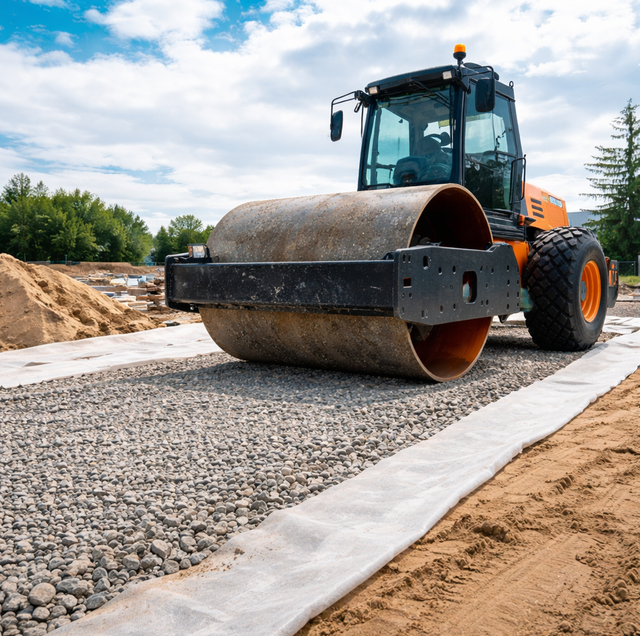
Not every subgrade problem is about water sitting under the driveway. A property can have well-drained, low-water-table ground and still give a gravel driveway trouble, because the soil itself is fine, loose sand rather than a denser soil like clay or loam. Native ground like this is often called sugar sand for how fine and pale it runs. It drains fast, and it's easy to dig, which makes it feel like an easy build site. What it isn't is a soil that locks together the way a denser subgrade does, and that difference changes how the base course above it needs to be built. (Drainage and a high water table are a separate mechanism covered elsewhere; the concern here is what loose sand does to compaction and load-bearing capacity on its own, water table aside.)
Why Loose Sand Doesn't Compact Like Clay or Loam
Compaction works by forcing soil particles closer together, reducing air and void space between them, and the effectiveness depends on the shape and size range of the particles being compacted. Clay and loam carry a mix of particle sizes and enough natural cohesion that, once compacted, the particles bind and interlock and largely stay where they're pressed. Fine, uniform sand is a different case. Individual grains are typically rounded to sub-rounded rather than angular, similar in size to their neighbors, and held together mostly by friction between grains rather than by any real cohesion. That combination gives compaction less to grab onto: press sand down, and without something to lock the grains together, it has a greater tendency to loosen back up or shift sideways under load than a denser soil does. The subgrade isn't necessarily unstable on its own, but it gives the base course above it less of a firm shoulder to key into.
What That Means for the Base Course Above It
A gravel driveway's base course, the compacted layer of angular crushed stone between the subgrade and the finish material, does its job partly by interlocking and partly by pressing down into a subgrade that resists and holds that pressure. On firmer ground, that resistance comes from the subgrade with comparatively little extra effort. On loose sand, the base has to do more of the load-bearing work on its own, because the ground underneath doesn't push back the same way. That's not a reason to skip subgrade prep on sandy ground; it's a reason to compact the subgrade itself more deliberately before base stone ever goes down, rather than treating a sandy lot as already firm enough to build on.
Geotextile Fabric Matters More on Fine Sand
Geotextile fabric's job, as on any gravel driveway, is separating the subgrade from the base course so fines don't pump up into the stone. On a soil with a wide range of particle sizes, larger grains tend to bridge over a fabric's openings and hold the smaller fines behind them. Fine, uniform sand doesn't have that natural bridging effect: the grains are close enough in size that more of them can migrate straight through a fabric with openings sized for a coarser or more mixed soil. That's why the fabric's aperture size, not just whether fabric gets used at all, is worth matching to the soil on a sandy lot. A woven fabric with a tighter weave, sized to the fine grain of the sand rather than a generic mid-range product, is often the better match on sandy ground for that same reason. Seam overlap matters everywhere fabric is used, and it matters just as much here: a gap at a seam is a gap regardless of what soil lies beneath it.
Extra Depth or an Extra Compaction Pass to Reach the Same Bearing Capacity
A standard gravel driveway base runs 4 to 6 inches, built in lifts of roughly 2 to 4 inches rather than one thick pass, and that figure is the starting point on most sites. On a notably loose, fine sand subgrade, reaching adequate bearing capacity sometimes takes more than that starting point, since loose sand gives up less resistance per pass of the compactor. That can mean an added lift of base material to reach a firmer compacted result, or it can mean running an extra compaction pass over each lift before moving to the next one, checking that the surface is firm and no longer visibly deflecting under the compactor's weight before calling a lift done. Which adjustment makes more sense depends on how loose and how deep the sandy layer runs on a given lot, which is a site-specific call rather than a fixed rule.
Compaction Equipment and Technique on Sandy Ground
Plate compactor: a vibratory plate compactor is the standard tool for a residential gravel driveway, and vibration is well suited to granular soil like sand, since the shaking helps grains rearrange into a denser pack rather than relying on static weight alone to press them down.
Roller: a heavier roller is used more on longer or wider drives, or wherever a plate compactor's smaller footprint would require an unreasonable number of passes to cover the same ground.
On sandy ground specifically, crews also pay closer attention to moisture: sand that's bone dry resists locking together almost as much as sand that's oversaturated, and a light, even dampening before compaction, well short of standing water, often gets a noticeably denser result than compacting it dry. Working in overlapping passes in more than one direction, rather than one straight pass down the length of the driveway, also helps on sand, since loose grains can shift sideways out from under a plate compactor moving in only one direction.
A Driveway That Flexes Underfoot Even When It Looks Fine
A gravel driveway corridor over a sandy subgrade can look complete and still flex or give slightly underfoot in a way a corridor over firmer soil doesn't, even with no standing water involved and no visible rutting yet. That's the loose sand underneath still settling and redistributing under repeated weight, rather than a sign of a failed base the way a soft, muddy give usually is. It's worth distinguishing from a moisture-driven soft spot, since the fix isn't the same: a section that flexes dry, with no mud or surface discoloration, generally needs more compactive effort or added base depth in that spot, not fabric replaced or drainage corrected. Left alone, that kind of underbuilt spot on sandy ground tends to show up eventually as a shallow depression in the wheel path, even without the pumping and mudding a wet subgrade produces.
Frequently Asked Questions
No. Sand quality varies widely even within the same neighborhood, and coarser, more angular sand with a mix of grain sizes compacts more like loam than very fine, rounded sugar sand does. A rough field indicator: sand that holds a loose shape when squeezed damp in a fist has more fines and structure to it than sand that falls apart the instant you open your hand, which tends to be the loosest, most uniform kind.
Dig a hole a foot or two deep with a shovel. Sand that offers almost no resistance to the shovel and won't hold a vertical-cut wall, where the edge just slides back down into the hole, is a rough sign of loose, cohesionless sand with little natural structure. Soil that holds a cut edge for at least a few minutes has more clay or organic content binding it together, even if it looks sandy on the surface.
Not necessarily. If loose sand only runs a foot or two before hitting a firmer stratum, the standard lift count for the base often still works, since the firmer layer underneath does some of the load-bearing work the sand itself can't. It's mainly on deep sand, several feet or more with nothing firmer within normal excavation reach, where the number of lifts, not just their depth, typically needs to increase.
They can be, for driveways carrying heavier, repeated loads like an RV pad or a corridor used daily by a work truck. Soil stabilization, mixing in a polymer or cement-based additive to bind the sand grains together before compacting, is a more involved and more permanent step than adding a lift or an extra pass, and it's typically reserved for cases where the load or the sand's looseness makes standard compaction alone a poor match for what the driveway needs to carry.
To a degree. Ordinary traffic and vibration continue to densify loose sand somewhat after installation, sometimes called self-compaction, but it happens unevenly: the two wheel paths see far more repeated load than the untraveled center and edges. That uneven settling is why a driveway on sandy ground can develop a faint dip specifically in the tire paths a year or two after a technically adequate build, even without any single event causing it.
Often yes, though what gets removed is different. The top few inches of sand on an undisturbed lot are frequently looser than the sand a foot or two down, especially anywhere the surface has been recently disturbed, graded, or piled. Compacting straight over that loose surface layer without stripping or scarifying it first tends to give an uneven, less predictable result than compacting sand that hasn't been recently disturbed.
Get a subgrade compaction evaluation — we assess sandy soil conditions and recommend the right base depth and prep before any stone goes down. Polk Services LLC serves Lakeland, Highland City, and Mulberry. Call (863) 344-5806.
