

Fill Dirt vs. Topsoil vs Sand: The Order That Holds
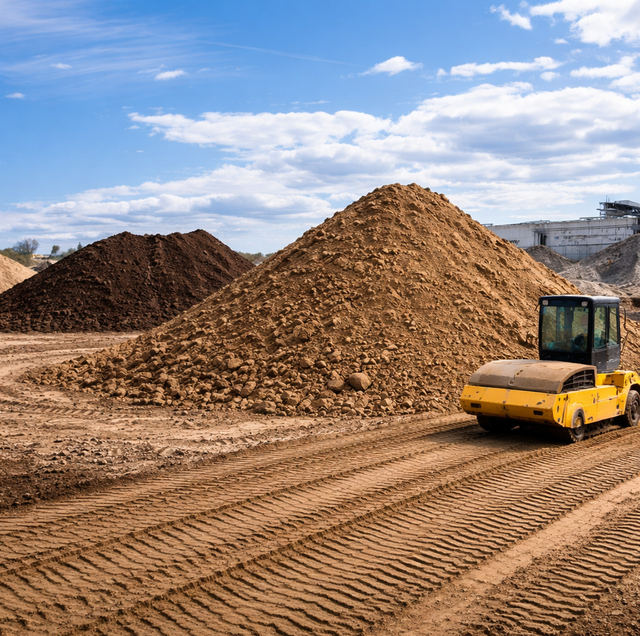
Quick Answer: Three materials do three jobs. Structural fill builds grade and carries weight. Topsoil is a thin cap where grass roots grow, never load-bearing. Bedding sand levels a layer under pavers, not a general fill. Mixing them up is why a spot sinks again.
Three Materials, Three Jobs
A lot of yard problems trace back to one habit: treating "dirt" as one material instead of three. Someone needs to raise a low spot, and whatever's on hand or cheapest goes in, whether that's bagged topsoil from a garden center, leftover fill dirt from another project, or a few loads of sand because it's easy to shovel and spreads flat. All three will sit there looking fine for a while. Only one of them is actually built to hold shape and carry weight over time.
Structural fill, topsoil, and bedding sand are different products with different jobs: bulk grading, surface planting, and hardscape leveling. Used in the wrong role, or stacked in the wrong order, each one fails in a specific, predictable way.
Fill dirt built up too fast without compaction: It settles in patches.
Topsoil used to fill depth instead of cap it: It collapses as the organic matter breaks down.
Sand poured in loose to build up height: It shifts and never locks into a stable base. Getting the order right is less about any one material being "better" and more about matching each one to the only job it's actually suited for.
Structural Fill: Built to Carry Weight and Hold Shape
Structural fill, often sold as "clean fill dirt," is mineral soil (clay, sand, or a blend) with the topsoil, roots, and organic debris screened out. That matters because organic matter is exactly what a load-bearing layer can't have much of. Fill dirt compacts into a dense, stable mass when it's placed and worked correctly, which is the entire point of using it under a raised area: it needs to hold its shape and support whatever sits on top of it (soil, sod, a shed pad, foot and mower traffic) without shifting or losing volume over time.
The mineral particles in structural fill lock together mechanically when compacted, similar to how gravel settles into a dense mass when shaken and tamped. Run a plate compactor or a roller over it, and the particles rearrange into a tighter structure with less air space between them. That's what makes it "structural." A pile of loose fill dirt tipped off a truck and left alone isn't doing this job yet; it still needs to be spread and compacted.
If building up grade means removing more than a few inches of existing soil to key the fill in, call 811 before digging. The locate marks buried gas, power, water, and communication lines before equipment cuts into one.
Why Topsoil Fails When It's Used as Structural Fill
Topsoil is the opposite of fill dirt in almost every way that matters for this job: it's deliberately rich in organic matter (decomposed leaves, roots, compost, microbial life) because that's exactly what makes it good for growing something. That same organic content is what makes it a poor choice at any depth below the surface.
Organic matter decomposes. Bacteria and fungi in the soil break down dead plant material and root fibers over months and years, and as that material breaks down, it loses volume, the same way a pile of leaves shrinks to a fraction of its size as it composts. If topsoil is used to build up several inches or a foot of grade, that decomposition keeps happening underground, out of sight, long after the yard looks finished. Every bit of organic material that breaks down leaves a tiny void where solid matter used to be. Multiply that across a few cubic yards of topsoil-as-fill, and those small voids add up to real settling, usually uneven, because decomposition doesn't happen at the same rate throughout the pile. The result is a soft spot, a shallow dip, or a slight bowl-shaped sag that shows up months after the topsoil was placed and looked perfectly flat.
There's a second problem layered on top of the first: topsoil also compacts differently than mineral fill. Its looser, more porous structure, part of what makes roots able to move through it, means it doesn't lock into a dense, stable mass the way clean fill dirt does. It's built to stay loose enough for roots and water to move through it. That's correct for the surface. It's the wrong property entirely for something meant to bear weight below the surface.
The One Job Topsoil Is Built For
Used in the right spot, topsoil isn't a problem at all. It's the right material for exactly one job: the thin surface layer where grass, groundcover, or garden beds actually root. A cap of roughly two to four inches of topsoil over compacted structural fill gives grass seed or sod the organic content, nutrients, and workable texture it needs, while sitting on a base that won't shift.
The order matters as much as the material choice: structural fill goes down first and gets compacted to establish the shape and grade, and topsoil goes on last, as a cap, not as bulk. Reverse that order (topsoil at the bottom, compacted mineral fill on top), and there's no functional soil layer left near the surface for anything to root into, while the organic material that should have capped the job is now buried and decomposing under a load it was never built to carry.
Bedding Sand: For Leveling and Drainage Layers, Not General Fill
Sand has a real, narrow job in yard and hardscape work, and it isn't building up bulk grade. Coarse sand, often called bedding sand, leveling sand, or concrete sand depending on the supplier, is used in thin, precise layers: screeded to an even thickness of about an inch over an already compacted base, so pavers, flagstones, or a gravel surface sit flat and level. It's also used as part of a drainage layer, spread over gravel to help water move through rather than pool at a hard boundary.
What sand doesn't do well is serve as a general-purpose fill to raise the grade of a large area. Bedding sand is a narrowly graded, washed material, almost all one particle size with the fines screened out, which is exactly what makes it easy to screed flat and level. That same narrow grading is what keeps it from locking into a stable mass: without a range of particle sizes and fines to fill the gaps between grains, a thick, loose layer of sand has little to hold it together, so it shifts and redistributes under foot traffic, mower weight, or a few seasons of wet-dry cycles, and a mounded area built from loose sand tends to lose height and flatten out again over time. Well-graded fill dirt is a different product entirely: its mix of particle sizes and fines is what allows it to compact into a load-bearing mass under a compactor. That narrow grading is a fine, forgiving property for a thin leveling course under pavers. It's the wrong property for anything expected to hold several inches of new height and stay there.
Structural fill gets compacted in lifts of roughly four to six inches at a time, not dumped in all at once. Each lift is compacted before the next is placed, so compaction extends to the bottom rather than just crusting the surface.
The Order That Actually Works
Put together, the sequence for building up grade correctly runs bottom to top, by function, not by whatever material happens to be on hand:
Structural fill first, compacted in lifts: Clean fill dirt (or a mineral fill/aggregate blend where more bearing strength is needed, like under a shed pad) is spread in shallow lifts of a few inches each, with each lift compacted before the next goes down. This is what establishes the actual grade and gives the area its lasting shape.
Bedding sand only where hardscape needs it: A thin, screeded sand layer goes down only directly under pavers, flagstone, or similar hardscape, not as a substitute for compacted fill underneath it. The compacted fill or aggregate base still does the structural work; the sand's job is only the top inch or two of fine leveling.
Topsoil last, as a thin cap: Two to four inches of topsoil goes over the compacted fill wherever grass or plants need to root, worked or tilled lightly into the top of the fill layer so there isn't a sharp, slick boundary between the two.
Skip a step, or do them out of order, and the grade doesn't fail all at once. It fails slowly, in the specific way that matches whichever step got skipped: a topsoil-only fill sinks as it decomposes, a sand-only buildup flattens back down under traffic, and fill dirt placed without compaction settles unevenly wherever it wasn't tamped enough.
Frequently Asked Questions
For sorting fill from topsoil specifically, texture and organic content are the tell, not color alone (color mostly tracks the parent soil's mineral content, not whether it's fill-grade). Clean structural fill is mostly mineral (clay, sand, or a blended mix) and should feel uniform, gritty or claylike, without visible roots, mulch chunks, or a dark, crumbly, compost-like texture underfoot. If a load smells earthy and organic, or holds together in loose dark clumps that fall apart easily, it's closer to topsoil than fill, no matter what it was sold as.
Yes, when it's processed, graded recycled aggregate from a supplier, not broken concrete chunks mixed into unscreened spoil. Processed aggregate compacts even more predictably than natural fill dirt because the particle sizes are more consistent. It's a common substitute or supplement beneath structures, driveways, or anywhere extra bearing strength is needed, though it's typically a heavier, coarser material to work with by hand than screened fill dirt.
Often yes. Mineral fill compacts best at a specific moisture range, sometimes called the optimum moisture content: too dry and the particles won't lock together under a compactor; too saturated and the compactor just pushes water around instead of densifying the soil. A light misting between lifts is common on dry material; a heavily saturated load usually needs time to drain and dry before it's workable.
There's no fixed universal number, but giving compacted fill at least a few weeks, and ideally a full wet-weather cycle, lets any residual settling show up before the finish layers go on. Sodding immediately over freshly placed fill can hide a settling problem beneath the grass, rather than letting it surface where it can still be corrected.
A blended pile isn't structural and isn't a proper planting medium either. The organic fraction still decomposes and still creates voids, so the settling problem doesn't go away; it's just distributed unpredictably through the whole depth instead of concentrated at the surface, which is often harder to diagnose after the fact than a clean two-layer setup.
Not really; even a two-inch lift benefits from a pass with a plate compactor rather than being left loose, especially near the surface where foot traffic and mower weight apply repeated pressure. The real risk is the opposite: lifts placed too thick (say, eight inches or more at once) where a compactor can't reach the full depth, leaving the bottom of that lift loose no matter how solid the top looks.
Most repeat sinking comes down to one of these three materials being asked to do a job it was never built for. Matching structural fill, topsoil, and bedding sand to the layers they actually belong in is what most separates a grade that holds from one that quietly sinks again.
Get your yard graded right the first time — proper structural fill, compacted in lifts, capped with real topsoil where it belongs. Polk Services LLC serves Lakeland, Highland City, and Mulberry. Call (863) 344-5806.
