

Pool Past Repair or Just Aging? How to Tell
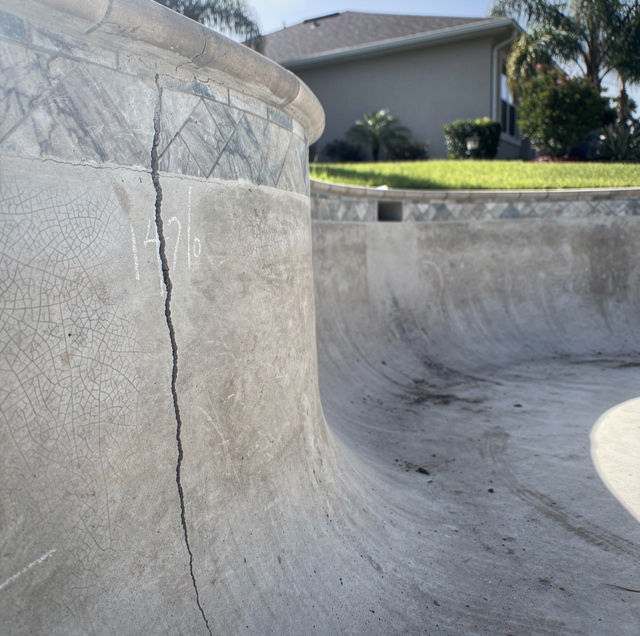
A crack that has widened since it first appeared, with its edges no longer lining up as they once did, is a different problem than the fine spiderweb of hairline lines common in an aging pool finish. One is cosmetic. The other is telling you something about the shell underneath. Knowing which one you are looking at and reading the other signs alongside it is what determines whether a pool is a repair job or a removal job. That call gets made on condition, and on nothing else.
Cracks That Move Are a Different Problem Than Cracks That Sit Still
Surface crazing, the fine, web-like lines that spread across a plaster or pebble finish, is a finish-layer issue and does not by itself mean the shell is failing. A structural crack behaves differently. It tends to run in a fairly straight or stepped line rather than a scattered web, and it keeps changing. Measure it against a reference mark and check again after a few weeks and a good soaking. If the gap has opened, if one side has dropped relative to the other, or if it now runs through the shell material rather than just the surface coating, the shell itself is moving. Movement in the ground underneath, not just the finish on top, is the more likely cause once a crack behaves this way, and it is a different order of problem than a stained or pitted surface that has simply aged.
Rust Bleeding Through the Finish
A brownish-orange stain that keeps reappearing in the same spot after being cleaned or patched is not ordinary mineral staining. It usually means the steel reinforcement inside the shell is corroding, and as it rusts, the steel expands, pushing outward against the surrounding material from the inside rather than remaining still. Staining plus a location that keeps coming back is the combination that separates this from a one-time mineral deposit that wipes away and stays gone. A stain that shows up once, cleans off, and does not return is far less concerning than one that keeps finding the same spot.
A Shell That No Longer Sits Level
Ground moves, and when it moves unevenly under a pool, the shell moves with it. Signs include a waterline that no longer reads level around the perimeter, coping that has separated or tilted away from the shell, a deck that has pulled away at the edge, and walls that bulge, feel soft, or read as unstable rather than rigid. A failing wall often shows a faint waviness across its face that a sound shell never has, visible from the deck through clear water and unmistakable on a pool someone else has already drained. Lowering the water yourself to get a better look is the one thing not to do, because the water is what is holding the shell down. That instability, not just a crack or a stain on its own, is one of the clearer signs that erosion or settling under the shell has already progressed past anything a surface fix would touch.
A shell with bulging or soft walls is holding back soil it may no longer be able to carry. Stay off the deck edge above it, and if the pool has already been drained by someone, stay out of it entirely.
Water Loss and Finish Failure That Keep Coming Back
A pool that loses water and keeps losing it, even after a leak has supposedly been addressed, is telling you the source was not actually fixed, or that there is more than one source at work. The same logic applies to the finish: plaster or pebble that fails, gets patched, and fails again at the same spot rather than somewhere new. A single failed area, addressed once and holding after that, is a normal repair outcome and nothing to read too much into. A failure that keeps returning to the same location is different. It is a sign the underlying shell condition at that spot, not the finish material itself, is the actual problem, and patching the surface again will not change that.
Equipment Aging Out Together, Not One at a Time
A pump that finally quits after years of service is routine and does not say anything about the pool itself. A pump, filter, heater, and salt cell all reaching the end of their working lives around the same time is a different situation. It usually means the whole system was installed together and has simply run its course together as a set, which changes how you should read it. A new pump on its own does nothing for a shell that has structural cracking, rust bleed-through, or uneven settling underneath it. Equipment failure and shell failure are separate problems with separate causes, and fixing one has no effect on the other.
Storm Damage Changes the Calculation
A fallen tree that cracks the shell or the surrounding deck, a screen enclosure torn loose and tossed by wind, or equipment left sitting in standing water in a low spot after heavy rain are physical events, not gradual wear, and any one of them can turn a pool that was otherwise sound into one that is not. What matters afterward is the same condition-based read as everything above: is the resulting crack a straight structural break or surface damage to the finish, has the shell shifted, is the equipment actually still functional once it has dried out. Storm damage does not change what you are looking for. It just compresses the timeline for how fast you have to look.
Reading the Signs at a Glance
| Sign | What's Actually Failing | What It Usually Means |
|---|---|---|
| Crack that keeps widening or runs through the shell | Structural material, not just the finish coating | Shell movement, likely past repair |
| Rust stain returning at the same spot | Corroding, expanding reinforcement inside the shell | Reinforcement failure, likely past repair |
| Waterline uneven, coping separated, walls bulging | The ground supporting the shell | Uneven settling, likely past repair |
| Water loss that returns after a repair | An unresolved or additional source | Deeper shell issue, worth a second look |
| Finish failing at the same location repeatedly | The shell beneath that spot, not the finish itself | Localized structural weakness |
| One component failing, shell otherwise sound | That single part only | Ordinary repair |
| Sound shell, tired or outdated finish | Cosmetic layer only | Ordinary repair, not removal |
When It's Actually a Repair Job
Not every sign here points toward removal, and it is worth saying plainly: a shell that is structurally sound but has a finish that is simply old, faded, or rough is a repair or a resurfacing job, not a removal. So is a single component failure with no other signs present alongside it. In both cases, the right move is a conversation with a pool contractor who can evaluate the finish or the equipment directly. Repair and resurfacing are a different trade from removal, and that call belongs to the people who do it. It is also the honest answer more often than the removal side of this list, no matter how the crack or the stain looked at first glance.
When the Pool Simply Isn't Used Anymore
Not every removal starts with a defect. A pool that still holds water and runs fine, but that the household stopped using years ago, is a legitimate reason to remove it on its own. Reclaiming the space for something the family will actually use does not require anything on the list above to be true first.
Frequently Asked Questions
Most often at a corner, a step, or a light niche, points where the shell was already thinner or already interrupted by a fitting before anything went wrong, which is why those spots are worth checking first even before a crack shows up anywhere else.
Sometimes. A pool contractor evaluating that call typically sounds the surrounding surface, tapping it to listen for hollow or delaminated spots, since a crack can appear isolated while the shell around it has already begun to separate beneath the surface.
Usually, though the reinforcement itself is typically a steel rebar grid or mesh embedded when the shell was originally built, and staining can become visible only once the finish above it has thinned enough to let it show, meaning the corrosion was already underway before the stain ever reached the surface.
Not automatically, but it is worth a quick check regardless: a flooded salt cell or heater can fail in a way that looks identical to one that simply reached the end of its service life, so replacing the failed part alone does not confirm the rest of the equipment pad, or the shell, came through undamaged.
Not automatically. Deck separation on its own, with a level waterline and no cracking in the shell, can sometimes be addressed as a deck-specific repair. It is the combination of deck movement with an uneven waterline or bulging walls that points toward the shell itself.
Photograph it with something in frame that fixes both the scale and the location: a coin laid beside a crack, or a tape held across it with the deck joint visible in the same shot. A crack photographed alone is unreadable a month later, because nothing in the picture says how wide it was. Shoot the same framing again after a heavy rain cycle, since that is when a moving crack moves. Hand the set to a pool contractor if the shell looks sound and to a removal contractor if it does not.
The distance between a pool that looks tired and a pool that is failing is usually one or two of these signs turning up together, and it is rarely obvious from a single look on a single day. What separates the two is whether anything is still moving.
Book a pool removal walk-through — see what taking the pool out would actually involve on your property. Polk Services LLC serves Lakeland, Highland City, and Mulberry. Call (863) 344-5806.
