

Farm & Work Truck Driveway Loads: Built Not to Rut
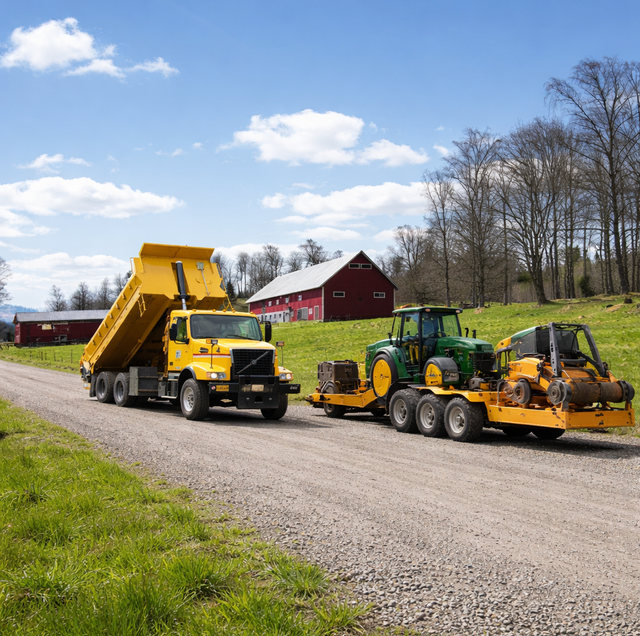
If a tractor, an equipment trailer, or a work truck rolls up your driveway several times a week, that driveway is doing a different job than the one built for a sedan and the occasional grocery run. It's not one heavy thing sitting in one spot: it's the same wheel path getting loaded, flexed, and loaded again, week after week. A driveway sized for daily cars will eventually show it, usually as a pair of grooves that deepen every time it rains. Building it right from the start costs less than building it twice.
Why Repeated Heavy Traffic Wears a Driveway Differently
A passenger car puts maybe a ton and a half on four contact patches, spread across whatever route the driver takes that day. A loaded work truck, a tractor with a box blade, or a gooseneck trailer full of equipment concentrates several times that weight onto a narrower set of tires, and it almost always follows the same two ruts from the road to the barn, shop, or parking pad. That repetition matters more than the raw weight. Gravel and the soil under it shrug off a single heavy pass the way a lawn survives a few footsteps. It's the hundredth pass over the exact same track that starts to matter, because each load pushes stone downward and sideways a little before it springs back, and the subgrade never quite gets a full recovery between passes.
This is different from a driveway that took one bad week of dump trucks and now needs patching, and different from a spot where an RV or trailer jack sits still for a season. A parked point load punishes the soil beneath a small footprint; construction traffic punishes the entire surface once and then stops. Rolling farm and work-truck traffic does neither: it returns to the same two lanes, over and over, which is why the fix belongs in the base across the entire travel path, not at a single trouble spot.
How a Wheel Path Turns Into a Rut
Rutting under repeated heavy rolling loads works differently from a pothole caused by occasional traffic. With light, varied use, stone particles interlock and stay interlocked, and minor settling stays shallow. Under a heavy vehicle tracking the same two lines dozens of times a month, three things stack up. First, the stone in the wheel paths compacts tighter than the stone between them, so the surface stops draining evenly and water collects in the low spots you just created. Second, standing water softens the subgrade right where the load lands, and a soft subgrade, under repeated load shifts, shifts sideways instead of compressing straight down; that lateral shove is what carves a rut, not simple crushing. Third, once a groove exists, tires track into it, so the same spot keeps taking the load and the rut deepens faster. By the time you see two parallel channels, the base under them has usually already lost most of its structure, not just its surface stone.
That's why topping off ruts with loose gravel every season rarely solves anything: you're refilling the symptom while the compacted, waterlogged base keeps doing the same thing to the next load of stone.
Build the Base to Match the Actual Traffic
For a driveway that sees regular tractor, trailer, or commercial-vehicle traffic, the base needs to be planned for the whole travel corridor, not just the easy stretches. Where a standard car driveway typically runs a compacted base somewhere in the 4-to-6-inch range, a route carrying regular heavy-axle loads generally wants to push closer to 8 inches or more, the same depth a stationary point load like a parked trailer calls for, across the full width of the travel lanes rather than just where you think the tires will land. Tires drift side to side on every pass, so "the wheel path" is really a band a couple feet wide, and the base has to support that whole band.
Depth alone isn't the whole answer; compaction quality under that depth is what resists rutting. A base dumped and roughly leveled, but never mechanically compacted in real lifts, will settle unevenly under heavy load, no matter how thick it looks on paper. Compacting in layers, checking each lift is solid before adding the next, gives you a base that behaves like one dense mass instead of loose stone finding its own settlement pattern over the first year.
To check whether an existing base is actually compacted rather than just dumped and leveled, drive a loaded vehicle over it and watch for visible deflection, then check it again after a rain for footprints or depressions underfoot. A properly compacted lift resists both; loose, uncompacted stone shifts or leaves depressions either way.
A woven or non-woven geotextile fabric between the native soil and the aggregate base is worth including in a driveway carrying regular heavy loads, especially where the soil contains clay or retains water after rain. The fabric keeps base stone from working down into soft subgrade, and keeps subgrade from pumping up into the stone under a saturated heavy axle. Skip it on a light-use driveway, and it's a nice-to-have; skip it under a route a tractor uses three times a week and the stone alone is doing a job it wasn't designed for.
Choose Materials That Hold Up to Repeated Loading
Not every gravel product resists rutting the same way. Rounded pea gravel has almost no interlock and rolls under a heavy vehicle, tracking the same line repeatedly instead of locking against its neighbors, which speeds up rutting rather than resisting it. Angular crushed stone with a mix of particle sizes compacts into something much closer to a solid mat, and that interlock is what carries a rolling heavy load without the surface deforming underneath it.
Surface and base material don't have to be identical, but they should be compatible: a well-compacted crushed-stone base topped with a driving surface course that's also angular and properly graded resists rutting from the base up, not just at a nice-looking top layer. If you're maintaining an existing driveway rather than building new, matching new stone to the existing base's gradation matters. Mixing a fine, dense top layer onto a coarse, loose base creates a stiff crust over a soft foundation, and that crust cracks and ruts faster than a properly matched system would.
Reinforce the Zones That Take the Most Punishment
Not every foot of driveway needs the same treatment. Treating it all identically usually means overbuilding the easy stretches or underbuilding the hard ones. The straight run between the road and the yard mostly just needs the consistent base described above. The zones that deserve extra width, extra depth, or both are where a vehicle changes direction, slows, or pivots: the approach to a gate, the turning apron near a barn or shop, and any spot where a trailer has to back and swing to line up with a door. Turning grinds stone sideways in a way straight-line travel doesn't, and maneuvering a trailer in a tight radius puts more shear stress on a smaller patch of ground than the same vehicle cruising down a straight lane.
Widening those areas gives the driver room to complete a turn without grinding along the same narrow arc, spreading the wear rather than concentrating it. Extra base depth at gate approaches and turning aprons accounts for vehicles slowing or stopping right at the gate: a vehicle that stops or crawls there works the same patch of ground for far longer than one rolling through, and braking, accelerating, and turning all add sideways shear on top of the vertical load that a straight run never sees. Grading these zones so water sheds away rather than pooling matters as much as the extra stone, since a soft, saturated turning area under regular heavy use is where rutting shows up first and worst.
Frequently Asked Questions
Yes, and it's a common way to handle it on a property that can't go without driveway access for several days straight. Working one half of the width at a time, excavating and rebuilding that lane's base while traffic uses the other half, keeps the property accessible, though the seam where the two lanes meet needs its own compaction pass so it doesn't become a soft joint running the length of the drive.
An existing driveway can often be reinforced in place by excavating the travel lanes down to subgrade, adding fabric if it's missing, and rebuilding the base in compacted lifts, rather than tearing out material that's still structurally sound elsewhere on the property.
A properly compacted lift resists visible deflection when a loaded vehicle drives over it and won't leave a footprint underfoot after rain. Loose, uncompacted stone visibly shifts or leaves depressions under foot traffic alone, a sign that it needs mechanical compaction before more material is added on top.
Axle configuration matters as much as total weight. A tractor's narrow tires concentrate load differently than a dual-axle work truck or a gooseneck trailer, so a driveway serving mixed equipment should be built to its heaviest, narrowest-tired regular visitor, not an average of everything that uses it.
Yes, and it flattens out faster on a heavy-traffic route than on a light-use driveway, since the same two wheel paths get compressed on every pass instead of traffic spreading evenly across the width. A crown that needs re-cutting once a year on a car driveway may need attention closer to twice a year on a route a tractor or work truck uses regularly.
Low tire pressure on a trailer spreads its contact patch over a larger area, which can actually ease the load per square inch, but it also means more sidewall flex, working the stone underneath on every pass. Speed matters less than dwell time in wear: a vehicle that idles or stops repeatedly at the same spot, like a gate, gives that ground far longer under load than one that rolls through at a steady pace.
Schedule a gravel driveway consultation — a technician will walk your travel lanes and gate approaches before recommending a base plan. Polk Services LLC serves Lakeland, Highland City, and Mulberry. Call (863) 344-5806.
