

Glue-Down Carpet Removal vs Wall-to-Wall: What Actually Comes Up
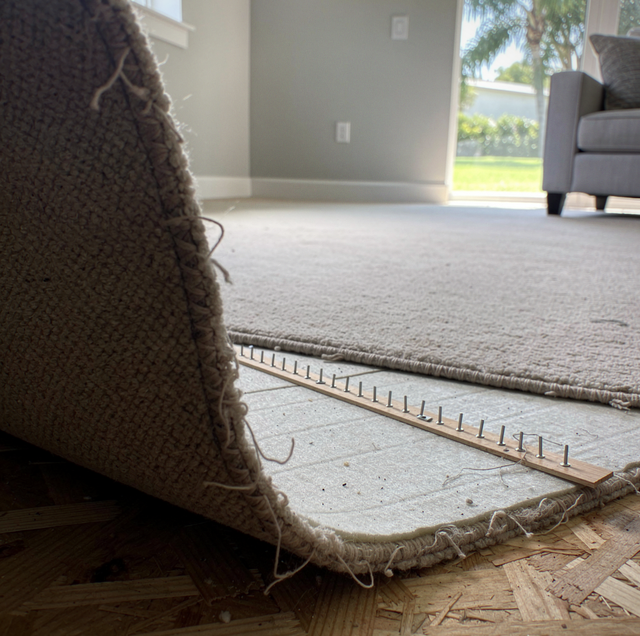
Lifted at the corner, one of two things happens. The carpet peels back clean, a full sheet separating from a padding layer underneath it, tack strip visible along the wall. Or it stops after an inch, held fast to the deck itself, fiber tearing before it lets go. That first lift tells you which installation is actually under your feet, and the two methods behave nothing alike from there.
What Holds Each Installation Down
Standard wall-to-wall carpet is held by tension: tack strip at the perimeter, a separate pad underneath, and nothing along the field of the floor bonded to the deck. Glue-down carpet works on a different principle. There is no tack strip and usually no separate pad, since adhesive is typically spread across the whole underside of the carpet and it bonds directly to the sub-floor, whether that sub-floor is concrete or wood. Because the entire underside is fixed rather than just the perimeter, removal is a bigger job in scope and labor than for a comparable stretched-in room, and that difference shapes everything that follows.
How Each One Comes Up
The two methods release in completely different ways once work starts. A stretched-in room lets go at the tack strip, and because the carpet was held by even tension across the whole floor, freeing one corner releases that tension across the rest of the piece. It comes up as one connected sheet, with the padding lifting separately underneath. The contrast is between a surface held taut by even tension across the whole field and a decal that stays fixed only where its adhesive still grips the surface beneath it.
Glue-down carpet has no shared tension to release. Each section of the underside is bonded individually, so freeing one area does nothing for the adjacent section. It comes up in strips or pieces rather than a sheet, and the adhesive has to give way section by section. How readily it lets go depends heavily on the adhesive's age and type. Older adhesive can be harder and more brittle than newer adhesive, which affects how the carpet separates from the deck. That difference is also part of why glue-down removal takes more effort across the same amount of floor than pulling a stretched-in room.
What Each Leaves Behind on the Sub-floor
A stretched-in room leaves a fairly predictable set of leftovers: the tack strip itself, the staples that held the padding down, and general debris from the carpet and pad. Complete removal in one visit covers all of it, including carpet, padding, tack strip, staple removal, and haul-away, and the sub-floor is left swept once the room is clear.
Tack strip carries angled pins that stay sharp after it's pulled, and loose staples from the padding can remain in the sub-floor after removal. Watch bare feet and hands around the perimeter until the room is fully swept and cleared.
Glue-down carpet does not leave the same clean surface, and what it leaves behind depends on what is underneath it. Over concrete, pulling carpet away from a bonded installation leaves adhesive residue on the slab that has to be addressed before anything new goes down. Over a wood subfloor, glue-down carpet can pull up surface fibers as it releases, since the bond can be stronger than the fiber itself.
Bonded adhesive residue left on a concrete subfloor after glue-down carpet is removed is a separate condition from the removal itself, and it typically needs its own resolution before new flooring goes down over that area.
What It Means for the Next Floor
What is left on the sub-floor after removal shapes what happens next, and the two methods hand off very differently. A stretched-in room, swept clean of tack strip and staples, gives the next installer a bare deck to work from. A glue-down room can hand off a slab with adhesive residue still bonded to it, or a wood sub-floor with patches of fiber pulled loose. Either condition has to be dealt with before new flooring, whether that is tile, vinyl plank, or another glue-down carpet, can go over that same area.
Stretched-In vs Glue-Down at a Glance
| Stretched-In Carpet | Glue-Down Carpet | |
|---|---|---|
| Fixed down by | Tack strip at the perimeter, carpet stretched over a separate pad | Adhesive typically spread across the entire underside, bonded to the deck |
| Comes up as | One connected sheet, with padding lifting separately | Strips or pieces, released section by section |
| Sub-floor left with | Tack strip and staples pulled, then swept | Adhesive residue on concrete, or pulled fiber on wood |
| Padding layer | Separate, removed on its own | None, unless part of a double-glue system |
When a Room Turns Out to Be Both
Some rooms complicate the corner check. A double-glue installation bonds a cushion layer to the deck and then bonds the carpet to that cushion, creating two adhesive bonds instead of one. Underfoot, it can feel like a normal padded, stretched-in room, since a cushion layer is present. Pull that same corner, and it behaves like neither pure type on its own: the cushion does not tuck under a tack strip and lift free, and it does not come off the deck as easily as a single glue-down bond either. Each layer has to separate at its own bond line.
A cushioned feel underfoot is not proof of a stretched-in installation. If that cushion layer is glued to the deck rather than tucked under the tack strip, it releases in a separate step during removal.
That is exactly why the first lift at the corner matters more than a glance at the room. A visible pad does not rule out a bonded installation, and a smooth glue-down look on top does not rule out a cushion layer glued underneath it.
Frequently Asked Questions
Not usually. Modular carpet tiles are often set with releasable pressure-sensitive adhesive applied in dots or a partial pattern rather than a full spread, so individual tiles lift on their own instead of coming up in the connected strips typical of a full-spread glue-down room.
No. Some installations use perimeter glue, where adhesive is applied only around the room's edges and at seams, rather than across the entire underside. The field of a perimeter-glued carpet lifts more freely than a full-spread bond, while the edges still resist like standard glue-down.
That is outside what a removal crew assesses or handles. In an older structure, an asbestos assessment is licensed specialist work and is referred out before any removal is scheduled.
Yes. A rigid material like tile, vinyl plank, or engineered wood telegraphs ridges or buildup left on the subfloor far more than another glued-down carpet would, so residue that seems minor on a soft floor covering can still need to be removed before a hard-surface installation goes down.
Yes. In a full-spread glued room, each side of a seam is bonded independently to the deck, so the seam itself can open without the rest of the floor shifting. In a stretched-in room, the whole piece moves as one tensioned unit, so a seam that starts to separate usually points to a loss of stretch across the room rather than a problem isolated to that one spot.
The strip still carries its angled pins or nails when it comes free, so it gets handled separately from the carpet and pad as sharp debris rather than bundled in with the rest of the material for haul-away, since those pins can catch skin or a trash bag alike.
If the corner came up and the carpet stayed stuck — get the whole room cleared in one visit, sub-floor swept and ready for what goes down next. Polk Services LLC serves Lakeland, Highland City, and Mulberry. Call (863) 344-5806.
