

4 Yard Obstacles That Change How Grading Gets Done
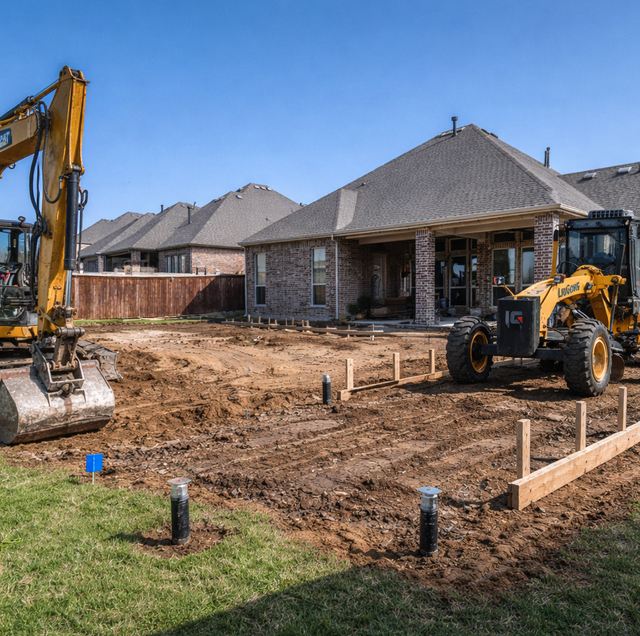
Quick Answer: Four fixed features change a grading plan before equipment moves: irrigation lines that need flagging, pool cage footings that can't be struck, a fence line that limits access, and a narrow gate that determines which machines fit. Each usually means finishing that zone by hand.
A grading plan sketched from the street assumes an open rectangle of dirt. Most yards aren't that. Irrigation heads sit with only their cap at grade and their body buried several inches under the sod, a pool cage is anchored into its own concrete footings, a fence runs the property line, and the gate that equipment has to pass through is sometimes barely wider than the equipment itself. None of those four are things a crew can push through the way they'd push through open lawn, and each one changes what machine shows up, where it can go, and what still has to be finished by hand.
Why Irrigation Heads and Buried Lines Get Flagged First
Locating irrigation before grading starts is a lot like running a stud finder along a wall before drilling into it: skip that step, and the first sign of trouble is the tool hitting something it was never supposed to touch. Pop-up spray heads and rotor heads usually sit only a few inches under the turf, and the lateral lines feeding them, most often half-inch or three-quarter-inch PVC, typically run just six to eight inches deep. A single grading pass at the wrong height can shear a head clean off or crack a lateral line, and the break is often invisible until the system runs again and a section of the yard starts flooding from underground rather than draining.
A standard 811 locate covers public gas, electric, water main, and communication lines, not a private irrigation system. Zone lines and heads have to be located separately before equipment moves through that area.
The practical fix is to run the system zone by zone before the first pass, watch where each head pops up, and mark it with a flag color specific to that zone. The lateral line between two flagged heads usually runs a fairly direct path, giving a crew a reliable line to route equipment around rather than a guess. Valve boxes, the small in-ground boxes holding the solenoids for each zone, need the same treatment, since they're often buried flush with the soil in a bed and are just as easy to crush as a head. If a line runs directly through an area that needs regrading, an irrigation contractor caps and reroutes it before the grading crew works that section, rather than the crew having to guess at a splice.
Why Equipment Keeps Its Distance From a Pool Cage's Footings
A screen enclosure isn't just standing on the patio; its posts are typically anchored into a thickened footer at the deck's perimeter, or, in some installs, straight into the slab itself, and, either way, that anchor point is only as strong as the soil still holding it in place. A tracked machine working right up against that edge risks catching the anchor with the bucket or the frame, or loading the soil beside it enough to shift it out of level, and neither failure announces itself the day it happens. Both tend to show up weeks or months later as a post gone slightly out of plumb or a crack tracing along the footing line.
Because of that, a crew grading up to a pool cage treats the boundary as a hand zone rather than a machine zone, the same standoff logic that applies near any anchored structure on the property.
How a Fence Line Limits Access and the Finished Grade
A fence changes grading in two separate ways, and it's easy to only plan for one of them. The first is access: equipment generally can't cross a fence line, so whichever side of the property the fence sits on has to be reachable through a gate, a removable panel, or an open stretch of yard that isn't fenced. The second, and the one that gets missed more often, is what the finished grade does once it reaches the fence.
Fence posts, wood or chain link, are almost always set in concrete footings of their own, similar in principle to the pool cage's, so the same standoff logic applies near each post. The bigger issue is usually the run of fence between posts. Regrade one side of a shared fence line and leave the other untouched, and the new grade can leave a ledge or a step right at the fence, exposing several extra inches of post or bottom rail that used to sit at or below soil level. On a wood fence, the opposite shift can bury the bottom rail or picket ends, and wood sitting against damp soil for months starts rotting from the bottom up well before the rest of the fence shows its age.
Matching the grade on both sides of the fence: the finished elevation should meet the fence at roughly the height it left it, tapering gradually rather than stepping down, so neither side ends up with an exposed footing or a buried rail.
Why Gate Width Has to Be Measured Before Anything Else Is Planned
Every other constraint on this list assumes equipment can get onto the property in the first place. A gate settles that question before any of the others matter, and it's the one obstacle that has to be checked before a machine class even gets picked, not adjusted for after the fact.
Measure the gate opening at its narrowest point, including latch hardware or a post that isn't perfectly plumb, before assuming a machine will fit. Clearance on paper can disappear once a post has settled out of square.
When a gate is narrower than any machine that could reasonably do the job, and a panel can't be pulled without disturbing a shared fence line, the work in that zone shifts to wheelbarrows, hand rakes, and a plate tamper carried in by hand. It's slower, but it's the only option once the gate rules out anything with wheels or tracks wider than the opening.
Where Hand Work Takes Over From the Machine
Put those four constraints together, and a pattern shows up on almost every yard that has more than one of them: the open middle of the property gets graded by machine, and a ring of hand-graded ground forms around every fixed obstacle at its edge. That's not a compromise a crew makes reluctantly; it's the sequencing that actually works. Machine passes handle the volume, shaping most of a yard's dirt in a fraction of the time hand tools would take. The tight zones next to a flagged irrigation line, a pool cage footing, a fence post, or a gate opening are finished with a rake, a hand tamper, and a level, since those tools can work within a few inches of an obstacle without risk of catching it.
The tradeoff worth knowing going in is compaction. A machine's tracks or a vibratory roller compacts a wide area evenly and fairly quickly. A hand tamper covers the same ground far more slowly and, pass for pass, doesn't reach quite the same density, which is one more reason hand-graded strips deserve a few extra passes rather than treatment as an afterthought. Locating obstacles first, then letting machine work handle the open ground while hand work finishes the edges, is what keeps a clean grade from turning into a redo six months later.
Frequently Asked Questions
Often, yes. Many wood fence panels are screwed or clipped between posts rather than nailed solid, and a section can come off and go back on without disturbing the post footings, using corrosion-resistant screws. Chain link is usually a bigger job, since a section typically has to be unbolted at a terminal post rather than lifted out. If the fence is shared with a neighboring property, that panel shouldn't come off without checking with the neighbor first, since a shared fence is their business too.
Beyond flagging individual heads, a contractor running the system zone by zone will usually trace the control wire bundle that runs alongside the pipe from the valve box to each zone, since cutting that bundle disables the whole zone even if the pipe isn't touched. Flags are typically color-coded per zone, so a crew can tell at a glance which lateral line belongs to which run without re-testing the system mid-job.
Not always by shearing it, but depth alone doesn't make a line safe to drive over repeatedly. PVC irrigation pipe is rated for the soil pressure it normally experiences, not for the repeated point loading from a machine's tracks or tires passing directly overhead. A line that survives one pass can still crack from cumulative loading over several, which is one more reason flagged lines get routed around instead of driven over on the assumption that depth alone protects them.
A gate opening only solves half the access question. A machine still has to turn from the gate into the yard, and a tight dogleg right after the gate, a narrow side-yard strip, or a corner around an AC pad or a bed can rule out a machine that would otherwise fit through the opening itself. Measuring the gate alone and assuming clear sailing past it is a common miscalculation; the actual turning path matters as much as the opening width.
No, and the same paperwork trail that helps with irrigation laterals often helps here too: original enclosure or fence permit drawings, filed with the county at install time, sometimes show the footer or footing line even when nothing is visible above grade. Where no paperwork exists, a thin probe rod pushed carefully by hand along the suspected footing line, well outside the standoff zone the equipment already avoids, can confirm roughly where it runs before any digging happens nearby.
Sometimes. When irrigation heads, a fence corner, and a narrow gate all sit within a few feet of each other, some crews bring in only the smaller machine for the entire property rather than swapping equipment mid-job, even though a larger machine could have handled the open areas faster. Trading some speed in the open ground for not staging two machines, or moving one through a tight gate twice, is often the simpler call once the obstacle cluster is mapped out.
Working around what's already on a property isn't the exception in grading, it's most of the job on any yard that isn't a bare, freshly cleared lot. Flag what's buried, respect what's anchored, measure what's narrow, and the machine work and the hand work end up meeting in the middle instead of fighting each other.
Schedule a grading assessment for a yard with fences, irrigation, or tight equipment access — get a plan that works around what's already there instead of against it. Polk Services LLC serves Lakeland, Highland City, and Mulberry. Call (863) 344-5806.
