

Sleeper Sofa Removal: Why the Fold-Out Mechanism Matters
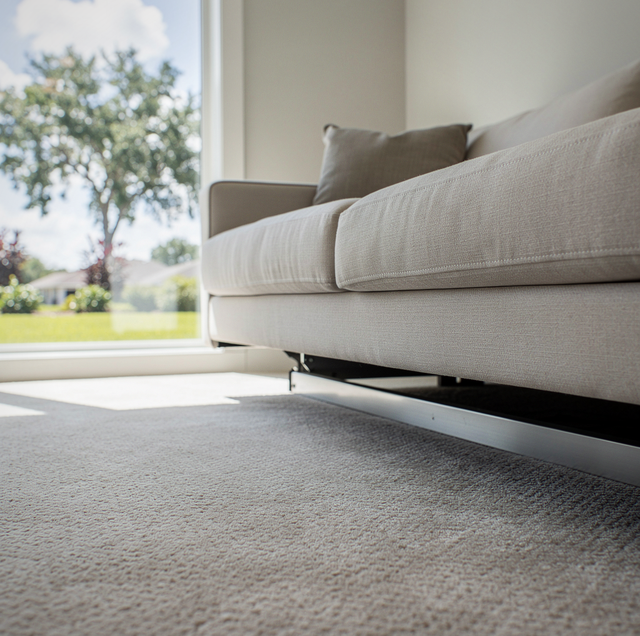
Underneath the cushions of your sleeper sofa sits something a regular couch doesn't have: a welded steel frame and a thin mattress folded flat inside the sofa body. From across the room, it reads as an ordinary sofa. Once it has to leave the room, that hidden hardware is the whole story. The weight, the balance, and the options for getting it out all trace back to what's folded inside, not what the upholstery looks like.
The Weight Sits in One Concentrated Spot
A regular sofa's weight spreads evenly through its wood frame, padding, and cushions, so nothing about carrying it stands out. Your sleeper sofa carries differently. The steel bar assembly that holds the mattress sits low in the frame and generally toward the front of the piece, so most of the weight concentrates in one section rather than spreading across the whole body. The crew notices it immediately: one end feels far heavier than the other, and shifting the piece can throw off a carrier's balance in a way an all-upholstered sofa never does.
A filled toolbox carries the same kind of concealed weight: ordinary-looking on the outside, with nearly all the heft concentrated in one section rather than spread throughout the piece. That's the concealed-ballast problem hiding under your sleeper sofa's cushions, and it's the first thing that changes the crew's approach to the carry.
That concentration is also why a generic size estimate rarely tells the whole story. Two sofas that measure the same on paper can call for a different grip, a different number of hands, and a different plan once weight this uneven is factored in.
When you send access photos, include a shot of the sofa's back and underside, not just the front — that angle helps the crew judge how the mechanism folds before the truck arrives, which can speed up the pickup.
The Frame Won't Flex through a Tight Spot
An all-upholstered sofa gives a little: the frame flexes, the cushions compress, and the whole piece can angle just enough to clear a tight turn. Your sleeper sofa doesn't have that give. The steel frame inside holds its shape no matter what angle the crew carries it at, so the piece behaves less like soft furniture and more like a rigid box wrapped in fabric. Whatever clearance your sleeper sofa needs is close to its actual measured size, because there's no flex left to work with once the mechanism is folded inside.
A cushion that would normally compress just enough to clear a corner stays firm on a sleeper sofa, and that firmness holds constant from one end of the piece to the other. There's no soft spot left to lean on for extra room, which is part of why this piece gets planned for differently than an ordinary sofa of the same size.
An Unsecured Mechanism Can Move on Its Own
The fold-out mechanism in your sleeper sofa runs on a spring-assisted hinge system, the same basic principle that lets the frame swing open with one hand at bedtime. That spring tension doesn't disappear once the mechanism is folded shut inside the sofa body; it remains under load. That's not something to secure or hold shut yourself. It's crew work, handled by the crew on every pickup, regardless of how the piece looks from the outside.
Before your piece is moved at all, the crew checks whether the mechanism is fully closed and caught, since a sleeper sofa that looks shut from the outside can still have a catch that hasn't fully engaged. That check happens every time, not just on sofas that look old or worn. It's also why boxes or bins left stacked on the sofa while it waits for pickup are worth clearing off in advance: the folded mechanism isn't built to bear extra load, and unexpected pressure on it can interfere with that closed-and-caught check.
A sleeper sofa's fold-out mechanism stays spring-loaded even when folded shut. If it isn't secured before the piece is tilted, lifted, or set down, it can release on its own and swing open with real force.
A Mechanism That Won't Close All the Way Changes the Carry
Years of use can leave a sleeper mechanism that no longer folds flush. A hinge catches partway, a leg won't tuck all the way in, or a latch stops holding. A sofa bed in that condition doesn't carry the same way a fully closed one does, because the frame can shift mid-carry instead of staying locked in one shape, and the balance point moves along with it. The crew accounts for this before your piece is ever picked up, adjusting how they grip and angle it rather than forcing a stuck mechanism shut.
It also means two visually identical sleeper sofas can take different amounts of time to move out of the same room, since one closes cleanly and the other needs to be handled with the mechanism only partly secured all the way out.
Disassembly Has Real Limits
Cushions and pillows: These come off the same way they would on any sofa, and for your sleeper sofa, that's usually where disassembly stops. The steel frame is generally welded or bolted together as part of the sofa's structure and is not designed to separate from the sofa body without damaging it. That's different from a bed frame or a bookshelf, where loosening a few fasteners turns one large object into several small ones. A sleeper sofa mostly stays one unit from the day it's built to the day it leaves your home.
Even where a modular piece, like a removable back cushion, can come off, it changes the bulk more than it changes the weight, since the steel frame stays with the base of the sofa either way. That welded- or bolted-steel frame is what takes disassembly off the table when a piece won't clear an opening intact; unlike a bed frame or a bookshelf, no sleeper sofa comes apart into smaller, lighter pieces. Getting it out at that point is a question the crew works out on site, not something you're expected to sort out ahead of time.
What the Crew Needs to Know before Pickup Day
Access photos are reviewed before the truck ever shows up, which lets the crew account for your sleeper sofa's size and condition ahead of time instead of working it out on arrival. That review also shapes where the piece rides: a sleeper's concentrated weight and rigid frame usually put it against the truck wall and loaded early, ahead of lighter, softer items that can shift around it without harm. Getting there means starting inside your home, not at the curb: the crew locates the piece, works it out through the doorway or hallway it needs, and carries it the rest of the way themselves. What's left behind once it's gone is swept clear, so the effort that went into moving such an awkward piece doesn't show up as a mess in its place.
Frequently Asked Questions
Not exactly. Bi-fold and tri-fold bar mechanisms and pop-up frames fold and stow differently, so two sofas that look nearly identical from the outside can need different amounts of clearance depending on how each mechanism sits when it's closed.
Not quite. Sleeper mattresses are built thinner than a standalone mattress so they can fold, using either a slim coil unit or foam.
The crew doesn't diagnose it; what matters to the carry is that the frame no longer locks into a single shape. A mechanism stuck fully open extends the frame well past the sofa body, so the piece's exit footprint is closer to a sofa-plus-bed than to the sofa alone, and doorways and turns get measured against that longer shape.
Some do. A sectional with a chaise or corner piece can hide a second, smaller mechanism separate from the main fold-out frame, which means the piece carries two steel assemblies instead of one, each with its own weight and balance point.
Not necessarily. Even on a sectional with only one fold-out mechanism, that mechanism can sit in the chaise or corner piece rather than the main body of the sofa, so the section that looks heaviest to the eye isn't always the one carrying the steel frame.
Not really. A trundle is a separate frame on wheels that rolls out from underneath a bed rather than folding inside upholstery, so it typically separates into two independent pieces well before pickup, unlike the fold-out frame built into a sleeper sofa.
One sofa, a steel frame and a mattress folded inside it — one call gets it assessed, secured, and hauled out complete. Polk Services LLC serves Lakeland, Highland City, and Mulberry. Call (863) 344-5806.
