

Sleep Number Beds and Powered Bases: Air Chambers and Motors
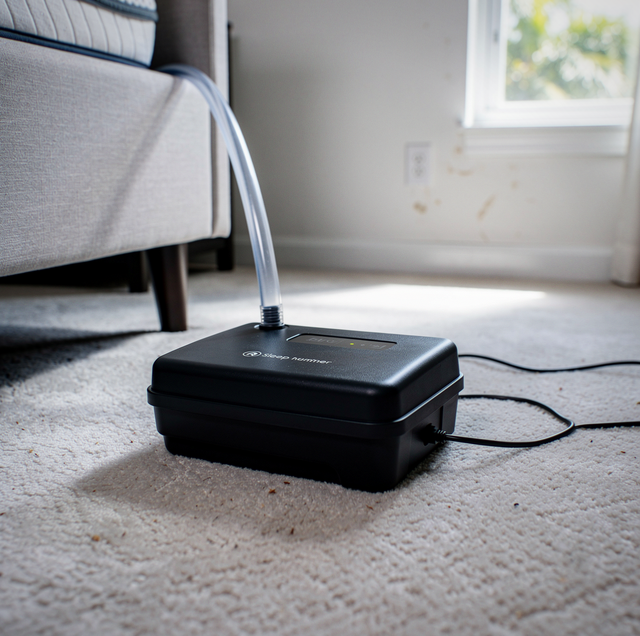
You strip the sheets off to get the bed ready for pickup and find a hose. It comes out of the side of the mattress near the head, drops down behind the frame, and runs into a plastic box on the floor, with a power cord running to the wall. Whatever else is going on here, this isn't a mattress in the way the word usually gets used. A smart bed built around air chambers, or an ordinary mattress sitting on a powered adjustable base, is an assembly of machinery with soft goods laid over it. The machinery determines how the bed comes out of the room.
An Air Chamber Sits Where the Support Core Would Be
A conventional mattress holds you up with steel coils or a slab of dense foam. An air bed removes that layer and replaces it with one or two sealed air chambers. Sleep Number is the name most people know for the category, though the layout is usually the same across air-chamber beds: a heavy reinforced chamber, seated inside a foam rail or border that gives the mattress its rectangular shape and its edges, with ordinary comfort foam and a quilted panel stacked above it.
From three feet away, it reads as a normal mattress. Same size, same ticking, same profile against the frame.
What's different is where the support comes from. A coil unit pushes back at thousands of individual points, and a foam core pushes back with the stiffness of the material itself. An air chamber pushes back with pressure spread across one large flat surface, and the firmness you feel is the amount of air in it rather than any property of what the chamber is made from. That's why an air bed's firmness is a setting instead of a specification. It's also why the chamber holds the mattress's shape only while it's holding air.
Each chamber has a port on one side, and a hose runs from that port through the mattress's side panel. That hose is the reliable tell. No coil or foam mattress has one coming out of it.
The Pump and Firmness Control Are Their Own Machine
The box on the floor is the pump, sometimes called the firmness control unit, and it's a small appliance in its own right. Inside sits an electric air pump, a set of valves, and a control board that reads what the remote or the phone app requests and moves air until the chamber matches it. On the outside are one hose port per chamber and a power cord.
It isn't built into the mattress. It sits on the floor under the foot of the bed, on a shelf in the headboard, or tucked against a wall behind the frame, tethered to the mattress by hoses and to the room by a plug.
That makes the pump a separate object with its own weight and its own place in a load, counted on its own rather than folded into a mattress. It's also the piece people forget. It lives under the bed; it's quiet, and once the mattress is off the frame, the hoses come with it, while the box stays on the carpet.
The Cabling, the Power Supply Box and the Hand Control
A powered base's wall cord runs into a power supply box, usually a sealed black case strapped to the frame rails, which steps household power down to the low voltage the motors run on. From that box, a bundle of low-voltage cable fans out, clipped or zip-tied along the underside of the steel, carrying a lead to each motor and another to whatever the sleeper holds in their hand. None of it hangs free. Each run is fastened to the steel it feeds.
The hand control is either wired or wireless. A wired one plugs into a jack on the base and hangs off the side of the bed on a coiled cord. A wireless one talks to a small receiver mounted on the frame, so the remote itself isn't attached to anything: it's a loose object living in a nightstand drawer.
The whole electrical side of these beds is cord-and-plug. Nothing on a smart bed or a powered base is wired into the building, which keeps each of these components within the category of furniture rather than fixtures.
Count the hand controls and the power cords before pickup day, not on it. Two of either means you've got two complete bases under one bedspread, not one wide one.
A Powered Base Is a Steel Machine under the Mattress
Under the mattress, a powered base is a welded and bolted steel frame carrying three or four deck sections: a head section, a fixed center, and a foot section that's one piece on some bases and split into a thigh and a foot section on others, joined to each other on hinge lines. The deck itself is usually a perforated steel panel or a slatted surface fixed to the frame.
Each moving section is driven by a linear actuator, an electric motor that turns a threaded screw inside a tube, causing the tube to extend in a slow, straight push and lift the section it's pinned to. The actuators anchor at both ends into brackets welded or bolted to the frame; legs thread into sockets at the corners, and at the foot of the bed sits a retention bracket, a low steel bar that stops the mattress from creeping off the deck every time the head section rises and the surface tips forward.
None of that is soft goods.
The hinge lines are also what the top mattress has to live with. A powered base doesn't raise the sleeping surface as one plane. It breaks that surface into sections and rotates them against each other, so the mattress has to bend along each hinge line every time the head or the foot goes up, and it has to come back flat when the deck does.
That bend is a load a rigid foundation cannot take at all, and one an interconnected coil grid resists, which is why the mattresses paired with these bases are usually all-foam, latex, or pocketed coils in a flexible casing. The relationship runs the other way as well. A mattress too stiff to follow the deck lifts away from the sections rather than with them, and the retention bar at the foot is there because the whole surface tips forward on every cycle of the head section. Base and mattress were picked as a mechanical pair, not as two objects that happen to measure the same.
A powered base's deck sections close on real pinch points at every hinge, and a base still connected to power can move under its own motor. Keep hands, fingers, and pets clear of those gaps.
A Powered Base Has Nothing in Common with a Box Spring
Set a powered base next to a box spring, and the difference becomes obvious. A foundation is a wooden frame in a fabric cover, with nothing moving inside it, and it travels as a single inert panel. A powered base is equipment consisting of a steel frame, a hinged deck, two or more motors, a power supply box, a bundle of low-voltage cable, threaded legs, a retainer bar, and a remote, which may or may not be in the room.
So it travels as its own object, not as a layer of the bed. A base and a mattress share a spot in the room and almost nothing else: not the material, not the rigidity, not how either one behaves when it's tilted.
Many bases do come apart, at least partway. Legs thread out of their sockets, and many models are built to fold at a center hinge because that's how they shipped in the first place. That's crew work on the day rather than something to sort out the night before.
A Split King Doubles Most of the Count
Split king is where the arithmetic surprises people. A split king is two twin XL halves sitting side by side under one set of bedding, and on a powered setup those halves are two complete, independent bases. Two steel frames. Two sets of actuators. Two power supply boxes, two power cords, and in most cases two hand controls, even when one remote has been paired to run both sides in sync.
Bridging brackets or connector hardware often tie the two frames together so they don't drift apart in use, which makes the pair read as one wide bed from across the room. Pull the bedding back, and the seam down the middle is right there.
On the mattress side, a split king air bed can go either way. Some are single-mattress shells with two chambers inside, one per sleeper, both fed by the same pump. The others are two separate twin XL mattresses, each with its own chamber, sharing a pump. Either version still has hoses running to a box on the floor, so the number of mattresses and the number of pumps aren't the same question.
The Hinge Lines Are No Help on the Way Out
The hinges on a powered base are not a way to make it smaller. The deck folds on one axis, across the bed rather than along it, and each section moves only when the motor pinned to it drives it. Hands can't work those joints on a stairwell landing. The base reaches a stair turn in the shape the motors left it, and it holds that shape for the rest of the way to the truck.
The measured rectangle isn't the whole object, either. The retention bar stands proud at the foot, the legs thread down below the frame at the corners, and the power supply box rides on a rail somewhere along the side, so the widest and deepest points of a powered base sit outside the deck panel a tape lands on. Those outlying points meet a door casing first.
Weight sits differently from a mattress as well. A mattress carries its bulk in foam and fabric, which is why it's big and light for its size. A powered base carries its weight in the steel frame, the motors, and the power supply box, dense components spread low across the deck rather than volume that weighs almost nothing. A queen mattress on a stair route is more awkward than it is heavy. The same size in a powered base runs the other way around.
The two pieces also clear a route independently of each other. Getting the mattress down the stairs first tells you nothing about whether the base follows, so access is measured against the base and against the bar, the legs, and the box hanging off it.
Frequently Asked Questions
Usually yes. Air-chamber mattresses are commonly built with a zippered cover so the comfort layers and the chamber underneath can be reached, unlike a conventional mattress, where the ticking is sewn into a sealed shell. The cover coming off doesn't make it a separate piece, though. It's part of the mattress and travels with it.
No, and this trips people up. "Smart bed" covers anything with electronics attached, including ordinary foam or hybrid mattresses with a thin sensor layer inside, sleep-tracking pads that sit under the sheet, and beds where the only powered part is the base underneath. If there's no hose and no pump box, there's no air chamber, whatever the bed is marketed as.
It's a small battery holder clipped to the frame that gives the motors enough power to bring the deck back down flat when the house loses power. Without it, a base caught mid-recline during an outage stays where it stopped. It's a separate little component with its own wiring lead, so it's worth knowing it exists.
Usually not. A firmness control unit built for a split king typically has two hose ports and two air circuits in a single box, so a pair of twin XL air mattresses can run to a single pump on the floor. Count hoses at the box rather than mattresses on the bed. What comes in twos on a split king is the bases underneath, not the pump.
Not at all. An air-chamber mattress can sit on a modular foundation, a platform frame, or a slatted base with nothing electrical about it, and plenty of them do. In that case you've got a mattress with hoses and a pump, and nothing motorized anywhere in the setup.
Yes. Most wall-hugging bases add a sliding carriage on a track, so the whole deck translates backward as the head lifts, keeping the sleeper's nightstand within reach rather than pulling away from it. That's an extra moving assembly beneath the deck, on top of the actuators already there.
Name the pump and the powered base when you book — a smart bed is made up of several separate machines, not one mattress. Polk Services LLC serves Lakeland, Highland City, and Mulberry. Call (863) 344-5806.
