

RV, Boat & Trailer Pads That Don't Sink: Base Depth Matters
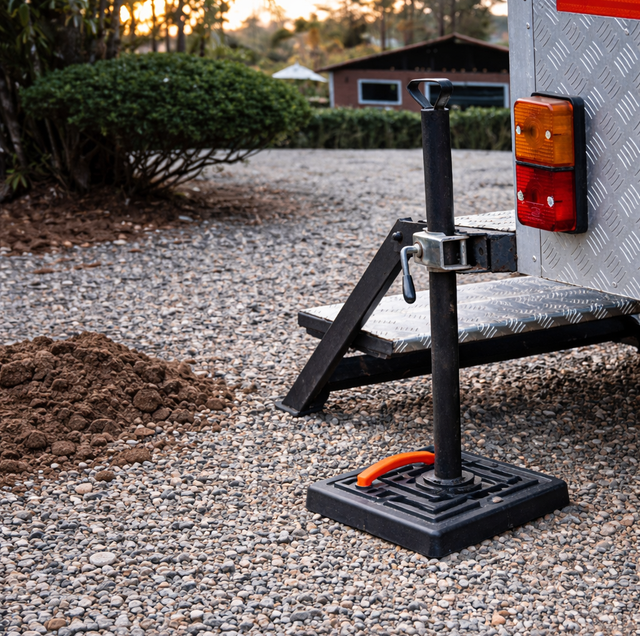
A car rolls across a driveway. Its weight moves down the wheel path and never sits in one square foot for more than a few seconds. A parked RV, boat trailer, or utility trailer does the opposite: once it's leveled and chocked, its weight settles onto a handful of fixed points and stays there for weeks or months at a time. A driveway built to handle rolling traffic and a pad built to handle that kind of stationary load are not the same project, even though they look like the same pile of stone from the street. Build a trailer or RV pad the way you'd build a car driveway, and the base underneath the tongue jack or the leveling pads is usually the first thing to fail.
Why A Parking Pad Isn't A Driveway
The difference comes down to how weight is distributed. A moving vehicle's tires roll across a wide path, so no single point in the ground ever holds the full weight of the vehicle for long. A parked RV or trailer does the opposite. Its full weight rides on the tires, a tongue jack foot, and often one or more stabilizer or leveling legs, and none of those points move once the vehicle is set. That's the same physics behind why a stiletto heel sinks into soft turf while a flat boot barely leaves a mark: the same body weight concentrated into a much smaller footprint pushes far harder into whatever it's standing on.
A tongue jack foot or a stabilizer pad covers only a few square inches of ground, so even a lightly loaded trailer can put more pressure into that one small point than a loaded car tire puts into its whole contact patch. Ground and base material that would comfortably support a rolling driveway can still settle, dish, or be squeezed out from under a stationary jack foot within a season if the underlying base isn't built to resist a fixed, concentrated load.
Base Depth: Why A Stationary Pad Needs More Underneath It
Because a driveway spreads load across a rolling path and a pad concentrates it at a few fixed points, the compacted base under a trailer or RV pad needs to run deeper than what's typically fine under a car driveway. A shallow base can hold up under moving traffic that never dwells in one spot, but the same shallow base under a stationary jack foot has nothing left to resist once that one point starts pushing down day after day.
Depth alone isn't the whole story, though. What matters as much as how deep the base goes is what's underneath it. Soft, loose, or sandy native soil compresses more easily than firmer ground, so a pad set over unprepared soil needs a thicker, well-compacted base layer to spread the point load before it ever reaches the soft soil below. Skipping that groundwork and just laying stone over untouched native soil is the single most common reason a pad looks fine on install day and shows a sunken ring under the jack foot within a few months.
Excavate before you build up: Stripping the topsoil and any loose organic material first gives the compacted base something solid to bond to, rather than compacting stone on top of material that will still settle on its own.
Build the base in layers: A thick base dumped and compacted only from the top leaves the bottom loose no matter how many passes a compactor makes over it. Building it up in thinner layers, each one compacted before the next goes down, gets the whole depth of the base actually knitted together instead of just the surface.
A separation layer keeps the base from disappearing into the soil: On soft or sandy ground, a woven fabric barrier laid between the native soil and the compacted base stops the two from mixing together over time. Without it, the base material can gradually work its way down into loose native soil under repeated point loading, quietly thinning the base from below even when the surface still looks fine.
Angular Stone vs. Pea Gravel: Why Shape Decides What Locks In Place
Once the base is in, the surfacing layer on top matters just as much, and here the shape of the stone is the whole story. Angular crushed stone, crushed concrete, and limerock or limestone screenings all have jagged, irregular edges that wedge and lock together under pressure. Push down on a bed of angular stone, and the individual pieces bite into their neighbors rather than roll out of the way. That interlock is exactly what a stationary point load needs, because the stone under a tongue jack foot has to resist being squeezed sideways, not just support weight straight down.
Pea gravel and river rock behave the other way. Those stones are rounded and smooth, so instead of locking together, they roll against each other under pressure, the same way marbles shift underfoot instead of staying put. That's a real limitation under a driveway, where moving tires already push gravel around, but it's a bigger problem under a stationary point load, since a jack foot or stabilizer leg sitting on rounded stone has nothing to grip and will keep working its way down and out to the sides as the rounded pieces migrate away from that one spot. Pea gravel and river rock can still work as a decorative top layer or in areas that never carry a fixed heavy point, but they're a weak choice directly under tires, jack feet, or leveling pads on a pad meant to hold a parked RV, boat, or trailer.
Crushed asphalt millings sit in between the two. The residual binder still clinging to the stone softens under heat and traffic and re-hardens as it cools, so a properly compacted millings surface knits into something closer to a bound mat than loose rock, and that bond helps resist the same kind of point loading that pea gravel can't. Millings still benefit from a leveling block or a wide scrap board set under the tongue jack foot during the first season, while the surface is knitting together.
Edge Containment: Where a Concentrated Load Escapes
A base built deep enough and topped with the right stone can still fail at the edges if there's nowhere for the load to push against. Under normal foot or vehicle traffic, the stone near the middle of a pad has material on all sides, holding it in place. Stone near an unrestrained edge has support on only one side, so it's already the weakest point in the pad before a single trailer ever parks on it. Put a tongue jack foot or a leveling leg anywhere close to that edge, and the stone underneath has an easy path to spread outward instead of staying compacted, which is how a pad can start crumbling or slumping at its perimeter well before the middle ever shows a problem.
Two things address this. First, size the pad wider than the vehicle's footprint so that tires, the tongue jack, and any stabilizer legs land well inside the compacted area instead of near a raw edge. A pad cut exactly to the outline of the RV or trailer all but guarantees that at least one contact point ends up sitting near an unsupported perimeter. Second, compact the perimeter of the pad at least as thoroughly as the middle, since an edge rushed during grading will always be the first place where stone works loose, regardless of how well the interior was built.
Give the pad extra width, not a tight fit: Build it a few feet wider on every side than the vehicle's actual footprint so no contact point ends up parked at the edge.
Compact the perimeter, not just the center: An edge that was skipped or lightly rolled during grading stays the weak point in the pad no matter how solid the middle turns out.
Signs A Pad Was Built Too Thin
A few patterns show up consistently on pads that were built without enough base depth, the wrong stone shape, or no edge margin. A shallow dip or ring forming right where the tongue jack or a stabilizer leg sits, while the rest of the pad stays flat, points to a base that wasn't thick enough to resist that one concentrated point. Stone that keeps migrating toward the perimeter and leaving a bare or thin patch under the tires points to rounded, non-locking stone or a base that's shifting underneath it. And cracking, slumping, or a visible step-down right at the edge of the pad, especially after the vehicle has sat in the same spot for a while, points back to an edge that never got compacted or a pad that was cut too close to the vehicle's actual footprint.
Building A Pad That Holds Up Long-Term
The fixes here aren't exotic: excavate down to firm ground, build the base up in compacted layers rather than one dumped pile, choose angular stone that locks together instead of pea gravel that rolls, and give the pad enough width and edge compaction that a fixed point load never lands near an unsupported perimeter. A pad built that way spreads a stationary RV, boat, or trailer's weight the way it needs to be spread, instead of concentrating it into the handful of points that a driveway-grade base was never asked to hold.
Frequently Asked Questions
There's no single universal number, since it depends on the native soil and the vehicle's weight, but as a working range, a stationary pad's compacted base often runs around 8 inches, noticeably thicker than the 4 to 6 inches that's typical under a standard car driveway. Soft or sandy native soil pushes that depth up further, since a thin base over compressible ground gives a jack foot's point load nowhere to spread before it reaches soil that will still settle.
Yes. Crushed concrete has the same jagged, interlocking shape as angular crushed stone, so it resists the same sideways spreading under a point load. Leftover unhydrated cement fines in the material can even let it firm up slightly on its own over time as they react with moisture. It's a solid substitute where crushed stone isn't readily available.
As a working guide, plan for the compacted area to extend a few feet past the outer edges of the tires on every side, and farther past wherever the tongue jack or any stabilizer legs land when the vehicle is fully set up and leveled. A fifth-wheel or gooseneck trailer needs extra margin at the front where the hitch overhang extends past the axle, and an RV with slide-outs needs the same consideration on whichever side the slides deploy, since that weight lands outside the tire footprint entirely. A pad cut tight to the vehicle's footprint places at least one contact point near an unsupported edge, the spot most likely to crumble first.
A driveway crown is built to shed water from a wide, continuously trafficked surface, but a stationary pad does better with a gentle slope in one direction rather than a full crown, since a crown would leave the vehicle sitting at an angle. The goal is to keep water moving off the pad rather than pooling under the tires, or the jack foot, where standing water softens the base fastest.
They need it even more in some cases, since stabilizer legs often have a smaller contact area than a tongue jack foot and carry weight that shifts as the RV settles or as people move around inside. A molded plastic jack pad spreads load evenly and won't rot or split the way a scrap board eventually will, but it only helps if it's sized bigger than the foot or leg sitting on it; a pad barely larger than the leg itself just relocates the same concentrated point a few inches over instead of actually spreading it out.
Check the pad after the first heavy rain following installation and again after the vehicle has been moved and re-parked a few times, since both moments tend to reveal a sunken jack spot or a thin patch under the tires that isn't obvious while the vehicle sits still. Catching that early means a top-dressing and re-compaction job instead of having to pull up and rebuild the whole pad later.
Ready for an RV, boat, or trailer pad that actually holds? — Get a properly graded pad built with the right base depth and interlocking stone. Polk Services LLC serves Lakeland, Highland City, and Mulberry. Call (863) 344-5806.
