

How Edge Loss Accelerates the Rest of a Gravel Driveway's Decline
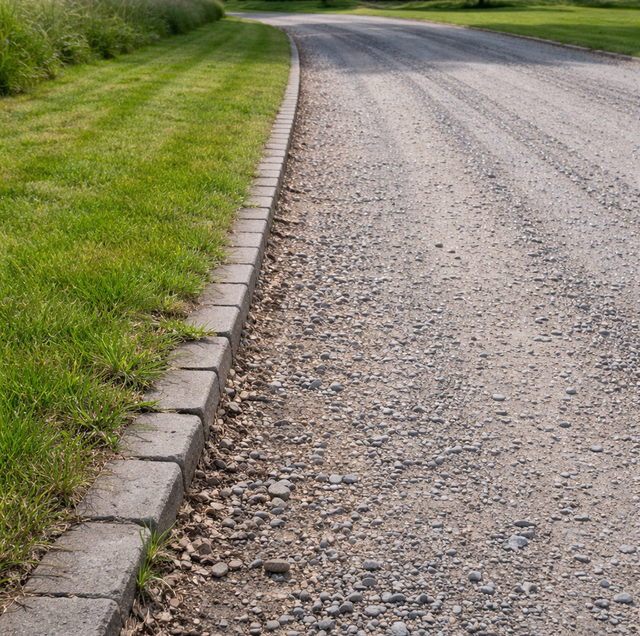
A gravel driveway rarely fails all at once. It loses ground an inch or two at a time along the edges, and by the time that narrowing is obvious enough for you to notice from the street, the center of your driveway is often already showing wear that seems to have nothing to do with the edges at all. It isn't unrelated. Measuring a lost edge and rebuilding it is its own job, and choosing an edging material at install time is a separate decision made even earlier in a driveway's life. What gets skipped over between those two is what the narrowing itself does to everything in between as it happens.
Losing a foot or two of combined width changes how vehicles move across the surface that's left, and that change doesn't stay contained to the strip that went missing.
How Edge Loss Narrows the Usable Path
A driveway's working width isn't quite the same as its measured width. Most drivers, without thinking, leave a buffer between the tires and the outer edge, wide enough to avoid a soft shoulder, an overhanging shrub, or gravel that thins toward the grass line. That buffer eats into the usable path before any traffic even starts. As the edge itself recedes into the lawn, that buffer has to shrink too, or the tires start riding on ground that isn't really driveway anymore. Either way, the strip of surface a vehicle can comfortably use gets smaller than the raw width loss alone would suggest.
Less Room to Vary the Line
On a driveway that still holds its full width, drivers don't track the exact same line every time. Two vehicles in the same household take slightly different paths. One driver favors the left side to avoid a low spot, another swings a little wider on the way in than on the way out. That variation matters more than it looks like it should, because it spreads tire contact across a broad band of the surface instead of concentrating it on one narrow track.
Full-width travel path: Tire contact spreads across a wide band of the surface as different drivers, different vehicles, and different days of small course corrections all land in slightly different spots.
Narrowed travel path: WIth less margin on either side, drivers instinctively pull toward the middle to keep tires off the soft, uneven ground near the edge, and that instinct collapses most of the variation into a much tighter band.
The second pattern doesn't require anyone to consciously decide to drive down the center. It happens on its own, as the safer margin of error shrinks.
Why Concentrated Center Traffic Wears Faster
A narrower travel band carries the same total vehicle weight as before, but with less surface area. That means more passes rolling over the same few feet of stone and base, instead of that load being spread across a wider swath. Stone in that band works looser, sooner, and the base underneath compacts unevenly under repeated, tightly grouped pressure rather than settling evenly as it does under distributed traffic.
Once a shallow depression starts to form down that center band, the pattern feeds itself. Drivers who might have varied their line before now have an added reason to stay centered: avoiding the rut itself. What began as a slightly narrower comfortable path turns into a defined track that gets reinforced every time someone pulls in.
A Worn Center Flattens the Crown
A driveway's crown, or cross-slope on a flatter lot, works by being the high point that water rolls away from toward both edges. That shape depends on the center sitting measurably higher than the shoulders. Repeated, concentrated compression from a narrowed travel band presses down on exactly that high point, the same ground that's supposed to be shedding water outward, more often and more heavily than the rest of the surface gets pressed.
The elevation difference between the center and the shoulders shrinks with every pass that presses down on it. Rather than one event, the crown gets pressed flatter a fraction at a time, in the same spot, by the same concentrated traffic that the narrowed edges pushed there in the first place.
Poor Drainage Picks Up Where Shape Left Off
A flattened crown sheds water more poorly, and water that used to run off the surface instead sits on it, keeping that same low line wet longer after every rain rather than draining past it. That extra saturation compacts the ground further under the next pass of traffic, deepening the low spot and making it hold water even longer the next time. This is the same shape-loss pattern that shows up as a rut running the length of a driveway, and it's worth treating as a signal rather than something to just top off with loose stone: dumping fresh material onto a spot that still can't shed the water landing on it tends to wash or rut back out within a season.
Where This Leaves an Already Narrow Edge
The chain doesn't stop at the center. A driveway with a flattened crown sheds water less cleanly to the sides, and whatever runoff does reach the margins arrives with less momentum and more time standing near the edge rather than moving through quickly. That softens the same edge zone that was already narrowing, which can widen the erosion problem the driveway started with. Edge loss narrows the path, the narrowed path concentrates traffic, concentrated traffic flattens the crown, and a flatter crown drains worse at the same edges that were already losing ground. Each step is small enough on its own to look like ordinary wear, which is part of why the pattern tends to run for a year or more before anyone connects the shrinking edge to the rutted middle.
Catching the Chain Early
The clearest early sign isn't at the edge at all. It's a single, tightly defined track down the center of your driveway where wear used to be spread wider, especially if it's developed after the edges visibly narrowed rather than before. If you're catching this pattern early, your driveway generally needs two separate but connected fixes: the lost width restored at the edge, and the surface regraded so it sheds water off both edges again across its whole width rather than getting patched only where the rut sits. Exactly how those two fixes get sequenced and locked in place is its own question, worth working through with whoever restores the edge.
Frequently Asked Questions
Curves see it faster. Turning a vehicle already narrows the practical travel line more than driving straight does, since a driver has to track a tighter arc through the bend, so a curved section with lost edge width tends to develop a defined center track sooner than a straight run losing the same amount of width.
It varies with the driveway's starting width, but a single-vehicle driveway that started around 10 to 12 feet wide and has lost roughly 2 feet of combined edge width on both sides is where drivers stop having any real margin to vary their line. A wider double driveway can absorb more loss before the same forced-centering pattern sets in.
Yes, up to a point, and a mid-run parking pad or turnaround changes the picture rather than simply adding margin. A pad interrupts the concentration pattern by giving drivers a place to pull off-line partway down the driveway, spreading travel-lane wear across two shorter, less-concentrated stretches rather than one long one. The pad itself doesn't get that benefit: the pivoting and backing-and-filling traffic it takes wears a pad faster than either straight stretch beside it, so a driveway with a pad often shows its earliest wear right there instead of down the center.
It can. A work truck, trailer, or any vehicle used far more often than the others sharing the driveway will naturally wear its own track over time even on a driveway that hasn't lost any edge width, since one dominant user reduces the natural variation in travel line the same way a narrowed edge does. Where both factors are present, the wear tends to show up faster than either one alone would cause.
Not in the same spot. A loop driveway pitches from the inner edge near the island outward rather than crowning at a centerline, so the equivalent concentration effect on a loop shows up as extra wear and drainage strain along the inner edge rather than down a center band, since that inner edge is the effective high point doing the equivalent job.
Look at how sharply the tire tracks are defined. Ordinary wear on a driveway with plenty of margin tends to spread across several feet, without a hard boundary between worn and unworn stone. Concentration wear shows up as two tight, closely spaced bands with a noticeably crisper edge, and it's a stronger signal if those bands line up with the driveway's visibly narrowed edge rather than appearing at a random point along the run.
Get your driveway's edge width and crown checked together — we'll trace whether narrowed edges are concentrating traffic and flattening your crown, then map out the fix before it spreads further. Polk Services LLC serves Lakeland, Highland City, and Mulberry. Call (863) 344-5806.
