

Pool Utility Disconnection: What Happens to Every Line
Quick Answer: The water and gas lines are capped and the pool's circuits de-energized by the licensed trade before a machine arrives. The buried pipe and conduit left behind afterward are the demolition crew's problem.
The disconnects set the start date. A pool cannot be broken up while anything feeding it is still live, so the day a machine goes in the yard is usually decided by how soon a licensed trade and the utility can get out to the property, not by how soon a crew has an open week.
Most in-ground pools are served by three things: a water line, at least one electrical circuit, and, less often, a gas line to a heater. Each of those is shut down and capped by someone licensed to do that work. What remains afterward is pipe and conduit sitting in the ground with nothing running through it, and that is a different problem with a different owner.
The Water Line Feeding the Pool
Most in-ground pools have a supply line running to them off the house plumbing. In most yards, it feeds an autofill device set into the skimmer throat or a small valve assembly near the deck, and it tops the pool off quietly enough that many owners have never thought about it once.
Somewhere on that line there is a shut-off. It might be in a valve box under a shrub, on a garage wall behind stored gear, or grouped in with the irrigation valves. People forget it exists because nobody has turned it in years. Finding it is usually the homeowner's first job, and the plumbing trade's if it does not turn up. The same hunt comes up on the sprinkler side in what to move before a pool demolition crew arrives.
The line is shut off and capped by the plumbing trade. Once it is dead, the portion running under the deck becomes ordinary abandoned pipe and is handled with everything else below ground.
The Power at the Equipment Pad
Electrically, a pool is simple to describe and unforgiving to guess at. A circuit runs from the house out to the equipment pad to drive the pump. If the pool has lighting, there is generally a second one, with a junction box sitting somewhere between the pool wall and the pad. Some installations have a small subpanel at the pad instead of individual circuits. That is the honest extent of what can be said from the outside. The actual arrangement in any given yard is to be established by the licensed electrician.
A pool can carry more than one circuit, and a breaker marked for the pump does not always cover the light or a heater. The electrician doing the work is the one who sorts that out before anyone touches concrete.
The pool light is the piece most owners have never pictured. The fixture sits in a niche formed into the pool wall below the water line, and its cord runs back out of that niche through a conduit to the junction box. The fixture itself pulls out of the niche on a slack loop of cord, which is how a lamp gets changed without draining the pool. Nobody bothers with a demolition, because the niche is a formed part of the wall and the wall is coming down. Once the circuit is dead, the fixture, cord, and niche are removed together as part of that wall section.
All of this happens before the crew arrives. The circuits are de-energized by the licensed electrician, the pad is dead, and what a demolition crew inherits is concrete, pipe, and empty conduit.
The Gas Line, When There Is One
Only some pools have gas. It feeds a heater on the pad, arriving either as a branch off the house's natural gas service or as a run from a tank on the property. A pool with no heater or an electric heat pump has nothing here at all.
Where a gas line does exist, it is disconnected and capped on the utility side or by the licensed gas trade. This is the service with no gray area at the edge of the demolition scope: a crew does not cut it, cap it, or work around it while it is connected. If a line turns up in the ground that was on nobody's list, digging in that area stops until the right trade has been out to look at it.
Whatever the trade leaves behind, capped and inert, stays where they left it, and the crew treats it as one more thing in the yard that is not part of the pool.
The Buried Runs Nobody Calls a Utility
Out under the deck and into the yard is a second network that no utility owns, and no trade is coming to cap it. Suction lines from the skimmer, return lines back to the wall fittings, a dedicated line to a cleaner port if the pool had one, and the conduit that carried the light cord all leave the shell and head toward the pad. They are dead pipe the moment the pool stops circulating. They are also the crew's responsibility, and they get the least thought of anything in a pool removal.
Two things happen to them.
Accessible runs come out: where a line sits under a deck being removed, it is pulled up with the deck and the fill around it. Excavating for the deck exposes most of the short runs anyway, and they are left on site as debris.
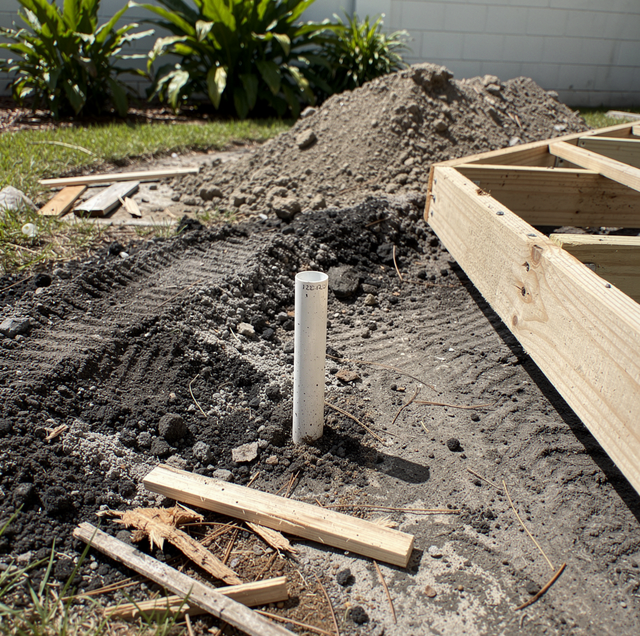
Runs heading out beyond the dig are stopped at the edge of it: a length carrying on under a patio, a walkway, or a section of lawn that is staying gets cut at the excavation line, capped or plugged there, and the reachable portion crushed or filled so it cannot hold an open space. What continues past that point is noted and left, because chasing it means opening ground that had no other reason to be opened. Ends are left showing wherever that is possible. The look of a cut conduit end standing above fresh fill is not an oversight; it is a marker for whoever opens that ground next.
The reason for crushing and filling is mechanical instead of tidy. An empty length of pipe under fill is a void, and a void beneath compacted material is a collapse that has not happened yet. Water finds abandoned pipe, soil migrates into it, and the surface above settles into a line or a dip long after the yard has been sodded and forgotten. Compaction over a hollow pipe compacts around the hollow. That link between abandoned pipe and later settlement is the entire reason this step is never skipped. The main drain line under the deep end is its own exception, and it belongs to what goes back into a pool cavity.
One detail catches almost everyone. The light's wiring does not stop at the junction box by the pool. From there, a further run heads back toward the panel, which can put buried conduit under a walkway, a driveway apron, planting beds, and most of the side yard. A homeowner picturing a neat loop of pipe around the pool is picturing a fraction of what is actually down there.
Where the Crew's Work Stops
Three categories of line get handed straight back instead of touched.
Anything still live: If a service has not been confirmed dead, it is not a demolition item that day.
Anything that turns out to be a service instead of a pool line: An irrigation main, a feed to a shed, a well line, a communications cable crossing the yard.
Anything running off toward the house: Past the point where pool plumbing ends, it belongs to the trade that installed it.
Marking underground utilities is a separate service arranged before machines dig, and a demolition crew does not perform it. How tangled the underground picture turns out to be is one of the things that stretches the scope, which determines the size of a pool demolition job from the scoping side.
Frequently Asked Questions
The disconnects, in the ordinary case. The pad is de-energized and capped before anyone starts moving water, and the water comes down with the crew's own pump, not the pool's circulation pump, which loses prime the moment the level drops below the skimmer throat. What if the pool's circuit also feeds something else in the yard?
Yes, the slab is concrete and concrete removal is part of the job. Conduit and pipe stubs rising through it are cut and their positions noted before it gets broken up, so the pad's runs are accounted for the same way the yard's are.
Age does not mean dead. On long-idle pools, the breaker was often just switched off and the fill valve closed, with the line behind it still pressurized and the wiring still connected at both ends. Old conduit is also commonly full of water and root growth by then, which changes how much of it can be pulled instead of crushed.
Where a run passes under ground that might carry a slab, a footing, or a driveway later, the cut ends are photographed against a fixed reference such as a house corner or a property pin. That record outlives anyone's memory of the job, and it pairs with the ground-condition questions in can you build over a filled-in pool.
Mostly the owner, since utilities and the licensed trades take the request from the account holder, not from a third party. The demolition contractor says which services must be dead and holds the schedule until confirmations come back. Lead times differ between an electrician's visit and a utility's, and the longer of the two determines the start date.
A pool is the endpoint of a small set of lines installed to serve it and nothing else. The services decide when the work starts, and the buried runs decide how the ground behaves for years afterward.
Planning a pool removal? Get a clear picture of the disconnects and what happens to the pipe and conduit in your yard. Polk Services LLC serves Lakeland, Highland City, and Mulberry. Call (863) 344-5806.
