

Removing a Spa Attached to the Pool: One Job or Two?
Quick Answer: An integrated spa built into the pool wall comes out with the pool because the two share a single structure. A separate spa can sometimes stay, but it loses the equipment that ran it. A portable tub is its own job.
The question underneath this one is a scope question: Is this one job or two? You want the pool gone; there is a spa sitting against it or beside it, and from the deck the two read as separate features. Separate water, separate temperature, its own jets, its own step down. Nothing visible from up there settles whether a demolition crew treats them as one piece of work or two.
That is because almost everything joining a pool and a spa is out of sight. It is in the shell below the waterline, in the pipe under the deck, and on the equipment pad off to the side. A spa can look attached and share nothing with the pool, or look like a separate feature and still run entirely on the pool's machinery. So the useful way through is to take what the two share one item at a time, because each shared item is its own reason the two jobs turn out to be a single job.
The Three Ways a Spa and a Pool Are Joined
Nearly every spa next to a pool falls into one of three arrangements, and the three do not get the same answer.
Built into the pool: The spa is part of the same shell, usually raised above the pool and spilling over into it through a formed opening. There is no second structure. The wall you are looking at belongs to both bodies of water.
Its own shell, shared equipment: The spa sits in the ground near the pool with a shell of its own, sometimes with a strip of deck between them, but it draws from and returns to the same pump and filter, with valves at the pad sending flow one way or the other.
A freestanding tub: A portable hot tub, a molded cabinet on a slab or on the deck, with its pump, heater, filter and control pack all inside the skirt. At most it meets the pool at the electrical panel, and on plenty of installs not even there, since a portable tub usually gets a dedicated circuit of its own.
Three arrangements, three different jobs. The first cannot be separated from the pool at all. The second can be, with consequences. The third was never really a pool job.
One Wall Doing Two Jobs
When a spa is built into the pool, the two share a structural wall, and that is not a loose way of putting it. In a gunite build, the steel is tied continuously through the wall, and the concrete is sprayed in one operation, so the spa's outer wall and the pool's inner wall are one piece of material, thickened where it carries the raised spa above pool level. The spillway is a formed opening through that same wall, which is why water crosses between the two without a pipe.
Follow that through, and the answer to whether the spa can stay writes itself. Removing the pool means breaking out its walls, and one of those walls is the spa's support and its inboard face. Once the poolside is opened, the spa has water and is weight-bearing on a wall, with nothing behind it. There is no version of this that a demolition can deliver. Separating the two leaves the pool's own wall open along the shared face, which is a pool builder's repair rather than the end of a removal, because the shared wall was never two walls to begin with.
The same logic carries into how the shell is handled. The floor is perforated so groundwater can move through it, and the integrated spa floor is part of the same shell, so it gets the same treatment. One shell, one cavity, one job.
Once the water is down, an integrated spa's coping is the top of a drop into an empty pool. The area remains off-limits to children and pets from that hour until the cavity is filled and graded.
One Pump, Two Bodies of Water
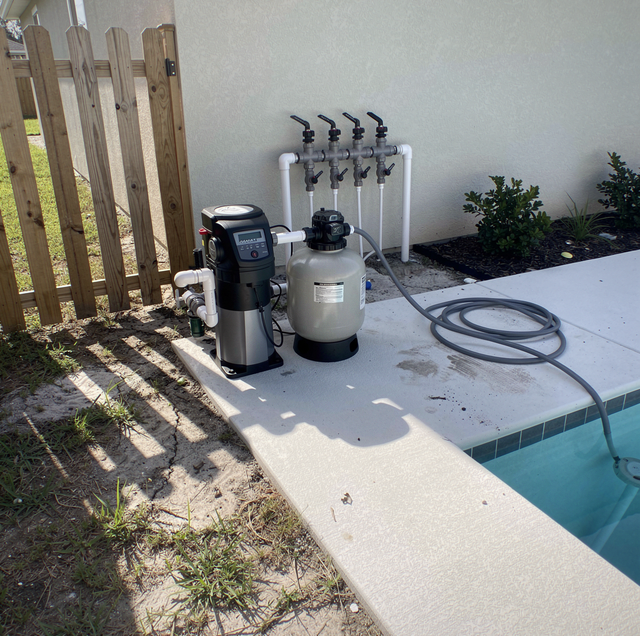
Walk to the pad, and you will usually find one pump and one filter serving both bodies of water, with a set of valves deciding where the flow goes. Handles one way, and the pump pulls from the pool and returns through its wall fittings. Handles the other way, and the same pump pulls from the spa and pushes hard through its jets. A spa also tends to carry two things a pool alone often does not: a heater sized to bring a small body of water up fast, where a pool heater is sized to hold a large one steady, and a blower that feeds air into the jet ring.
That single pad is why taking only the pool requires more than it sounds. If the pool goes and the spa stays, the spa keeps its shell and loses the machinery that ran it: the pump it drew from, the filter it returned through, and often the pipe that carried both. Bringing the spa back into service after that requires new plumbing and new electrical work by licensed trades, not something a demolition leaves running. The crew takes equipment out; it does not re-plumb or rewire a pad for whatever is staying. What becomes of the pump, filter, heater, and salt system once they are out of service is covered in pool pump, filter, heater, and salt system removal.
Photograph the pad with every valve handle in its normal running position, then label each pipe where it leaves the pad. That record is what tells another trade later which line fed the spa and which fed the pool.
What Runs in the Trench Between Them
Between the two shells and back to the pad, there is pipe, and on most builds it does not travel in tidy separate paths. Suction and return lines for both bodies of water leave the pad together, drop into a common trench, and run bundled along the same route before branching off where each fitting needs them. Spa jet lines, the spa's suction, the pool returns, and the pool's skimmer line can sit in one strapped run, sometimes stacked, with the blower's air line riding along.
The consequence is plain: you cannot separate the spa's plumbing from the pool's without opening the trench they share. If the pool is coming out and the spa is meant to stay live, someone has to expose that run, sort out which pipe serves what, and re-route what belongs to the spa, and that is plumbing work rather than demolition work. If both are going, the question disappears, because the lines are abandoned together and the ground is opened once. The order in which buried lines are shut down and abandoned is covered in the pool utility disconnection, conduit, and buried lines sections.
The Circuit, the Gas Line and the Grid
The pad is fed by its own electrical circuit, and where the heater burns gas, a gas line runs to it as well. Neither is the crew's to touch. A licensed electrician de-energizes and disconnects the electrical side, and a licensed gas fitter handles and caps the gas, both before the demolition crew arrives. That sequence is not a formality. It is the reason nobody is guessing about a live conductor or an open gas line with a machine working overhead.
The other thing the two share is metal. Shell steel, ladder and rail anchors, light niches and the equipment itself are commonly tied together with a bonding conductor into one grid, and a spa built alongside a pool usually lands on that same grid. If the pool goes and the spa stays, the spa is left tied into a grid missing most of its parts, which is one more item for the electrician rather than something the demolition sorts out.
The Freestanding Tub That Was Never a Pool Job
A freestanding hot tub is a different job in the plainest sense. The shell is molded acrylic with foam behind it, the frame and skirt hold it together, and the pump, heater, filter and control pack live in one bay inside the cabinet. Nothing about it is built into the pool. It shares no wall, no pipe, and no equipment. Take it away, and the pool is exactly as it was.
This is the one arrangement where taking just the tub is a real answer. Hot tub removal is a service on its own here, with no pool work attached to it. Once the electrician has disconnected it, the crew can lift the tub off its pad, break the cabinet down where access will not let it out whole, and haul the pieces off. A tub whose foam has taken on water over the years is much heavier than it looks, which makes it a lifting and access question rather than a demolition one.
It works in the other direction too. If a portable tub happens to sit on the deck near a pool that is coming out, that tub is a line item you can add or leave off without changing the pool scope. It is the only one of the three arrangements where that holds.
Frequently Asked Questions
Look at the joint. A spa with its own shell has an expansion joint and a run of deck material between it and the pool, and the coping stops and starts again. An integrated spa carries continuous coping and tile around the corner with no joint anywhere along the shared face. If the original build drawings survived, an integrated spa appears on the same shell section as the pool instead of as a second detail with its own dimensions.
For an integrated spa, no, for the reason already given: it becomes a pool builder's repair, and shell repair and resurfacing are not services here. For a separate shell, yes. It can be taken out and its cavity filled while the pool stays in service, though the pool loses whatever the spa's return line was contributing to circulation, and a plumber has to close the tee at the pad and rebalance the valves so the pool is not pulling against a dead leg.
That depends on whether the lower shell is broken out or left buried with its floor perforated, the same partial-versus-full call the pool itself gets. Either way, expect any small slab the spa's own equipment sat on, capped pipe stubs, and a conduit stub standing out of the ground for the electrician. Under a raised spa, whatever was built up to carry it stays until it is dug out, and it does not read as ordinary yard under a probe. The broken shell itself goes back into the cavity under the same rule as the pool's.
A retrofit spa is nearly always its own shell, and the tie-in was made at the pad rather than in the original trench. Some builders added a second pump for the spa instead of running everything through diverter valves. The added pipe often takes its own route and crosses the original lines rather than running with them, so the single bundled trench described above does not hold for every property.
If the frame and shell are sound, yes. Tubs travel on edge on furniture dollies, so the real limit is a path wide enough for the cabinet to stand upright and firm enough to roll on. A tub with a cracked frame, a split shell, or acrylic gone brittle from years of sun is a haul-away, because it tends to come apart under its own weight the moment it is tipped onto its side.
A licensed electrician, before anyone touches the tub. Portable tubs are wired one of two ways: hard-wired from a disconnect box mounted within sight of the tub, or plugged into a dedicated receptacle. Either way, the electrician de-energizes the circuit and makes the disconnection, and the box and its feed stay behind as the electrician's item rather than something that leaves with the cabinet.
The three arrangements do not just get three different scopes. They get three different sets of trades. An integrated spa is one demolition and nobody else. A separate shell kept alive is a demolition team plus a plumber and an electrician, working after the crew has gone, on a pad that has lost most of its parts. A portable tub is an electrician and then a lift, with the pool untouched either side of it. Identifying which of the three you have is the whole of the work here, and it is done by looking at the joint, the pad and the trench rather than at the water.
Get the spa question settled before the pool scope is written — one site visit covers the shared wall, the equipment pad and the trench between them, including hot tub removal in Lithia. Polk Services LLC serves Lakeland, Highland City, and Mulberry. Call (863) 344-5806.
