

Grading a Backyard vs. a Pasture: What Actually Changes
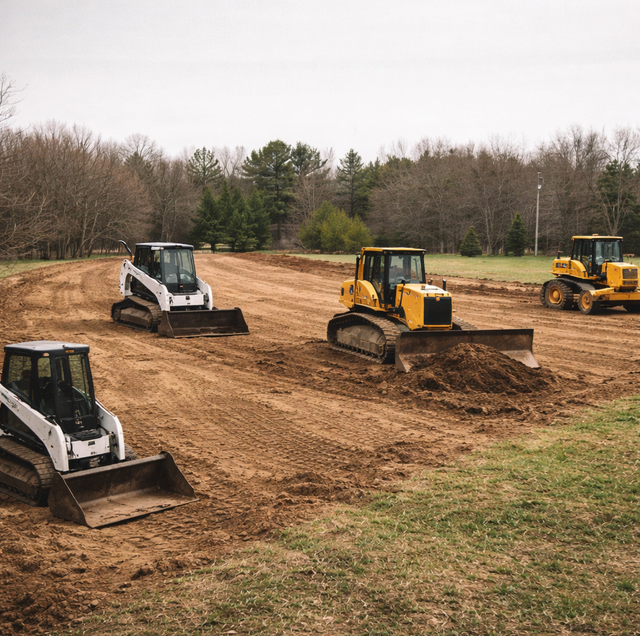
Quick Answer: A backyard and a pasture regrade both move dirt and shape a slope, but they scale differently. A backyard uses compact equipment to meet a tight elevation target since water has little room to travel. A pasture moves more dirt with looser tolerances.
A homeowner leveling a low patch behind a patio and a landowner regrading several acres of open field are technically asking for the same kind of work: read the existing slope, decide where the water needs to go, and move dirt until the ground matches that plan. Past that point, the resemblance mostly ends. Doubling the square footage of a project doesn't mean twice the work with the same machine; it can mean an entirely different class of equipment doing a different kind of job on the ground. Understanding what actually changes between a small lot and a larger tract helps explain why the two jobs look so different in practice, even though the underlying goal, ground that sheds water the way it's supposed to, is the same.
Equipment Size Doesn't Scale in a Straight Line
A typical backyard regrade gets worked with compact equipment: a mini skid steer or a compact track loader, sized to fit through a standard gate and maneuver between a fence line, a shed, a mature tree's root zone, and the house itself without clipping any of them. A bucket on that class of machine generally holds well under a cubic yard, and that's by design. A backyard job is defined as much by what the equipment has to work around as by how much dirt it moves.
Larger tracts often have buried utility, well, or septic lines far from any structure. Call 811 before any digging or deep grading, even out in open pasture, since buried lines don't announce themselves just because there's no building overhead.
A pasture or acreage-scale regrade calls for a different class of machine altogether: a full-size dozer, a motor grader for shaping the final contour, or a farm tractor pulling a box blade or land plane for lighter finish work. For a large cut-and-fill move across a long distance, a towed scraper (a pan that cuts, carries, and dumps a load in one pass) can move several cubic yards at a time instead of a fraction of one. None of that equipment is simply a bigger backyard machine; it's a different tool built to cover ground efficiently over hundreds of feet, not to thread between a pool cage and a fence post. Bringing dozer-class equipment onto a quarter-acre lot would be as impractical as trying to shape forty acres with a mini skid steer one bucket at a time.
Tight Tolerances Near the House, Looser Contours Across the Field
The reason a backyard needs tighter control isn't that the ground is somehow more delicate. It's that the water only has a short run before it reaches something that matters: a foundation wall, a patio slab, an AC pad, or a neighbor's fence line. A grade that's off by an inch or two right next to the house can be the difference between water shedding away cleanly and water sitting against the wall after every rain. That's why a backyard project is typically worked off frequent elevation checks with a laser level or a rotary level and grade rod, with the tightest tolerance held closest to structures.
Setting a picture frame level on a wall is a matter of a fraction of an inch, with a bubble that has to sit dead center before the frame looks right up close. That same small bubble illustrates how error scales with distance: a hair off at the tool reads as inches of drift over a short run, and would read as feet of drift if the same tool were stretched across a run of several hundred feet, which is why acreage-scale work is checked with elevation grids and equipment-mounted grade control rather than a hand level pulled taut over long distances. Across open acreage, that kind of drift usually doesn't matter for the finished surface, because the water has a much longer path and a much wider area to move through before it reaches anywhere it could cause a problem. What matters on a large tract is the overall direction of fall and ensuring no broad low pocket holds water, not whether any single point sits within half an inch of a target elevation.
A backyard regrade near structures commonly targets a slope of about 1 to 2 percent, roughly an inch of fall every 4 to 8 feet. Across open pasture, a workable fall can be a single foot of drop over several hundred feet.
Why the Total Volume of Earth Moved Grows Faster Than the Acreage
It seems like it should work the other way: a job with a looser tolerance sounds like it should be the easier one. In terms of total material, it's often the opposite. Volume is area multiplied by depth, so even a modest average cut or fill depth, spread across several acres instead of a few thousand square feet, adds up to a far larger number of cubic yards than the backyard job ever approaches. A pasture regrade that only changes the average elevation by a few inches across its whole footprint can still mean moving more raw material than a backyard project that's cut and filled by a foot or more in isolated spots.
Distance adds to that math on its own. On a backyard lot, cut material might travel twenty or thirty feet from a high spot to a low one. On acreage, a cut area and its matching fill area can sit a few hundred feet apart, and each trip takes real machine time, even when the tolerance for the finished surface is loose. That combination, more material and farther to move it, is the actual reason acreage-scale work calls for higher-capacity equipment even though the finished surface doesn't need to be nearly as precise as a backyard grade.
Drainage Planning Changes When Water Crosses More Than One Field
A backyard drainage plan has a defined endpoint: get the water off that one lot without sending it onto a neighbor's property or letting it pool against the house, usually by shaping a shallow swale toward a street, an easement, or a rear drainage path. The whole plan lies within a single property line.
A pasture-scale plan has to account for water moving across multiple fields, not just one lot. Regrading a section of high ground can change how much runoff reaches a downhill field, a culvert under a farm road or gate, a pond, or a natural drainage way that the whole property (and sometimes the property next to it) already depends on. Cross-fencing adds its own wrinkle: a fence line that seemed like a fixed boundary can act like an accidental dam if it sits across the new flow path, backing water up on one side instead of letting it continue where the regrade intended. Planning drainage at this scale means thinking about the whole basin the water moves through, not a single lot's edge.
Where Grazing Animals Change What Counts as a Hazard
On pasture that's actually grazed, the grading plan has to account for one more thing a backyard project never has to consider: the ground has to stay safe to walk on for animals, not just people. That mostly comes down to two things a grading plan can control directly. A slope reshaped too steep, especially anywhere it stays wet or gets churned up by regular foot traffic, becomes a place where a grazing animal can lose footing. And a low area reshaped so it holds water instead of shedding it doesn't just become an eyesore the way it might in a backyard; it can turn into a standing wallow that stays soft and muddy well after the rest of the field has dried out.
Neither of those is a judgment call about how to manage a herd, and a grading contractor isn't the one to make decisions about stocking density, rotation, or animal health. It's a matter of shaping the ground itself so it doesn't create an unstable slope or a trapped low spot in the first place, the same underlying job as any other regrade, just with a different set of consequences if it's done carelessly. Anything past that, how the pasture gets used once it's regraded, stays with whoever manages the animals.
Matching the Approach to the Actual Job
Sizing a project correctly starts with a site walk, but what that walk assesses varies by scale. On a backyard lot, the walk is mostly about counting fixed obstacles: which fence sections limit access, where the tree root zones are, how close the grading needs to come to the foundation, and where the tightest elevation control has to be held. On acreage, the walk is more about the overall shape of the land: where the natural high and low ground already sits, how many acres actually need reworking versus how many are fine as they are, and what the water does across the whole tract before and after the regrade.
That's also where mobilization becomes a consideration in its own right. A compact track loader can often show up on a trailer behind a pickup and start the same day. A dozer or a scraper is a bigger undertaking to bring on-site, and a property that includes both a yard needing tight-tolerance work and adjoining acreage needing broad contour work is often better scheduled as two distinct phases rather than one crew trying to do both jobs with one machine. Getting the equipment class, the tolerance target, and the drainage plan matched to the ground actually being worked, rather than assumed from the total acreage, is what keeps a project from running long or coming up short.
Frequently Asked Questions
Beyond bucket or blade capacity, the difference shows up in weight and transport. A mini skid steer runs roughly 2,000 to 3,500 pounds and can pass through a standard 36- to 48-inch gate, while a compact track loader is heavier, typically 7,000 to 10,000 pounds. A full-size dozer or scraper used on multi-acre work is even heavier, commonly 15 to 20 tons or more, and has to be brought in on a lowboy trailer, sometimes requiring a wide-load escort depending on the route and equipment width.
Not the same method. Instead of a handful of benchmark shots checked by hand with a laser level and grade rod, acreage-scale work is often planned off a wider elevation grid, and the earthmoving equipment itself may run a GPS-guided grading system that continuously tracks blade position against the planned surface, since walking a rod to every reading point across hundreds of feet isn't practical.
Usually not in a single mobilization. Trailering in a dozer or scraper is its own setup step, separate from a same-day compact skid-steer job, so a property with both a yard needing tight work and adjoining acreage needing broad regrading is commonly scheduled as two distinct phases of work rather than a single combined visit.
Fence sections within the work area typically have to come down before grading and be reset once the new grade is finished, since a fence set to an old ground profile can end up with gaps or low spots under the wire once the elevation changes. Gates get reset at the finished low point of the new grade, too, so they still swing clear over dry ground rather than dragging through a spot that collects water.
A compact backyard project is often completed within a day or two once the equipment is on site. A multi-acre regrade can run into multiple weeks once mobilization, the larger total volume of material, and multi-pass compaction across a much bigger footprint are all factored in, especially if part of the new grade has to route fall around an existing pond, treeline, or wooded section rather than straight through it.
Animals typically need to be kept out of the section being actively worked, both for their own safety around heavy equipment and because freshly graded, uncompacted ground doesn't hold up well to regular hoof traffic until it's had time to settle. The specific handling, rotation, or holding-pen plan for that period is best worked out with whoever manages the herd, not decided on-site by the grading crew.
A yard and a pasture are both graded ground in the end, but the resemblance is mostly in the vocabulary. The equipment, the tolerance, and the total volume of dirt all shift once the scale changes, and assuming a bigger lot is just a bigger version of the same small job is the assumption that gets a project over-equipped or badly undersized before the first bucket of dirt moves.
Get your yard or lot graded to its actual size — with the right equipment, tolerances, and drainage plan — before any dirt moves. Polk Services LLC serves Lakeland, Highland City, and Mulberry. Call (863) 344-5806.
