

Appliance Disconnection Rules: Who Breaks Which Connection
An appliance is ready to be hauled when nothing is still holding it to the house: no cord in a receptacle, no line running back to a valve, no duct clamped to a wall, no bracket screwed into a cabinet. That is the condition a truck gets scheduled against. Getting a unit into that condition is its own job, with its own rules about who is allowed to do it, and it happens before any removal work begins.
Disconnection and Removal Are Separate Jobs
A removal crew arrives at the moving company's closing table: nothing changes hands until the party ahead of them has signed off. The signing party, in this case, is whoever was qualified to break the connection that fed the appliance. Until that has happened, what sits in your laundry room or kitchen is not a heavy object waiting for a dolly. It is a live piece of equipment attached to a utility.
That distinction shapes the whole visit. A simple shut-off is within what your crew handles on-site. Past that point, anything that calls for a licensed trade gets referred out rather than attempted, because a hauler working on a gas fitting or a hardwired circuit is working outside their lane. Knowing which side of that line your unit falls on, before the truck is on the schedule, is the single most useful thing you can sort out in advance.
The Cord and the Outlet: Standard Electrical Connections
The connection: Most appliances draw power through a cord and a receptacle. A washer, a countertop unit, a standard refrigerator, an electric dryer, a freestanding range: all of them end in a plug of some kind, though a dryer or range typically uses a heavier receptacle on its own circuit rather than the one your lamp uses. A dishwasher, a wall oven, a cooktop, or a disposal is often wired directly into the house with no plug at all.
Who is allowed to break it: A cord coming out of a receptacle is the one connection almost anyone can undo, and it does not need a trade. A hardwired appliance is different. There is no plug to pull; the connection lives inside a junction box, and that is electrician territory from the first screw.
If it is still connected on pickup day: An accessible cord is a non-event. A hardwired unit that nobody has released is one that stays where it is, because the alternative is a removal crew opening up the house wiring, which is not something you want offered to you.
Water: Supply Lines, Drains, and the Valve That Shuts Off
The connection: A water-fed appliance has more attachments than most people count. A washing machine has hot and cold water supplies plus a drain hose. A dishwasher has a supply line and a drain run. A refrigerator with an ice maker has a small-diameter supply tucked behind the unit, thin enough and low enough that it is the single most overlooked line in any kitchen. Each of those supplies traces back to a shut-off valve somewhere upstream.
Who is allowed to break it: Closing a shut-off valve is a simple shut-off. Freeing supply and drain lines from the machine, and anything a valve does wrong once it moves, is plumbing work and is referred out.
If it is still connected on pickup day: Lines still on the machine mean the machine is still plumbed, and a unit dragged forward while plumbed will let you know immediately. The ice-maker line is the usual culprit, precisely because it hides.
A shut-off valve that has sat untouched for years can weep the moment it moves. Worth knowing before pickup day, because a valve that will not reseat becomes a plumbing call rather than a removal one.
Gas: The One Connection with No Gray Area
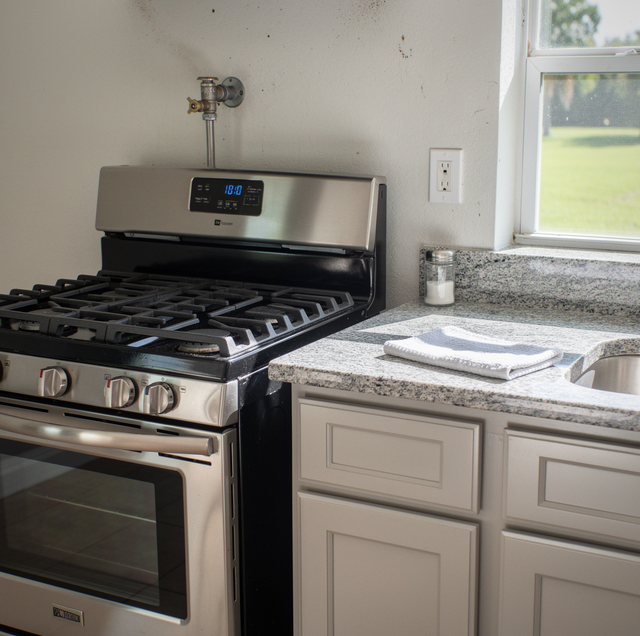
The connection: A gas appliance is joined to the house by a rigid or flexible connector running from a supply pipe to the back of the unit, with a shut-off in the line. Gas ranges, gas ovens, gas dryers, and gas water heaters all share this arrangement. A gas dryer is the one that surprises people because it has a gas connection, a power connection, and a vent duct all at once.
Who is allowed to break it: A qualified gas professional, and nobody else. This is licensed-trade work from beginning to end, including the requirement that a line taken off an appliance be capped by someone qualified to do so.
If it is still connected on pickup day: The unit does not move. There is no partial version of this, no careful workaround, no assessment made in the moment. A gas appliance that has not been released by a professional remains in the room until one has been.
A gas appliance is not a candidate for pickup until a qualified gas professional has released and capped the line. No removal crew belongs anywhere near that connection, and neither does an improvising homeowner.
Vents and Ducts: The Attachment That Gets Missed
The connection: A dryer moves air as well as electricity or gas. The duct behind it, whether flexible foil or rigid metal, must be free of the unit before pickup. A range hood has its own duct, and an over-the-range microwave either vents outward or recirculates through a filter, which determines what is attached to the back of it.
Who is allowed to break it: The duct must be clear of the machine before it moves. On an electric dryer, that is simple mechanical work. On a gas dryer, whoever releases the gas connection also releases the duct, since both attach to the back of the same unit.
If it is still connected on pickup day: The unit is not loose; whatever else has been released. A duct still clamped at both ends can tear its wall fitting when the machine comes forward under load, which turns a clean pickup into a drywall repair on top of it.
Units That Are Fastened as Well as Connected
The connection: Some appliances are held in place by hardware rather than by a utility. A dishwasher is usually secured to the underside of a countertop or to the cabinet sides. A wall oven sits in a cabinet opening and is screwed through its trim. An under-counter beverage or wine unit is set into a cutout and fixed to the surrounding cabinetry.
Who is allowed to break it: None of this is trade work, unlike gas or hardwired power. Fastening hardware counts as part of what must be undone before pickup, just like any other connection.
If it is still connected on pickup day: The unit does not come out. Whether that hardware comes out as part of your pickup is a question for the written estimate, not an assumption made while a truck idles outside.
Confirming the Scope before Pickup Day
The way to keep all of this from becoming a surprise is to describe the unit accurately before anything gets booked. You can text photos to get an estimate, and the more photos you send, the more useful the answer is. Shoot the appliance, then shoot the space around and behind it if you can reach it. Say what feeds the unit: power only, power and water, power and a duct, or gas.
Say what has already been arranged, too. If a plumber or gas professional is scheduled, that indicates the condition the unit will be in when the truck arrives. If nobody is scheduled yet, that is exactly the thing worth resolving first. The written estimate confirms the complete scope before work starts, which means the conversation about who breaks which connection happens on paper, not in your kitchen with a crew waiting.
Frequently Asked Questions
Usually not. It commonly ties into the inlet on a garbage disposal, or loops up to an air gap fitting mounted on the countertop beside the faucet before continuing down. The air gap stays with the sink when the machine goes. Knowing which arrangement you have tells a plumber what they are walking into.
The anti-tip bracket is a hardware fastening anchored to the floor or the wall behind a freestanding range, not a utility connection. It generally stays with the home and serves the next unit installed in that spot. Mention it when you describe the appliance so nobody treats it as part of the range itself.
A mounting plate anchored to the wall studs carries most of the weight, and bolts run down through the cabinet floor above into the top of the unit. The power cord is normally routed up into that same cabinet. So the microwave is held by hardware and a connection at once, and the plate typically stays behind.
They read as one appliance, but they are two machines joined by a stacking kit or bracket, each with its own connections. List them as two so the scope is accurate. If the dryer half runs on gas, the gas rule applies to the pair regardless of which machine is on top.
Often not at the refrigerator. Ice-maker supplies are frequently fed through a small saddle-style valve clamped onto a nearby water line, sometimes inside a sink cabinet or in a utility space on another wall entirely. That is why nobody can confirm the water is off simply by looking behind the fridge.
No. A pedestal or storage drawer is a separate base fastened underneath the machine, with its own weight and its own footprint. It is a distinct item, and it is easy to forget when you are describing what needs to go. Say plainly whether the pedestal is leaving with the appliance or staying.
One pickup, one condition — the unit is already disconnected, its lines released by whoever was qualified to do so. Polk Services LLC serves Lakeland, Highland City, and Mulberry. Call (863) 344-5806.
