

The Real Reason Mattresses Can't Go in a Rental Dumpster
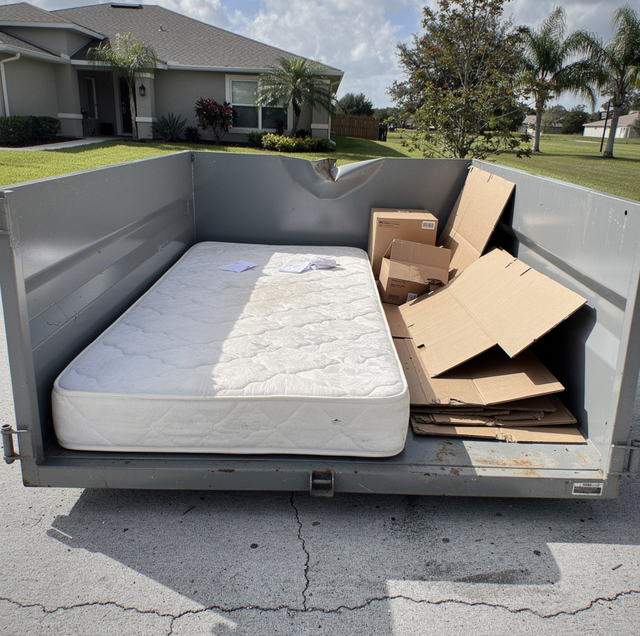
A lot of renters assume a mattress is just another bulky item: heavy and awkward, but no different in kind from a couch or a stack of drywall, so it should be fair game for whatever dumpster or bin is parked in the driveway. It isn't. A mattress is excluded from dumpsters and household bins because of how it behaves on the equipment that handles it, not as a judgment call made on-site. The reasons are mechanical and operational. A mattress behaves differently than almost anything else in a typical cleanout load, and that behavior causes real problems downstream, long after the load leaves the property. The distinction matters most before a container gets ordered or a bin goes out, not after a mattress is already sitting beside a load that was never going to take it.
How a Mattress Jams Sorting and Compaction Equipment
Most construction and demolition debris moves through a facility on equipment built around a simple assumption: the material feeding it is loose, broken, or at least willing to separate into pieces. Cardboard sheets, bagged trash, broken lumber, and drywall scraps move past rotating augers, shredder teeth, and conveyor rollers without catching on anything.
A sorting line built around that assumption meets its match in a mattress.
Steel coils: the innerspring layer is a continuous lattice of wire, and the wire wraps around rotating shafts rather than breaking free of them.
Fabric covers: the quilted outer layer behaves the same way, tangling around augers and conveyor rollers until the line has to be stopped and cleared by hand. What is a brief nuisance on a residential trailer becomes a facility-wide shutdown on a commercial line moving tons of material an hour. That is the operational reason haulers exclude the item before it ever reaches that line, not a preference stated for its own sake. The problem holds whether the mattress goes in whole or gets broken down partway first; a bent metal frame catches a shredder blade the same way intact coils catch an auger.
Foam layers and a wood-frame box spring round out the rest of a typical mattress. What matters at intake is shape and behavior, not composition further down the recycling chain.
A household bin's collection truck relies on the same kind of mechanism at a smaller scale: a compaction blade packs loose bagged waste into the truck body, and a mattress resists that blade the way it resists a facility auger; springs and fabric jam instead of compacting. That's the mechanical reason curbside programs typically route a mattress to a separate scheduled bulk pickup rather than the regular truck.
When booking a dumpster, tell the company up front if a mattress or box spring also needs to be removed from the property. Confirming in advance gets it scheduled separately, rather than surfacing as a surprise exclusion on drop-off day.
Why a Mattress Eats Space out of Proportion to Its Weight
A rented dumpster is sold and hauled by volume, not by weight alone, and a mattress is a poor use of that volume. Foam does not crush the way drywall or brush does. It resists compaction and springs back to its original shape as soon as the pressure is released, which means a mattress laid flat in a container continues to occupy nearly its full footprint even after everything else on top of it has been compacted.
That mismatch compounds fast. A queen mattress and box spring can occupy a meaningful share of a standard dumpster's usable interior while adding comparatively little to its weight, which is exactly the opposite of what makes a load efficient to haul. A dumpster filled mostly with a mattress's shape, rather than its mass, is swapped out sooner and hauled more often for the same amount of actual debris. On a larger cleanout that requires more than one container, that inefficiency multiplies with every swap, so the mattress ends up requiring more trips than its size alone would suggest.
How Receiving Facilities Route Mattresses as a Separate Stream
Mattresses that are collected properly move through the receiving facility as a separate stream, apart from general construction and demolition debris, for the same equipment reasons already covered. When a separate handling fee applies at the facility, it's disclosed as its own item.
What a Dumpster Rental's Accepted-Materials List Is Actually For
A dumpster rental's accepted-materials list isn't a formality tucked into paperwork. The container's material list gets confirmed on the written estimate before drop-off, because the container has to be hauled and processed by real equipment on the other end, and materials that jam that equipment or wreck a load's efficiency get named specifically so there's no confusion about what belongs in the container once it's delivered.
A mattress lands on that excluded list for the equipment and volume reasons already described, not as an arbitrary line item. Reading that list before a container is dropped off, and asking directly about anything bulky or unusual, saves a second trip later to deal with an item that was never going to make it through processing in the first place.
Planning a Cleanout Around the Mattress Exclusion
Because dumpster rentals and mattress removal solve different problems, treating them as a single task usually creates a gap in the plan. Confirming a mattress pickup before a dumpster delivery date is locked in avoids overlap on the day of service, since the two jobs are scheduled and routed separately.
A mattress with exposed or broken springs can puncture skin or snag clothing during a lift, and its size makes a two-person lift the safer choice. Let a crew move it rather than dragging it solo through doorways or stairwells.
Waterbeds and smart beds raise their own separate handling questions and are not covered by the reasoning above. For a standard cleanout, the practical takeaway is simpler: plan for the mattress as a separate item, confirm whether a per-item handling fee applies at the receiving facility, and let the dumpster handle everything else it was actually built to carry.
Frequently Asked Questions
Yes. A box spring's wood frame and fabric-wrapped mesh create the same tangling and volume problems as the mattress itself, so it's handled as a separate item on the mattress stream, distinct from the mattress it was paired with.
Not effectively. New mattresses are compressed at the factory using specialized sealing equipment that keeps the foam from re-expanding during shipping. Once a mattress has been unpackaged and used, that seal cannot be recreated by hand, so folding it only holds until the foam pushes back.
No. A loose foam topper or a pillow has no coils and no rigid shape, so it does not create the same tangling or compaction problem. Those items typically can go into a dumpster load without the mattress restriction applying.
Not in the way that's often assumed. A confirmed pest case is wrapped in plastic sheeting during pickup to keep the problem contained on the way out; that's standard procedure, not an extra step tied to whatever encasement is already on the mattress.
Yes, and for an added reason. An adjustable base is heavier than a standard box spring and contains electrical components (a motor, wiring, sometimes a control unit) that a standard mattress or box spring doesn't have. That's why a base gets handled as its own item rather than bundled in as part of a mattress set.
Twin, twin XL, full, queen, king, California king, and split king all move through the same process. Size changes how much a mattress weighs and how much room it takes up, but it doesn't change which stream the item goes on.
One item, one dedicated run — the coils, foam, and frame leave on the mattress stream so the container stays free for everything else. Polk Services LLC serves Lakeland, Highland City, and Mulberry. Call (863) 344-5806.
