

Restoring a Yard After Pool Demolition: Why It Sinks Later
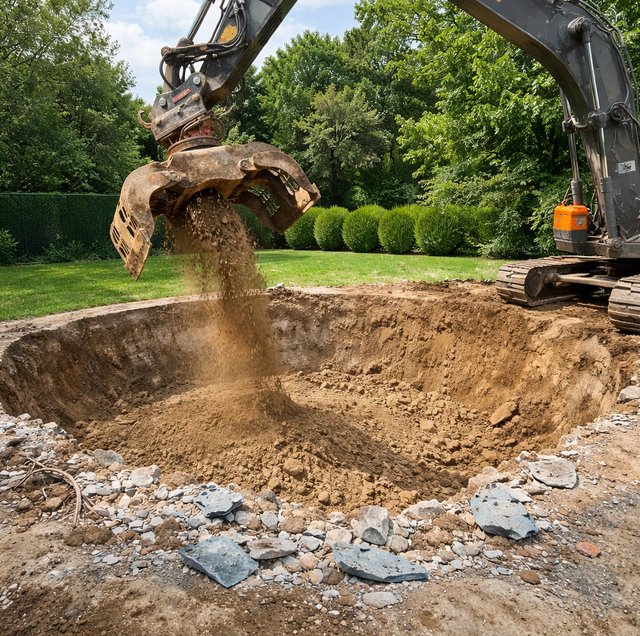
Quick Answer: A pool cavity is a large, deep, isolated pocket of loose fill, unlike a shallow low spot elsewhere in the yard. Dumped in all at once, that fill keeps compressing under its own weight, and can eventually open a sudden depression.
Once the pool shell and decking are gone, what's left behind is a rectangular pit in the yard, sometimes seven or eight feet deep at the old deep end, that has to become ordinary ground again. A well-graded pool cavity looks finished the same week the fill goes in: smooth, level, ready for sod. That first impression is deceiving in a specific, physical way, and the size and depth of the pit are exactly why.
Why a Filled Pool Isn't Just Another Low Spot
A shallow low spot in a lawn, the kind that forms after a sprinkler leak or a few seasons of foot traffic, is usually a few inches deep and surrounded on every side by soil that's been settled and load-bearing for years. That surrounding ground quietly supports the edges of the low spot and limits how much it can move.
A pool cavity doesn't have that. It can run six to nine feet deep at the drain end and twenty to thirty feet across, boxed in by native-soil walls that were never disturbed. Almost none of the fill inside that box has anything solid underneath or beside it except more loose fill. There's no surrounding, already-settled ground doing incidental work to hold the middle of it up. Whatever happens to that volume of material happens on its own.
What Loose, Dumped Fill Does Over Time
Fill a mason jar with dry sand, and it looks full to the brim. Tap the jar against a countertop a dozen times and watch the surface drop, maybe half an inch, as the grains work into the gaps between each other. Nothing was removed; the same sand just packed itself tighter. A pool cavity backfilled in one pour and graded flat on top is doing the same thing, only at a much larger scale, over months instead of seconds, with rain and vibration from routine yard use standing in for the tapping.
A pool of ordinary residential size, something in the range of 400 to 600 square feet of surface and five to six feet deep on average, works out to somewhere around 90 to 130 cubic yards of open volume once the shell and decking are gone, more material moved in one job than most other fill work on the same lot. What makes that a harder case than an ordinary deep-fill job isn't the volume by itself; it's that volume combined with being an isolated, boxed-in void rather than a shallow dish with support on every side.
Why This Void Can Collapse Instead of Settling Evenly
Depth and isolation change what "uneven settling" looks like on the surface. In a shallow low spot, uneven settling reads as a gentle dish a lawn mower barely notices. In a deep, isolated cavity, it can show up as a sharper, localized dip or a hole that opens faster than expected.
Part of that risk comes from what's often mixed into the bottom layers of a demolished pool: broken chunks of concrete decking or shell material. Angular pieces of rubble can lean against each other and bridge a gap rather than settle flat, leaving a hidden pocket underneath. That pocket sits fine for a while, holding the material above it, until vibration, moisture, or its own weight finally collapses the bridge. That's a mechanism a shallow low spot, which is just native soil, never has to deal with.
The Bottom of the Cavity Matters as Much as the Top
Once the pool shell and decking have been removed, what remains at the very bottom is often a section of broken concrete floor or the base of the old shell. If that floor is left mostly intact rather than broken up for drainage during demolition, it can act as a shallow, impermeable basin beneath the new fill. Rainwater soaking down through the yard has nowhere to go once it hits that layer, so it collects there instead, softening the fill directly above it and adding pressure the rest of the yard's soil doesn't have to deal with.
This is worth asking about specifically before backfill and grading work move forward: was the remaining floor broken through in enough places to allow water to pass into the soil beneath rather than pool on top of it? Compacting a fill correctly in every other respect won't fix a trapped-water problem sitting at the base of the cavity.
Keying the cavity's edges, trenching a drainage outlet, or breaking up the remaining pool floor all count as digging beyond the scope of the original demolition. Call 811 before any of that work, not just before the original pool removal.
Compacting in Lifts Built for a Deep Fill
The fix for the settling risk is to place fill in thin layers, called lifts, and compact each one before the next is placed. A typical lift runs about four to six inches of loose material, worked down to roughly three to four inches once compacted, starting from the deepest point of the cavity and building up.
If a shed, patio, or post with footings goes in near the old cavity, set the footings to bear on undisturbed native soil beside it, not on the fill itself. Even well-compacted fill settles more than ground that was never dug up.
Lift thickness matters more for a deep pool cavity than for an ordinary low spot because of the greater depth involved. Skip the layering on a two-inch patch, and the mismatch between a compacted top and a loose bottom is trivial. Skip it across seven feet of fill, and that mismatch repeats itself dozens of times over, stacking loose, air-gapped material the whole way down, beneath a top few inches that look and feel solid.
What to Ask About or Watch for Afterward
- Whether the fill was placed and compacted in lifts as it went in, rather than dumped to grade and compacted once on top.
- Whether the remaining pool floor was broken up enough to drain, not left as a sealed basin under the new fill.
- Some minor settling in the first several months is normal even with good compaction. What matters is whether a dip keeps returning to the same rectangular or kidney-shaped footprint the old pool had, rather than appearing randomly elsewhere in the yard.
- Whether the fill included large, angular rubble concentrated in one spot rather than spread and broken down, since that's where a bridging pocket is most likely to be hiding.
- Holding off on anything heavy directly over the old cavity, a shed, a paver patio, a large potted tree, until the fill has had a full season of rain to work through it.
Frequently Asked Questions
Most of the drop happens in the first six to twelve months after the fill goes in, since that's when rain cycles through the material the most. Smaller, harder-to-notice adjustments can continue for another year or two after that, especially in the deepest section of the old cavity, which is one more reason to hold off on anything permanent over that footprint right away.
It depends on how the weight gets carried. A shed that just rests on runners or a paver skid spreads its weight across the surface and tolerates a season or two of ongoing settling better than one built on poured footings that go down through the fill. A deep-rooted tree's bigger risk isn't its own weight; it's that its roots grow down into fill that's still finding its final density, which can leave the tree slightly out of plumb if one side of the root zone settles more than the other. Either way, giving the cavity at least a full rainy season before adding anything permanent lets the fill work through most of its settling first.
Simply topping off a settled spot with more loose material and grading it smooth repeats the same problem: it adds weight without adding density. The new material settles into the gaps left by the old fill instead of resisting them, so the dip tends to return, sometimes faster than the first time.
It does. Material with larger, angular particles, such as crushed rock or certain aggregate blends, interlocks as it compacts and maintains its density more predictably. Very fine, loose sand can migrate through gaps in broken shell fragments below it over time, a slow washing-out of fines into the voids below, which creates hidden pockets at depth that don't show on the surface until they do.
Timing is often the clearer signal than location. A pool-cavity dip usually develops gradually over the first six to twelve months as the fill compresses, deepens noticeably after a heavy rain cycle, then levels off as the material reaches its density. A drainage-related low spot elsewhere in the yard is usually present from the day the sod goes down, doesn't follow that same settling curve, and instead reappears the same way after every storm rather than continuing to get deeper over time.
Distance is the deciding factor. A cavity out in the open lawn, well away from the house, settling unevenly is a lawn and drainage issue. A former pool that sat close to the house, near a foundation wall or an attached deck, deserves closer attention to compaction and drainage at that edge, since water or movement there has a shorter path to the structure.
A patched, matched lawn over an old pool is the easy part to see. What actually holds it there, long after the sod has rooted in and the yard looks like it was never disturbed, is what happened underground while nobody was watching: six inches at a time, compacted before the next six inches went on top.
Get the fill graded and compacted the right way — even settling over your old pool cavity, not a sinking spot waiting to happen. Polk Services LLC serves Lakeland, Highland City, and Mulberry. Call (863) 344-5806.
