

Can Wood Rot on a Deck Be Repaired, or Is It Past Saving?
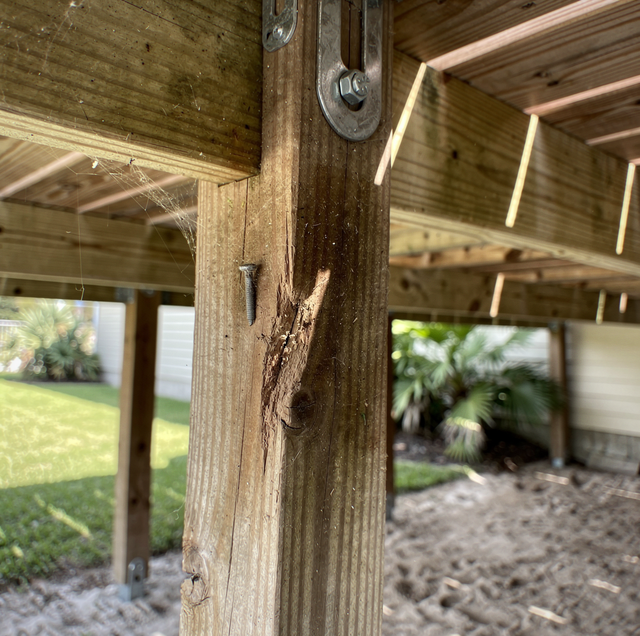
Quick Answer: Rot confined to a few surface boards on a sound frame is usually repairable. Rot in the joists, beams, posts, or ledger, or fasteners that no longer hold anywhere, generally puts the deck past repair and into removal.
The choice in front of you has two sides, and they sit further apart than they look. On one side is a repair that deals with damaged boards and leaves the frame, posts, footings, and the connection to the house exactly where they are. On the other is taking the whole structure out and standing on open ground. Both start from the same evidence: a soft spot in the surface, a board sitting lower than the ones beside it, a stain that no longer weathers away.
What usually settles the question is not preference. It is where the decay sits. A deck is two structures stacked together, the surface you walk on and the frame underneath that carries every pound of load onto the ground. Repair work lives almost entirely in the first one. Once decay is established in the second, the repair conversation is mostly finished, whatever the boards look like from the yard.
What a Board-Level Repair Replaces
The repair most people picture is a surface repair. It addresses decking, the horizontal boards you walk on. Those boards are the most exposed part of the whole assembly. They face up into the sun, they hold standing water after rain, and they take every dropped planter and dragged chair leg. They are the layer the deck is designed to lose first.
A repair path for that layer exists, and a deck builder is the right person to evaluate whether yours qualifies. What matters for your decision is the boundary of that work rather than its details. It reaches the walking surface and stops. The joists, beams, posts, footings, and ledger all stay, and whatever condition they are in on the day the work starts is the condition they will be in when it ends.
What a Repair Cannot Reach
Decay in a framing member is a subtraction problem. It consumes the wood fiber itself, so a joist that has softened has physically less material in it than when it was installed, and less material means less load capacity. Nothing applied to the surface can restore that capacity. The member either has enough sound cross-section remaining to do its job or it does not, and that is a question for someone qualified to evaluate the structure, not something to determine yourself from underneath a raised deck.
The frame also hides its own condition behind the exact layer a repair replaces. Framing is weathered less by sun than by water that has already passed between the boards, and by the slow drying of contact surfaces where two pieces of wood press together and air does not move. Those are the last places to dry out and the least visible.
The difficult version of this is not the deck with obvious damage everywhere. It is the deck where five boards look bad, and everything below them is an unknown.
The Conditions That End the Repair Conversation
A few findings reliably move a deck across the line, and none of them concern how the surface looks.
Decay in more than one framing member: One soft joist can be a local problem with a local cause. Soft joists in several bays mean the frame shared a moisture condition, and the members that still seem sound were living under that same condition the whole time.
Movement visible from the yard: A deck that has leaned out of square, shifts in the wind, or carries a railing run that is no longer in line with the frame is reporting on its connections and bracing, not on its boards. New decking does not address either one.
Decay at the ledger: The ledger is where an attached deck transfers its load into the house, which makes decay at that location the highest-consequence version of this problem and a specialist question in its own right.
Age combined with spread: A deck near the end of its expected service life, showing symptoms in the surface, frame, and railings at once, does not present a repairable defect. It is presenting a service life that has run out.
A frame that no longer holds fasteners: This one deserves its own section, because it is the argument that decides more of these calls than any other.
Why Loose Fasteners Make Re-Boarding a Losing Move
Nails backing out of deck boards get filed under cosmetic nuisance. They are not cosmetic. They are a status report on the wood around them.
Wood moves with moisture. Every wetting and drying cycle swells the board and the joist, then shrinks them again, and in hot, humid climates, that cycle runs constantly rather than seasonally. A smooth-shank nail is held by nothing but friction against the fibers pressed around its shank. When the wood swells, the board rides up the nail. When the wood shrinks, the board does not ride back down. Repeat that a few thousand times and the nail walks out of the joist a fraction at a time.
Decay comes at the same grip from the other side. A fastener holds by gripping intact wood fiber, and decay softens and consumes exactly the fiber it needs. A joist that has gone spongy along its top edge cannot hold anything reliably, screw or nail, new or old. There is also a history problem: every fastener ever driven into the top of a joist left a hole, and those holes are open paths for water into the framing.
The distinction that matters is local versus systemic. One popped nail is a fastener. Popped nails across the whole field, fastener heads standing above the surface of the boards, board ends sitting proud of their neighbors, and a rail that has shifted out of line are the decking telling you that its connection to the frame has been failing generally.
That is what makes re-boarding a frame in that condition a losing move. New boards do not bring their own holding power. They inherit the frame, and the frame's holding power is what already failed. You would be replacing the component that was not the problem and staking the result on the component that was.
A deck that has lost fastener grip can feel solid when you stand still and give way under a group, a grill, or a hot tub. Keep people and weight off it until someone qualified has looked at the structure.
When the Structure Is Sound, and Only the Surface Is Not
The line runs both directions, and plenty of decks land on the repairable side of it.
If the damage is limited to a small number of boards in one area with a traceable local cause, if the deck sits solid with no sway or bounce, if fasteners are still tight across the rest of the surface, and if the structure is comfortably inside its service life, then the frame is doing its job, and only the wear layer has given out. That is a real repair candidate, a case to put to a deck builder rather than defaulting to demolition.
One thing is worth doing before committing either way: get the frame evaluated, not just the boards. A surface repair placed on top of compromised framing has its life set by the framing underneath it, not by the new material on top. Knowing which layer you are dealing with is the entire decision.
What Removal Leaves Behind
When a deck is past saving, removal takes the whole assembly. Surface, framing, posts, railings, and the connections holding it together come out together, and the space returns to open ground. A standard residential deck under 500 square feet typically comes down and is hauled off within a single workday. Whether the footings come out with it or stay in the ground is a separate site decision made during the assessment.
Pressure-treated lumber and cedar or redwood framing are routed to a construction debris facility rather than into general waste.
What you are left with is a bare footprint, and settling its grade, soil, and turf is separate work from the removal itself.
One boundary is worth stating plainly. Polk Services removes decks. It does not build, rebuild, or repair them, and it does not pour patios or install hardscape. If a new deck, a slab, or a paver surface is going into that space, that is a different trade, and the removal is simply the step that clears the way for it.
Frequently Asked Questions
The surface changes; the frame question does not. Composite decking outlasts pressure-treated wood while still being finite, and most composite surfaces sit on a conventional wood frame that ages on its own schedule. That creates a particular version of this decision: a walking surface that still looks close to new sitting on framing that has quietly reached the end of its service life. PVC systems and aluminum framing shift the timeline again. The condition of the surface is not evidence about what is holding it up.
Less often than the idea suggests, because a deck's framing does not stop where the damage does. Joists run continuously from the house edge out to a beam, beams run the length of the structure, and a rim joist ties the whole perimeter together, so the outline of a bad area almost never lines up with a place the frame can be divided. Where a real division point does exist, whoever evaluates the structure has to treat what remains as its own structure rather than as most of the old one.
Partly. A roof keeps direct sun and most rain off the walking surface, so decking under cover usually holds up longer than decking in the open. The framing does not get the same benefit. Shaded, poorly ventilated framing dries more slowly after humid nights and wind-driven rain, so a covered deck can end up with a good-looking surface over framing no better off than an uncovered deck's. Judge the two layers separately.
The ledger, the board bolted through the siding into the home's framing, comes off with the deck, and its bolts leave penetrations through the wall behind it. Those holes are sealed with construction-grade sealant as part of the removal so the wall is not left open. What the exterior looks like afterward depends on the siding and how long the deck covered it, since the covered strip has weathered differently from the wall surrounding it.
It is treated more seriously. Railing posts are usually fastened to the outside face of the rim joist, so a post that moves is frequently reporting decay in the rim joist rather than in the post itself. Railings are fall protection, which makes a soft or loose railing post a stop-using-it condition rather than something to keep an eye on, especially on a raised deck.
It does, because disposal routing splits by material rather than by structure. Composite is not recyclable at most facilities, so it goes to a landfill rather than following the pressure-treated wood, cedar, and redwood into a construction debris facility. A deck with composite boards over a wood frame is two waste streams sitting on one set of posts, which is why it leaves the property as more than one load.
Book a free removal estimate — we take the deck out once the call has been made. Polk Services LLC serves Lakeland, Highland City, and Mulberry. Call (863) 344-5806.
