

Why Grading Matters Before a Buyer Walks Your Land
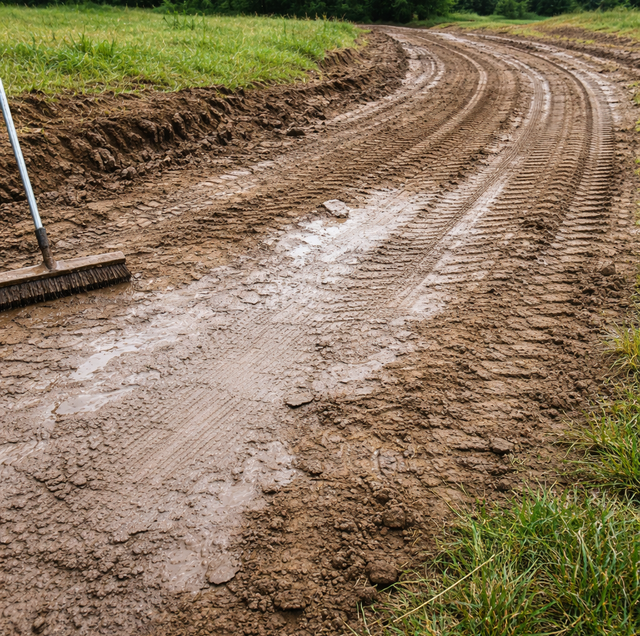
Quick Answer: Before a buyer or inspector reads a report, they walk the ground, and grading condition (standing water, ruts, erosion) is one of the first things a walk reveals. Less-maintained land exposes more of it. Walk your property first, ideally after a rain.
A buyer touring a property rarely brings a level or a soil probe. What they bring is a pair of boots and a couple of hours, and the ground tells them things a listing photo never will. A dry, cracked low spot reads differently underfoot than it does from twenty feet away. A rutted path that looks like "just a trail" from the driveway feels like a washboard the moment someone's foot sinks half an inch into it. None of that requires expertise to notice. It just requires walking the ground, which is exactly what a buyer or whoever they bring along is going to do.
Walking rough, overgrown, or previously graded ground carries a real footing hazard: grass can hide a rut, a settled patch, or an old equipment track deep enough to turn an ankle. Walk slowly, in sturdy boots, watching your footing.
What A Buyer's Walk Actually Picks Up On
A walk-through isn't a technical inspection. It's closer to a series of small, cumulative impressions: does this patch feel firm or does it give underfoot, is that a shadow or standing water, why does the grass look thinner right there. None of those questions get asked out loud. They just add up. A property that reads as "solid, cared-for ground" from one end to the other leaves a different impression than one where every third stretch has the buyer glancing down instead of ahead.
Grading condition sits near the top of that list because it's one of the few things that shows up the same way to a first-time walker as it does to someone who's toured a hundred properties: water sitting where it shouldn't, a channel where soil has visibly washed away, a low spot with matted or dead grass, a rutted track that clearly wasn't part of the original design. None of it needs interpretation. It's just what's there, underfoot, on the day of the walk.
Bare and Thin Ground Hides Less Than a Manicured Lot Does
A small residential yard mowed on a weekly schedule has a built-in advantage: thick, even turf smooths over many minor unevennesses simply by being consistently green and cut to the same height. A shallow dip under an inch or two of healthy grass can be nearly invisible until someone's foot actually lands in it.
Larger or less-maintained ground doesn't have that cover working in its favor the same way. Sections that get mowed occasionally, brush-hogged once or twice a season, or left to grow between visits show grading problems in a way a weekly-mowed yard doesn't. Erosion channels remain open and visible rather than being smoothed by regular foot traffic and irrigation. A rutted equipment or vehicle track holds its shape for a long stretch, since there's no lawn crew edging it back into place every week. And there's simply more ground to cover on a walk, more chances for a low spot or a soft patch to turn up somewhere the seller hasn't paid attention to in a while. Cutting the grass or brush-hogging a field changes what it looks like from a distance; it doesn't change what's underneath, and a walk that gets close enough to feel the ground still finds it.
Reading a Rut Versus Reading Erosion
The two most common things a buyer's foot finds aren't the same problem, and telling them apart is mostly about shape. A rut: a compaction mark, a depression left by repeated tire or foot traffic pressing the same line into wet or soft ground, usually running in a straight or gently curved path that matches whatever made it: a mower, a service truck, an ATV. It holds water because the compacted soil beneath it drains more slowly than the surrounding ground, not because water carved it out.
An erosion channel: a groove cut by moving water itself, usually starting narrow at the top of a slope and widening as it runs downhill, often exposing lighter-colored subsoil, small roots, or bits of rock that used to be buried under a layer of topsoil. A rut can often be corrected with the surrounding grade and some compaction work; an erosion channel usually means the water had somewhere it wanted to go and kept going there, which is worth understanding before any fill goes in the same spot, since fill dumped into an active channel without addressing where the water is headed next tends to wash right back out.
What's Reasonable To Check On The Ground You Actually Use
That doesn't call for walking every acre with a magnifying glass before a showing. It calls for paying attention to the parts of the property that get used and seen: the yard immediately around the house or home site, the approach to the driveway or gate, any path a buyer is likely to walk between the structure and the rest of the land. That's the ground where a rutted low spot or a mushy patch is most likely to get noticed and most reasonable to do something about before anyone else sees it.
A rut worn to roughly an inch or two deep along a well-used path is usually just surface compaction. Deeper than that on a slope more often means water has been re-using the same low channel after every rain.
For that residential-scale ground, the fix is usually modest: filling a shallow rut with matching soil and hand-tamping it in layers so it doesn't just settle back into the same low spot, regrading a small dip with a mini skid steer and a grading blade attachment so the surface sheds water toward wherever it already wants to go, then reseeding or laying sod once the new surface is firm. A mini skid steer is well-suited to this work because it fits through a gate and can work around a fence line, a wellhead, or a mature tree without the footprint a larger machine would require. It's not the tool for reshaping open acreage, and it isn't meant to be; it's sized for exactly the yard-and-home-site scale of work most sellers actually need addressed before a walk-through.
The Ground Farther Out Usually Just Needs An Honest Look
Land that extends well beyond the home site is a different situation and doesn't need the same treatment. Nobody expects a buyer to judge the far end of an unmowed field by the same standard as the lawn next to the porch, and pretending otherwise, or trying to fill and regrade ground you don't use and can't maintain, tends to create more problems than it solves. What's reasonable there is simply knowing what's out there: whether there's a persistent wet spot, an active erosion channel, or a section that's been rutted by regular vehicle traffic, so it isn't a surprise when someone else walks it for the first time. Knowing the condition of that ground and fixing every square foot of it are two different things, and only the part near the house or usable area is where hands-on grading work typically makes practical sense.
A Two-Sided Note On Timing
A walk right after a heavy rain shows grading problems fastest: standing water and soft ground don't hide. A walk during a dry stretch can make the same low spot look deceptively fine, since a dry depression with dead or thinned grass doesn't always register the way a puddle does. Neither extreme tells the full story on its own. A spot that's still spongy a day after the ground around it has firmed back up, in any season, is worth a second look regardless of what the sky is doing that week.
Grading problems aren't seasonal even though rain patterns are. A rutted track or an eroded slope left unaddressed through a run of dry weather is still there once the rain comes back, and a heavy-rain stretch just makes it obvious sooner rather than causing it in the first place.
Frequently Asked Questions
Look at what's growing in the bottom of it. A channel that stopped actively eroding usually has grass or ground cover established down inside it, sometimes thinner than the surrounding ground but present, since it's had enough calm time between storms for something to take root. An active channel shows bare, raw soil at the bottom and undercut, overhanging edges where the last few storms cut faster than anything could grow back, and that combination, bare floor plus undercut sides, is the sign water is still actively reshaping it rather than just having shaped it once in the past.
Thick, continuous turf holds soil in place and slows runoff enough that a shallow dip can go unnoticed for a while. Bare or thin ground doesn't have that root mat working for it, so water sheets across the surface instead of soaking in gradually, and the same low spot reads as visibly wet within minutes of a hard rain instead of staying hidden.
Often, yes, if it was truly one pass and the ground wasn't already soft from repeated use. A single set of tracks through wet grass compresses the top inch or two without fully collapsing the soil structure underneath it, and normal growth and root activity can work that back open over a season without any intervention. Tracks from repeated trips along the same line, or from anything heavier than a passenger vehicle, compact deeper than a season of regrowth reaches, and those are the ones that stay visible and eventually need the same fill-tamp-reseed sequence as a rut anywhere else on the property.
A boot tells you whether the top few inches give or hold; a probe or a length of rebar pushed by hand tells you how deep that softness actually runs. Steady, even resistance the first few inches down, then a sudden give, usually means a shallow compaction layer over firmer native soil below, an easy fix. Resistance that stays soft and inconsistent well past six or eight inches down points to a deeper, wetter problem, sometimes a spot where water has been collecting underground longer than it's been visible on the surface, worth knowing before assuming a spot is a quick one-afternoon fix.
Morning, while overnight moisture is still in the grass, makes a soft or spongy spot easier to feel underfoot than the same ground does once the afternoon sun has dried the surface. It's a small difference, but on a marginal spot, one that's just barely holding water rather than obviously flooded, that extra bit of moisture during a morning walk can be the difference between noticing it and missing it entirely.
Yes. Water finds the low end of whatever slope exists, so the downhill third of a sloped field or lot tends to show ruts, erosion, and standing water well before the uphill two-thirds do, simply because that's where everything draining off the higher ground ends up. Checking the low end of a property first, rather than starting at the entrance and working outward evenly, usually finds the worst of what's there in less time than a walk that treats the whole property as equally likely to have a problem.
A buyer's walk across a property is a plain, physical thing: feet on ground, weight shifting onto a soft patch, eyes catching a channel where soil clearly used to be. None of it requires a report to notice, which is exactly why it's worth a look before anyone else takes that walk. Checking the ground you actually use and understanding what's beyond it puts you in the position of already knowing what a visitor is about to find, rather than finding out alongside them.
Schedule a grading assessment for the yard, home site, and driveway approach — get it leveled and graded before your next showing. Polk Services LLC serves Lakeland, Highland City, and Mulberry. Call (863) 344-5806.
