

Crushed Asphalt vs. Crushed Concrete: Which Holds Up Better
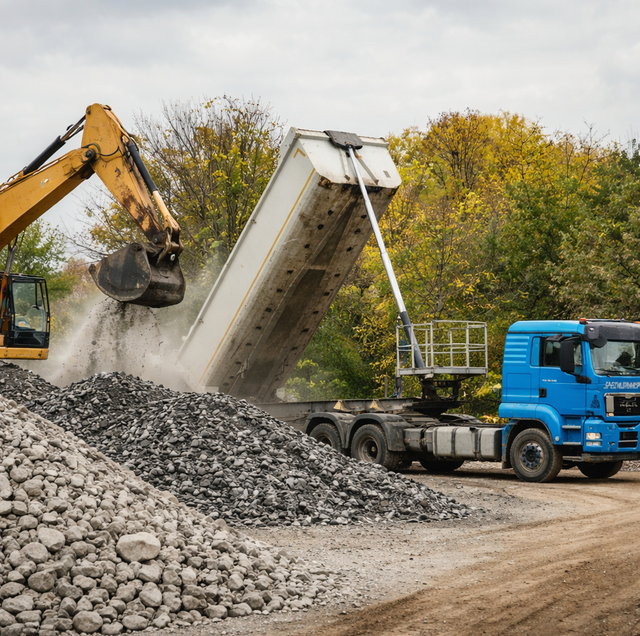
Call two different suppliers for recycled base material, and you'll likely get steered toward crushed concrete by one and crushed asphalt millings by the other, each confident their product is the right call. Both come from demolition waste, both get sold by the ton, and both stand in for quarried stone. What the sales pitch usually skips is that they behave differently once they're compacted and driven on: different waste streams, different binding mechanisms, different priorities depending on the property. What follows is a straight material-to-material comparison for someone picking between the two before a single truckload arrives, separate from deciding what to do with an old slab already on the ground or weighing millings against a fresh poured surface.
Two Different Starting Materials
Recycled concrete aggregate, properly called RCA, is demolished concrete (old slabs, sidewalks, foundations) broken down and screened into a driveway-ready gradation. It's chemically stable, though not perfectly inert, mostly crushed rock and cement paste, with no petroleum content of any kind.
Crushed asphalt millings, also called RAP (reclaimed asphalt pavement), are ground-up asphalt pavement that still carries a coating of residual asphalt binder on every particle. That binder is what lets millings knit into a firmer surface than plain aggregate, a mechanism covered in depth elsewhere; the short version here is that heat and compaction soften the binder just enough to tack particles together, then it re-hardens as the material cools. For this comparison, what matters is how that one difference, binder or no binder, plays out across compaction, drainage, looks, and daily wear.
How Each One Compacts and Interlocks
Both materials start with an advantage a rounded, smooth-edged stone doesn't have: angular, sharp-faced particles interlock and compact tighter, and both build the same way: a 4 to 6 inch base (closer to 8 inches on a heavy-axle or high-water-table lot), compacted in lifts of roughly 2 to 4 inches at a time rather than dumped and rolled in one pass.
Past that shared starting point, they behave differently. RCA holds together almost entirely through mechanical friction: angular fracture faces wedging against each other under compaction. There's a minor secondary effect: leftover unhydrated cement paste in the crushed material can slowly rehydrate when exposed to moisture and add a slight self-cementing firmness over the following months, but it's a modest bonus on top of friction, not a substitute for it. Millings get that same angular interlock plus the binder's tacking action at each contact point, so a millings surface tends to firm up into a more unified mat sooner, while a fresh RCA surface can feel slightly looser at the top until compaction and a season of settling do their work.
Drainage: Where the Water Goes
Properly graded, both materials drain adequately when the driveway is built with a real crown or cross-slope so water sheds off both edges (or, on a circular layout, pitches from the inner edge outward). The difference shows up in the fines.
RCA gradation typically includes a share of fine crushed-cement dust along with the coarser pieces, and that dust is what fills voids and locks the layer tight. Too much fine content, or fines that migrate upward from an unprepared subgrade, can start closing off the open pore space that lets water pass through, which is exactly why a geotextile fabric layer between the subgrade and base course matters on either material: its job is keeping fines from pumping up into the stone from below, not filtering what's already in the load. Millings behave similarly at the surface, since the compacted, binder-locked top layer has less open void space than loose stone, but the base underneath still needs to move water the same way any driveway base does. Neither material replaces a proper crown; both will pond water on a flat or reverse-graded run regardless of how well they compact.
Appearance and Color
This is where the two are easiest to tell apart at a glance. RCA reads light gray to near-white, with visible flecks of aggregate and occasional lighter concrete chunks mixed through the pile, and it brightens a driveway rather than darkening it. Millings read dark charcoal to black, closer in tone to pavement than to stone, and that dark, uniform surface tends to hide oil drips and tire marks better simply because there's less contrast for a stain to show against. Over time, RCA can lighten slightly further as surface fines wash and settle, while millings gray somewhat as UV exposure oxidizes the binder at the surface, the same slow fade a paved road goes through, though millings stay noticeably darker than RCA even after years of sun.
Performance Under Vehicle Weight and Turning
With a properly compacted base under either one, both materials handle regular daily vehicle traffic without trouble. The difference shows up specifically where tires pivot rather than roll straight, such as at a turning radius near a garage or at a spot where a car backs up and cuts the wheel while stationary.
RCA, relying on friction alone, can grind surface particles into finer dust at those pivot points over time, allowing material to shift or thin faster than the rest of the drive, since nothing is holding individual pieces together beyond how tightly they're wedged. Periodically redistributing surface material back into worn turning spots keeps it even. Millings, once fully knit, resist that same scrubbing better because the bonded surface spreads the twisting load across a semi-continuous mat rather than relying purely on point-to-point friction, though a fresh millings driveway is at its most vulnerable to scuffing during its first weeks, before the binder has finished re-hardening through the full compacted depth.
Material-Specific Quirks Worth Knowing
Heat response: Millings carry a thermoplastic binder, meaning they respond to temperature the same way they did on the original road. On the hottest stretches of the year, the surface can soften slightly and feel a bit tacky underfoot before firming back up as it cools, a normal, temporary characteristic rather than a defect. RCA has no binder to react to heat at all, so its surface temperature and firmness don't shift with the weather the same way.
Fresh-material odor: A freshly delivered load of millings typically carries a mild asphalt or petroleum smell from the residual binder, which fades within the first several weeks as the material airs out, weathers, and cures. RCA has no odor at any stage, since there's no petroleum content to off-gas.
Fuel and fluid exposure: Because millings retain an asphalt binder, an occasional gasoline, oil, or antifreeze drip in the same spot (under a parked car, say) can soften or discolor that specific patch of binder over repeated exposure. RCA has nothing petroleum-based to react with a fluid drip, so it holds up to that kind of occasional exposure without the same localized softening.
Sharp edges early on: Freshly crushed RCA has more jagged, angular fracture faces than material that's had a season to weather and round slightly under traffic and compaction. That sharpness fades with time but is worth knowing about for anyone barefoot or with pets in the first weeks after installation. Sourcing also matters here: RCA processed by a supplier that properly screens for embedded rebar and debris before delivery arrives cleaner than material that hasn't been screened as carefully, which is a fair question to ask before a load shows up.
Fresh RCA fracture faces are sharp enough to cut bare feet or a pet's paw pads. Keep barefoot traffic and pets off a newly installed RCA driveway for the first few weeks, until traffic and weather round the sharpest edges off.
Frequently Asked Questions
They can work together as two separate, purpose-built layers, most commonly RCA compacted as a base course under a millings finish layer, but they shouldn't be blended into a single loose layer. Mixing binder-coated millings particles with plain uncoated RCA in the same pass interferes with the binder's ability to tack pieces together during compaction and produces an uneven, mottled black-and-gray surface that neither material shows on its own.
Yes, though it's a different kind of nuisance. Freshly crushed, higher-fines RCA can leave a light gray dust on tires and shoes for the first several uses until surface fines settle in and lock down, while a millings odor is airborne and fades on its own rather than transferring by contact. Hosing down a new RCA surface once or twice in the early weeks speeds up the settling and reduces dust considerably.
Requirements vary by jurisdiction, so it's worth checking with the local building or planning department before ordering material. Some jurisdictions may classify RCA and asphalt millings differently for stormwater or impervious-surface calculations depending on the specific gradation and compaction, which is worth asking about during a permit review even though both are generally treated as permeable, recycled surfaces.
Fresh RCA tends to be the sharper of the two before it has weathered a season, since a broken concrete fracture face is naturally more angular than a compacted, binder-coated millings surface. A knit millings surface feels comparatively smoother underfoot, closer to a fine, slightly gritty pavement than to jagged stone, though neither is as smooth as poured concrete or asphalt.
RCA can typically be re-screened and reused as base material across multiple driveway lifetimes, since it's chemically stable, though not perfectly inert: the same leftover cement paste that gives it a slight self-cementing firmness in place can generate more fines with each additional crushing pass, so reclaimed RCA sometimes needs fresh material blended in to hit the right gradation a second time around. Millings that have fully knit are harder to reclaim cleanly for a second use, since the particles are now held together by re-hardened binder, so removal tends to produce chunks and clumps rather than loose, reusable stock.
RCA, having no binder to hold its shape, behaves like any loose crushed stone and generally benefits from a physical border, an edging strip or a low curb, to stay contained over the long run. A well-knit milling surface holds its own footprint better once cured, though a border still helps during the first season while the binder finishes that process.
Compare materials before you commit — we'll walk your site and recommend crushed asphalt millings or crushed concrete based on your drainage, traffic, and turning patterns. Polk Services LLC serves Lakeland, Highland City, and Mulberry. Call (863) 344-5806.
