

Asphalt Millings Driveway: How Millings Actually Harden
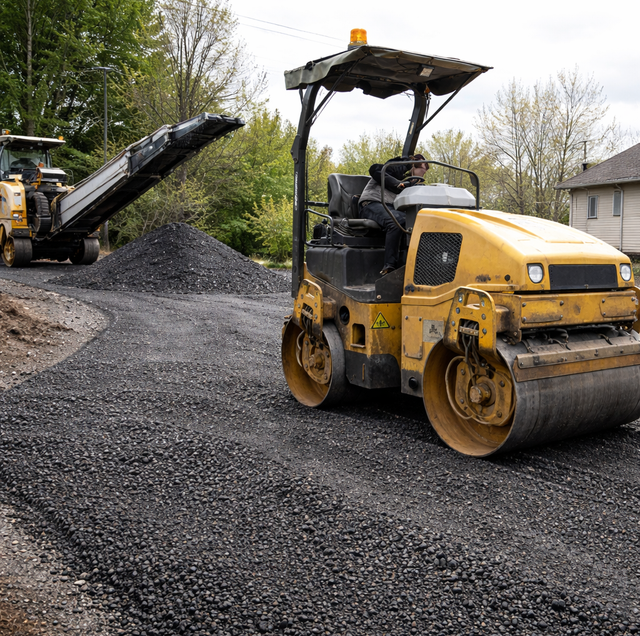
You have probably driven over a driveway or parking area surfaced in that dark, gray-black crushed material and wondered whether it's a special kind of gravel. It isn't gravel at all. It's reclaimed asphalt, milled off old roads and parking lots during resurfacing work, and it behaves in a way loose stone never will: given a little heat, weight, and time, it hardens into something closer to a solid mat than a pile of loose rock. That difference is why we reach for millings on most driveway jobs before anything else.
What Asphalt Millings Actually Are
When a paving crew resurfaces a road, the old asphalt doesn't get hauled off as waste. A milling machine grinds the worn top layer into chunks and fine crumbs, and that material, aggregate stone still coated in the asphalt cement that held the original pavement together, gets screened, stockpiled, and sold as millings. So a load of millings isn't just crushed rock; it's crushed rock that still carries a residual asphalt binder, sometimes called bitumen, clinging to every fragment.
That residual binder is what does the work described below. It's what separates millings from ordinary crushed gravel, and it's the reason a millings driveway ends up feeling closer to paved than loose.
The Binder Is the Mechanism, Not the Marketing
Asphalt binder is a petroleum-based material, and like most petroleum-based materials, it responds to temperature. Warm it up, and it softens and gets pliable; let it cool, and it stiffens back up and holds whatever shape it settled into, the same way a pool of melted wax firms into a solid puddle as it loses heat. That thermoplastic behavior doesn't disappear just because the asphalt has been milled into small pieces. The binder coating each stone fragment is still there, still capable of softening under heat and friction and rehardening as conditions cool.
So when millings get spread and compacted, especially on a warm day, the binder on the surface of each particle softens just enough to let the pieces shift, press together, and squeeze the air pockets out from between them. As the material cools and settles, that softened binder re-solidifies, and now it isn't individual stones sitting loosely next to each other. It's stone particles lightly fused at their contact points by asphalt cement that has re-hardened around them. That is the mechanism that turns a pile of millings into a surface that resists shifting, rutting, and washing the way loose gravel does.
Loose gravel never gets that step. Virgin crushed stone carries no binder at all, so whatever hold it has comes purely from the angular shape of the stone wedging against itself. That's a real bond, but a much weaker one than a layer of particles actually fused by re-hardened asphalt cement, which is why a gravel driveway stays loose and shifts underfoot while a properly installed millings driveway firms into something you can walk or drive across without kicking stone everywhere.
What Happens to the Binder During Installation
None of the locking-together described above happens on its own. It takes the right process to get the binder to do its job.
Compaction in lifts, not one dump
Millings should be placed in layers, often called lifts, and compacted, rather than dumped to full depth and rolled once. A compactor's energy only travels so far into loose material before it stops doing useful work, so a thick pile compacted only from the top will leave the bottom loose and un-knitted no matter how many passes you make over it. Building the surface in thinner layers, each compacted before the next goes down, lets the binder soften and reset through the full depth of the material rather than just at the surface.
Heat, moisture, and traffic keep working after install day
The knitting process keeps going for a while after installation. Sun exposure keeps the binder pliable enough to allow settling and interlocking under wheel traffic, and light moisture, combined with mechanical pressure from cars and foot traffic, can help press the particles together during that early period. That only holds for light moisture, though: saturated ground or standing water during this window can work against the process rather than help it, since excess water is also what drives stripping, the loss of adhesion between the binder and the aggregate. That's part of why a fresh millings driveway can feel a bit looser the first few weeks and firms up noticeably once it has been driven on and warmed by the sun repeatedly. In cooler weather, that same knitting happens more slowly, since the binder doesn't soften as readily without ambient heat to help it along; a driveway installed during a cooler stretch leans more on the mechanical pressure of compaction and traffic to press the particles together, and it may take a bit longer to firm up, but it still gets there.
The base course still matters
Millings harden into a tighter surface than gravel, but that doesn't mean the groundwork underneath can be skipped. A base course, typically a layer of larger crushed aggregate, still needs to go down first on soft or sandy native soil. The base spreads the load, keeps water moving through instead of pooling under the millings, and gives the compacted millings layer something stable to knit onto. Millings laid straight over soft, unprepared dirt can still shift, settle unevenly, or trap water underneath even after the surface itself has hardened, because the problem in that case is what's below the millings, not the millings layer itself.
Millings vs. Crushed Concrete vs. Loose Gravel
It helps to see how these three common driveway materials actually behave differently, because they aren't interchangeable.
Crushed asphalt millings carry that residual binder, so they compact and knit together into a semi-solid surface with real cohesion between particles. Crushed concrete, by contrast, is far more chemically stable than millings, though not perfectly inert: leftover unhydrated cement fines in the material can react over time, allowing it to firm up slightly on its own. It has no asphalt binder, so it depends almost entirely on angular shape and tight compaction for whatever hold it has, similar to gravel but often with somewhat better interlock because the crushed pieces tend to be more jagged. Loose gravel, especially rounded or pea-style stone, has neither a binder nor much natural interlock, so it stays the most mobile of the three. It scatters under tires, migrates with rain, and needs edging or frequent raking just to stay where it's put.
None of that makes crushed concrete or gravel bad choices for every job; they have their place. But if the goal is a surface that firms up and stays put with the least ongoing fuss, the binder in asphalt millings does work the other two materials simply don't.
What to Expect From a Millings Driveway Over Time
A well-installed millings driveway, built over a proper base and compacted in lifts, holds together noticeably longer before it needs attention than loose gravel does, and the surface resists the rutting and scattering that gravel is prone to. It isn't maintenance-free forever, though. High-traffic spots, like where cars turn or brake repeatedly, experience more friction than the rest of the drive and can wear thin or loosen before the rest of the surface does. Heavy, sustained rain can still soften the top layer temporarily even after it has knitted, and very hot climates can leave the surface slightly tacky on the worst days, while cooler stretches let it firm back up.
Periodic top-dressing, a fresh thin layer of millings raked and compacted over worn or rutted spots, keeps a millings driveway performing close to the way it did when it was new, and it's a far smaller job than rebuilding a driveway from scratch. Avoid aggressive blading or scraping with heavy equipment once the surface has knitted, since that can tear up the bonded layer rather than just smoothing loose material, a mistake that's easy to make if you're used to maintaining plain gravel.
Why This Is Our Default Driveway Recommendation
We reach for asphalt millings first on most driveway jobs because the material does something loose gravel physically can't: it turns from a pile of individual stones into a bound, semi-solid surface using nothing more than the binder it already carries, heat, and proper compaction. That gives you a driveway that resists rutting, holds its shape under regular vehicle weight, and doesn't need constant raking or edging just to stay where it was put. It still needs the fundamentals done right, a real base course underneath and compaction built up in layers, but once that's in place, millings do more of the long-term work on their own than gravel ever will. Where the ground or the job calls for something different, gravel or crushed concrete still make sense, but millings are where the conversation starts.
Frequently Asked Questions
No. Millings aren't laid or rolled with the heavy hot-mix paving equipment used for a true asphalt road, so they never form the continuous, non-porous surface a sealcoat is meant to protect. The compacted surface stays porous enough for water to pass through it, which actually helps drainage, so resurfacing is done by top-dressing with more millings rather than sealcoating.
Millings can often be installed directly over a firm, well-graded existing gravel driveway, since the gravel effectively becomes part of the base course. If the existing gravel is uneven, pot-holed, or sitting on soft ground, it should be regraded or partly removed first so the millings have something stable to compact onto, rather than locking in the existing problems.
Fresh millings can vary in shade batch to batch depending on which road or parking lot milling job they came from and how much original asphalt cement is still clinging to each piece, so a driveway installed with more than one load can look mildly two-toned at first. That difference typically fades within the first several weeks as sun exposure, compaction, and a light dusting of fine material even out the surface.
Repeated point-loading from heavy tires parked in the same exact spot can compress that one area more than the surrounding surface and eventually create a shallow depression, especially before the millings have fully knitted. Shifting the parking spot a foot or two during the first season, or setting driveway pads under stationary tires, spreads that load out and prevents the dip.
Light foot and vehicle traffic is usually fine within a day or two, but the surface is still in its early knitting phase during the first few weeks. Avoiding sharp, repeated turns in the same spot during that window, like a delivery truck making a tight three-point turn, helps the binder set rather than scuffing loose before it has had time to bond.
Yes, more than it would on solid asphalt. A downspout or gutter that discharges directly onto the driveway concentrates a large volume of water into one small spot instead of spreading it as general rainfall does, and that concentrated flow can erode a channel through the compacted surface well before the rest of the drive shows any wear. Routing downspout extensions away from the drive, or at least away from any spot where they'd feed directly onto the millings, matters more here than it does on a solid asphalt or concrete surface, since a millings surface relies on staying physically intact at the top to keep holding together.
Ready for a driveway that actually holds together? — Get an asphalt millings driveway installed with a proper base and correct compaction. Polk Services LLC serves Lakeland, Highland City, and Mulberry. Call (863) 344-5806.
