

Circular Gravel Driveways: Why the Center Island Floods
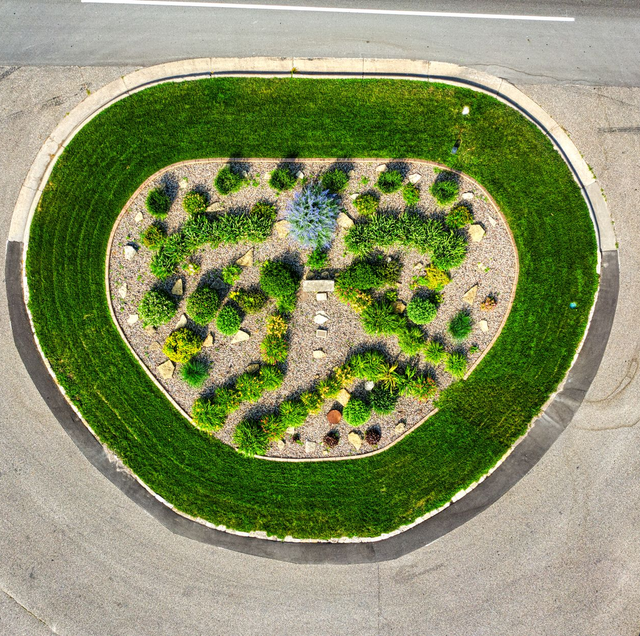
A circular or loop-shaped gravel driveway solves a real problem: it lets you pull in, park, and pull back out without backing down a long straight run. But the geometry that makes it convenient also makes the drainage plan harder, and it's a step that gets skipped more often than any other part of a driveway build. The landscaped circle or island in the middle isn't just decoration. It's the single lowest, most enclosed spot on the whole layout, and if the grading doesn't account for it, that island becomes a collection point for every drop of water that falls on the loop around it.
Why You Can't Just Copy a Straight Driveway's Crown
A standard straight driveway sheds water with a simple idea: build the middle slightly higher than both edges, and gravity pulls water off to either side. That works because a straight run has only two directions for water to go, and both lead off the driveway entirely.
A loop doesn't have two sides. It has an inside edge that borders the island and an outside edge that borders your yard, fence line, or planting bed. If you try to crown a loop the way you'd crown a straight run, either you're building the high point down the middle of the gravel band itself, which just splits water toward the island on one side and away from it on the other, inconsistently, depending on where you are in the curve, or you're guessing and hoping it works out. Neither approach accounts for the fact that the island sits within a ring, with runoff arriving from all directions around its perimeter rather than from two flat sides.
Pitch the Loop From the Inner Edge Outward
The fix is to flip the reference point. Instead of crowning down the center of the gravel band, the pitch on a loop typically needs to run from the inner edge, the edge closest to the island, outward to the outer edge, on both sides of the ring.
Inner edge: this becomes the local high point relative to the gravel band next to it. Outer edge: this is where the water is meant to end up, sheeting off into the yard, a swale, or wherever your existing drainage plan already directs runoff. Grading principles for how much fall you need per foot of run are the same ones that apply to any straight driveway; that's a separate subject with its own numbers. What changes here is the direction water needs to travel, not the ratio of fall to distance. On a loop, "outward" points away from the island on both the inner and outer halves of the ring, not toward one shared low side.
Done correctly, this means that someone standing on the island, looking outward in any direction, sees gravel falling away from them. That's the entire goal: no matter where on the ring water lands, it has a path away from the center and off the property, not a path that funnels it toward the landscaping in the middle.
The Island Itself Needs Its Own Grading
Even on driveways where the ring pitch was done right, one part still gets missed: the island isn't just a leftover space you didn't gravel. If it's left flat or, worse, slightly lower than the surrounding ring after grading, work compacts and settles the gravel around it, making it a bowl. Every bit of water that the ring sheds toward its inner edge lands right back at the base of the island, plus whatever falls directly on the island's own soil or turf.
The island needs a mild crown or mound of its own, highest near its center and falling away toward its outer edge where it meets the gravel. That keeps the planting bed or turf in the middle shedding water outward into the ring rather than holding it against tree roots, mulch, or sod in a spot that never gets to dry out between rain events. If there's a tree or larger planting in the island, keep the mounded soil off the trunk itself. A grade that pitches away from the trunk but still slopes down toward the ring edge does both jobs at once.
Curves Wear Their Edges Faster Than Straight Runs
Tires don't track through a curve the same way they track down a straight lane. On a loop, a vehicle's front and rear wheels follow slightly different paths through the turn, which means the tires sweep a wider band of gravel than the vehicle's actual width would suggest. Over time, that wider sweep pushes loose stone toward the inner and outer edges of the curve faster than it does on a straight approach.
The practical result: edge restraint, whether that's steel, aluminum, or paver edging, earns its keep more on the curved sections of a loop than on a straight driveway of the same length. If a loop was built without edging, or with edging only on the straight approach leading up to it, expect the curve to lose its gravel line and go ragged well before the rest of the driveway does. It's worth checking the curved sections first when you're deciding where added edge restraint will do the most good.
Where the Loop Meets Your Straight Approach
Every circular driveway connects to the road or your main approach at two points, one where the loop starts and one where it rejoins. Those two junctions are grade transitions, and they're easy to get wrong because two different pitch schemes are trying to meet at the same few feet of gravel: the straight approach's crown-to-both-sides pattern and the loop's inner-to-outer pattern.
If the transition isn't graded deliberately, water gets trapped in a low spot exactly where the two schemes meet, often visible as a puddle that lingers at the mouth of the loop long after the rest of the driveway has drained. The fix is to taper the pitch gradually across that junction rather than having it change direction abruptly. Walk the transition points after any grading work and check them specifically, since they're outside the pattern of both the straight run and the loop and can get overlooked by anyone eyeballing the driveway as a whole from one end.
Why the Base Matters More on a Loop
The base under a loop driveway does more work than the base under a straight one because it carries compacted turning loads at every point around the curve, not just straight-line traffic. A base that's thin or under-compacted will telegraph ruts along the tire paths faster on a curve, and once ruts form, they become the new low points that water follows instead of your intended outward pitch. That's why the base layer is not the place to economize on a loop, even though the surface layer on top is where you have more flexibility on stone size and color.
When to Bring in Equipment Instead of Hand-Grading
Small correction work, touching up the pitch near a single junction or reshaping a section of the island, can often be done by hand with a rake and a level or line string. But establishing the full inner-to-outer pitch across an entire loop, especially one with any real diameter, is a job where a mini skid steer with a grading attachment earns its time. It can cut and shape the ring consistently in a way that's difficult to match by eye, section by section, with hand tools. If you're planning a new loop or reworking an existing one where the drainage clearly isn't working, that's the point to bring in equipment rather than patching problem areas one at a time as they show up.
Frequently Asked Questions
Not usually. A properly mounded island sheds water into the surrounding gravel ring by grading alone, the same way a well-pitched straight driveway avoids needing extra drainage hardware. A pipe or drain inlet only becomes worth considering if the island sits in a low point relative to the rest of the yard, not just relative to the driveway ring, since in that case the water has nowhere to go even after it leaves the gravel.
There's no fixed rule, but a narrow ring has less total fall between its inner and outer edge at the same pitch percentage, so a half-inch high spot eats up a bigger share of that fall and is more likely to strand water. A ring in the ten-to-twelve-foot range or wider gives the same pitch more distance to work with, so small imperfections in the grading matter less.
Flexible aluminum or rolled steel edging bends to follow a curve without the visible kinks that rigid straight-segment edging leaves at each joint. Paver or brick edging can also follow a curve but requires a tighter-radius cut and more individual pieces, which create joints where gravel can migrate through if the base beneath them settles unevenly.
Only if there's a functioning catch basin or dry well built into the island to actually take that water somewhere, which is a separate scope of work handled by whoever does that drainage installation, not something surface grading alone provides. Without a structure to receive it, draining toward the center just relocates the standing-water problem to the one place on the property you're least likely to want it, right next to your landscaping.
Check it after the first few heavy rain events, since that's when settling shows up fastest, and then once or twice a year after that, particularly at the two junction points and along the tightest part of the curve where tire tracking concentrates wear. Catching a low spot while it's still a shallow puddle is far less work than regrading a rutted section that's had a season to get worse.
No. The inner-edge-to-outer-edge pitch is the same regardless of the direction vehicles travel around the loop, since it's determined by the driveway's geometry, not by traffic flow. What traffic direction can affect is which side of the curve sees more tire wear over time, since most drivers favor one side of the lane through a turn depending on which way they're coming from.
Get your circular driveway layout checked before gravel goes down — our crew can walk the pitch and island grading with you on site. Polk Services LLC serves Lakeland, Highland City, and Mulberry. Call (863) 344-5806.
