

Limestone vs. Crushed Concrete: Which Holds Up to Heavy Loads?
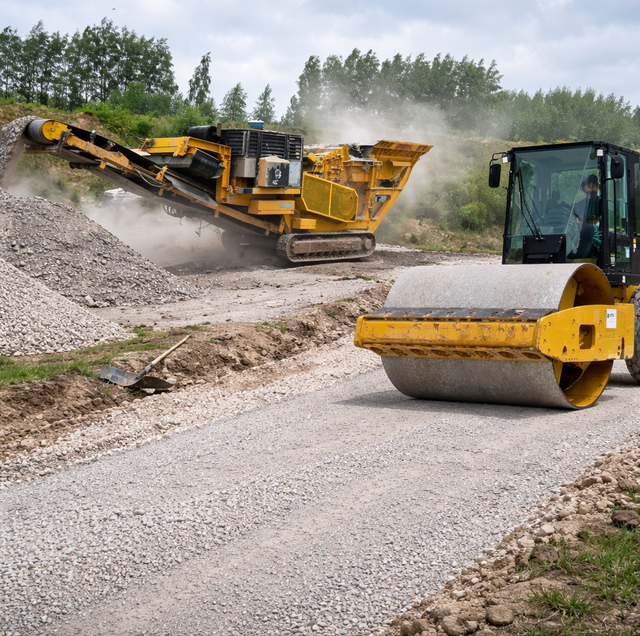
A driveway that only ever sees a sedan and a mail carrier wears differently than one that regularly carries a dually truck, a gooseneck trailer, a tractor, or a parked RV. On acreage lots with long unpaved runs, the heavier, repeated axle loads that the base material holds up to narrow the field faster than most people expect. Among the materials commonly compared for driveways, limestone screenings (also sold as limerock, the fines-rich product that locks into a tight surface through its own dust content) and crushed concrete are the two most often cross-shopped for heavy-use rural drives, since both compact into a firm, load-bearing surface rather than staying loose like round stone. This comparison refers specifically to limerock screenings, not washed, single-size crushed limestone sold as clean stone, which behaves differently and isn't part of this comparison. This article sets aside the wider material lineup and goes head-to-head on just those two, specifically for the kind of sustained heavy traffic an acreage driveway sees that a typical residential drive doesn't.
Where This Comparison Picks Up
Building a base that can carry repeated heavy-axle traffic, work trucks, tractors, loaded trailers, and an RV parked for a week is its own subject, covered in full in our guide to farm and work-truck driveway loads. Once that base is built to spec, the question that guide doesn't answer is which finish material holds up better on top of it. That's the narrow comparison here: limestone screenings against crushed concrete, once the base underneath is already right.
How Each Material Holds Its Density Under Repeated Heavy-Axle Load
Crushed concrete's strength under heavy load comes from its particle gradation: a mix of coarse rubble fragments down through fine concrete dust, all with sharp, broken faces. Under compaction, those angular pieces lock against each other across a wide range of sizes, so the load-bearing structure of the layer doesn't depend on any single particle size doing the work. When a heavy axle flexes that layer, the interlock between the larger angular pieces holds the structure together even as the finer material shifts slightly around it.
Limestone screenings compact through a different mechanism. The coarser limestone particles matter less than the fine limestone dust, since it's the fines that fill the voids between larger pieces and bind the surface into a firm mat once compacted with moisture. That fines-dependent lock is what gives limerock its tight, pale, load-bearing surface in the first place, but it also means the layer's strength is concentrated in its smallest, most mobile component. Under the same repeated heavy-axle flexing that crushes concrete's coarser interlock, limerock's fines are the part doing the structural work and the part most easily displaced, so they migrate and settle differently than they would under light residential traffic.
The Fines Trade-Off Under Heavy Use
Limerock's fines are what make it lock tight and maintain a clean, pale surface. They're also its main vulnerability once traffic gets heavy enough to matter. On a driveway with good drainage and light, occasional traffic, that trade-off rarely shows up: the fines stay put, and the surface holds for years. On a heavy-traffic acreage drive, two things push against that balance at once. First, repeated flexing from heavy axles loosens those fines from the surface layer faster than occasional car traffic would. Second, any drainage imperfection along a long unpaved run- a low spot, a flattened section of crown, a spot where water crosses instead of sheds- carries the loosened fines away with it. Neither factor alone is usually enough to cause a problem. Together, on a heavy-use acreage drive, they're the combination that turns a limerock surface from firm and tight into soft and rutted faster than it would on a light-use residential lot.
Crushed concrete isn't immune to fines loss either, since its mix includes concrete dust that plays a similar role at a smaller scale. But because its load-bearing structure leans more heavily on the coarse angular interlock and less on the fines alone, losing some surface dust to water or traffic doesn't undermine the layer's density the way it does with limerock.
When Limestone Screenings Still Make Sense on Acreage
Limerock isn't a poor choice for acreage use; it just needs the right conditions to earn its keep under heavy traffic. A long driveway with a well-maintained crown, consistent drainage the whole way down, and traffic that's heavy but not constant (a work truck a few times a day rather than equipment parked in the same spot for hours) can support a limerock surface for years without unusual wear. It's also a reasonable pick where the pale, compact finish matters to the property's look, or as a base course under a different finish material rather than as the standalone wear surface for the heaviest-traffic stretch. What limerock struggles with specifically is the combination of sustained heavy-axle load and imperfect drainage together, so a property with either great drainage or lighter traffic, but not necessarily both at once, can still get solid performance from it.
When Crushed Concrete Is Worth the Different Handling
Crushed concrete's angular interlock across a wide gradation is what makes it the steadier performer on the heaviest-traffic stretches: gate approaches, turnarounds where equipment pivots, and the tire paths under a frequently used trailer. Getting that interlock to actually lock takes more deliberate compaction than limerock needs, since a mix running from coarse rubble to fine dust needs every size range engaged rather than just the top few inches worked over. It's also worth confirming with a supplier that a load has undergone proper screening for embedded rebar or wire mesh before a large acreage-sized order goes down, since demolition rubble carries that risk in a way that limerock, being pure crushed limestone, never does. That extra attention during compaction and sourcing is a reasonable trade-off for how much better the material holds up on the heaviest-traffic stretches of an acreage drive.
Crushed concrete sourced from demolition rubble can carry embedded rebar or wire-mesh fragments that a magnetic separator missed. Confirm the load was screened before it's spread, and watch for exposed metal underfoot or under equipment tires once it's down.] Whichever material you land on, the base underneath still needs to run closer to 8 inches on a heavy-axle acreage drive, rather than the 4-to-6-inch range a standard residential base use, built in compacted lifts rather than a single thick pass.
Frequently Asked Questions
Not fundamentally. Both go through the same full-depth lift compaction as any base material, roughly 2 to 4 inches per lift, checked for firmness before the next lift goes on. Where they differ is what that compaction is locking together: crushed concrete's compaction has to work its full range of particle sizes, from coarse rubble to fine dust, into a single interlocked mass, typically two to three full passes with a vibratory plate compactor or roller at the right moisture content, while limerock's compaction is mostly locking its fine dust into the voids between the coarser pieces already in the mix.
It can, if the source slab was reinforced and the recycling yard's magnetic separator missed some fragments during processing. A magnetic separator is more reliable on larger pieces, so what typically slips through tends to be short wire-mesh snippets or small fragments rather than a full length of rebar.
Yes. Equipment that pivots in place, such as a skid steer turning at a gate, scrubs surface fines loose across a tighter radius than a truck's rolling tire does crossing the same spot. Limerock surfaces near gates, loading areas, and equipment turnarounds tend to show fine loss first for this reason, while crushed concrete's coarser interlock resists that scrubbing action longer.
A driveway that's simply dusty in dry weather still feels firm underfoot and doesn't flex when a vehicle crosses it. One that's losing its bond starts to show a slight spring or give in the wheel paths, along with fine material tracking further onto the shoulder after rain rather than settling nearby as dust. That gives the impression the compacted layer is thinning, not just weathering on the surface.
No. The first 50 to 100 feet nearest the road or a gate usually sees the most direction changes, braking, and weight transfer, so that stretch loses fines and shows wear fastest regardless of which material is used. A long, straight middle section generally holds up longest since traffic crosses it at a steady speed without turning or stopping on it.
Yes, some acreage owners use crushed concrete as the base layer for its load-bearing interlock, then finish with limerock screenings on top for a tighter, paler surface, compacting each lift separately before the next is laid. On the heaviest-traffic stretches, though, it usually holds up better to run crushed concrete through the full depth rather than letting a limerock finish layer sit as the top surface exposed to the heaviest axle loads.
Get a driveway material recommendation built for your acreage traffic — talk to Polk Services about matching limestone or crushed concrete to your heaviest-use areas. Polk Services LLC serves Lakeland, Highland City, and Mulberry. Call (863) 344-5806.
