

How Long Does It Take to Remove a Deck — And What Slows It Down
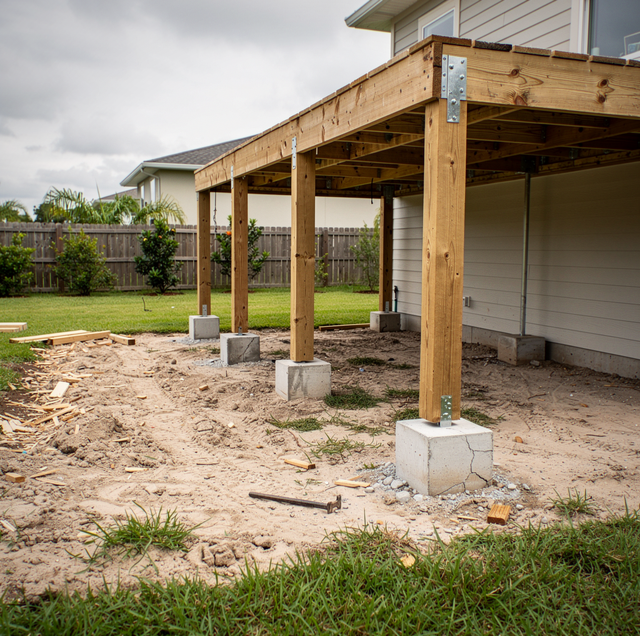
Quick Answer: One workday covers most residential decks under 500 square feet, start to rake-clean. Past that size, or across multiple levels, expect a second and sometimes a third day, set by hauling trips and below-grade work rather than by tear-off speed.
Homeowners asking how long a deck removal takes are usually asking something narrower: whether the crew arrives and leaves within one day, and, if not, how many days the yard remains a work site. The answer turns far less on how fast a deck comes apart than most people expect. Everything between the crew pulling in and the last load leaving counts against the clock, and only a small part of that stretch is tear-off.
What gets timed from the yard is the visible part: demolition, sectioning, boards coming off. That's the smallest slice of the actual timeline. The rest is setup, hauling trips, whatever is below grade, and the walk-through at the end, and each of those moves at its own pace no matter how fast the tear-off itself goes.
What Happens Before the First Board Moves
The crew's day starts with confirming that the job in front of them matches what was scoped: the same footprint, the same material, the same access route walked during the estimate, and, on an attached deck, the same connection to the house wall that adds its own step later in the day. Equipment gets staged wherever the drive-in access allows, and the ground close to the deck gets cleared of anything that isn't part of the structure: patio furniture, planters, grills, anything within reach of a machine working near the house.
The space under the deck is the part of staging that surprises people. It is where a property quietly accumulates over the years: firewood, bagged material, a mower, offcuts left over from the original build, none of it visible from the yard when the job was scoped through a skirt board or a lattice panel. That volume has to come out before a machine works near the structure, and moving it does not make it go away; it just moves it into the hauling total.
None of that shows up in a before-and-after photo, and none of it is optional. A crew that skips straight to demolition without confirming access and staging equipment first tends to lose time later working around something that should have been moved at the start. That setup happens on the clock, before a single board comes off, and it's the reason two jobs that look identical from the driveway can still start their actual teardown at different points in the morning.
Clearing furniture, planters, and anything stored under or beside the deck before the crew arrives keeps that time off the clock entirely, since staging then starts with the structure itself instead of what's stacked around it.
Why Demolition Is the Fastest Part of the Day
Once the site is staged, the tear-off is the one stage with a duration a crew can commit to in advance. Sectioned with a machine, a 300-square-foot deck is off its posts in two to four hours, a window narrow enough to plan the remainder of the day around. Worked entirely by hand, the same deck fills a day for two people, which is the far edge of the same task rather than a different one. Either way, the stage homeowners brace for- the noise and the framing coming down- has finished long before the crew has.
So the part of the day that looks slow from the yard is the part that is fast, and it is the part least likely to move a finish time. Sectioning scales well: twice the material does not take twice as long to bring down the way it takes twice as long to load and haul. The hours that decide whether a crew finishes by dark get spent on the stages either side of it.
How Trip Count Drives the Hauling Clock
Once material starts coming off the structure, it doesn't sit in a pile until the end of the day. It gets loaded and hauled out in trips, and trip count is what sets the pace of that middle stretch more than demolition speed does. An ordinary single-story deck usually clears in a small number of loads. A larger tear-off means more material leaving the property, which means more loading, more driving, and more time before the yard is clear.
Deck material also loads poorly for its weight. A rail section is mostly air: posts, a top and bottom rail, and a run of balusters that will not nest or stack flat against each other. A stair run has the same problem: a set of stringers and treads that stack against nothing. Those pieces take up trailer space out of all proportion to their weight, and they fill a load well before the deck boards do, which is why a modest deck carrying a long rail run and a full flight of stairs can need more trips than a bigger deck without them.
Each trip carries its own fixed overhead. A truck that has left the property is off the job until it comes back, regardless of how fast the crew worked to fill it, and that overhead repeats with every load. A job with twice the hauling volume doesn't take twice as long to demolish, but it can easily take twice as long to clear, since the sectioning is fast and the driving isn't.
Below-Grade Work Has No Fixed Time on the Clock
Everything above the yard follows a rhythm that scales with size: more deck, more sections, more trips. What's in the ground doesn't follow that same rhythm. If the footings are coming out, the below-grade stage has no predictable end time, and it is the only part of the day that can run long with nothing visible having gone wrong.
What sits under a deck is also not one mass. A concrete teardown has a slab whose thickness and reinforcement can be read at a broken edge, so its duration is roughly knowable before anyone starts. A deck stands on individual post footings instead, each one poured at its own moment, to its own depth, sometimes by a different pair of hands in a different year, and nothing about the platform above tells a crew which of those they are about to hit. A post can free up in a few minutes or take considerably longer, and no square-footage number predicts which. It's the one stage of the day that doesn't scale the way the rest of it does.
The Finish: Walk-Through and Rake-Clean
Every removal ends the same way, regardless of how the rest of the day went: a walk-through of the footprint and a rake-clean of the ground the deck used to sit on. That's not a cosmetic add-on tacked onto the end of the job; it confirms nothing got left half-loaded and that the yard is in a state the property owner can walk across without finding a stray fastener or a chunk of framing underfoot.
On a single-day job, the walk-through happens the same afternoon the truck first pulled in. On a job that has run into a second or third day, it's still the last thing that happens, after the last load leaves and after any below-grade work is finished, not a step that gets rushed to make up for lost time earlier.
When One Day Turns into Two or Three
A one-day job rarely turns into a two-day job for one reason. It happens when several of the following land on the same site, each one absorbing an hour or two the schedule had no slack for:
Footings emerging from the ground: The below-grade stage has no predictable end time, so it is the single item most likely to carry work into a second day.
Weather that stops equipment mid-day: Rain heavy enough to soften the yard, or wind strong enough to make overhead sectioning unsafe, can pause work for a stretch at any point in the year, not just one season.
More hauling trips than the estimate assumed: Stored material under the deck adds volume nobody counted, and a long rail run with a full stair set fills a trailer faster than its weight suggests it should.
Restricted access that shifts more of the job to hand work: Hand work is slower than the machine, and slower work stretches every stage that follows it.
For comparison, waterfront dock removals typically run one to two workdays even on an easy job, since working conditions over water set their own pace regardless of size. A deck and a dock aren't measured against the same one-day expectation, which is worth knowing before comparing two quotes side by side.
Frequently Asked Questions
Yes. If a job runs past one day, the crew leaves the site in a stable, secured state at the end of each day, framing sectioned to a safe stopping point and loose material staged for the next round of hauling, rather than picking back up from a half-collapsed structure. Nothing about the site sits in a hazardous state overnight.
It gets loaded into the same hauling trips as the deck itself. Firewood, stored equipment, or a scrap pile tucked against the skirting is often hidden until the platform comes up, so that added volume gets accounted for on removal day rather than at the original walk-through.
Faster in the sectioning itself, since weakened framing gives way with less effort than sound lumber. It tends to run slower overall, though, because deteriorated structure calls for more caution and more hand-clearing of debris that's already partly collapsed, which eats back the time the faster sectioning saved.
Not usually. A run of railing or a stair set adds volume to the load, but on most jobs it consolidates into the same trips as the rest of the platform rather than requiring its own haul. It becomes a bigger factor in trip count on a deck with an unusually long rail run or a tall stair set than on an average residential job.
Not entirely. Skipping footing removal shaves time off the below-grade stage, but the post still has to be freed from the footing before the structure above it comes off, so that connection point still gets addressed even when the footing itself stays buried.
No, and the two days are rarely even ones. The first day is sized to get the structure down and the bulk of the material off the property, so it tends to run its full length. The second picks up the remainder of one or two stages rather than starting all of them over, which is why it often ends by early afternoon, and why a third day, when there is one, is shorter still. A crew pulling out at two o'clock on day two has not cut the job short; that is what a second day usually looks like.
Get a realistic timeline for your deck — send photos or book a walk-through, and see how the same timeline runs for deck and dock removal in Winter Haven. Polk Services LLC serves Lakeland, Highland City, and Mulberry. Call (863) 344-5806.
