

Flat New-Construction Lot? Why It's Not Actually Graded
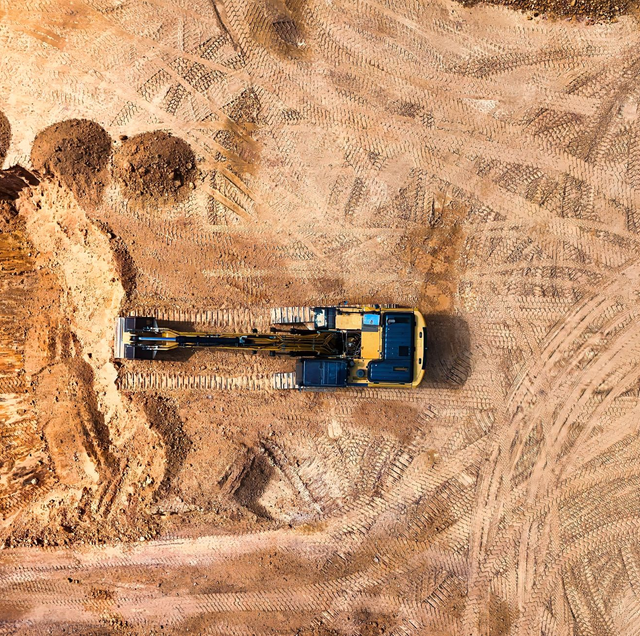
Quick Answer: A freshly cleared, filled, or rough-graded lot is built to hit one number: the required slab or pad elevation. That number has nothing to do with whether rainwater has a finished path off the property. Flat and new isn't properly graded.
If you just bought new construction, or you're sitting on a lot that was recently cleared and filled, the ground probably looks about as good as dirt can look. No ruts, no piles, no low spots you can point to. It's flat, it's clean, and it's obviously been worked by someone with equipment. So when the first heavy rain leaves standing water across half the yard, it feels like something must have gone wrong. Usually nothing went wrong. The lot was never finished for drainage in the first place.
What "Rough Grading" Really Means
"Rough grading" is a specific, limited scope of work, not a catch-all term for "the dirt work is done." A site or excavation contractor rough grades a lot to bring it to within a few inches of a target elevation, usually tied to the building pad, the slab, or the finish floor elevation (FFE) an engineer or the local permitting office set before a single truckload of fill arrived. That elevation exists to keep the structure above expected water levels and to match the pad height to the street, the septic drainfield if there is one, and neighboring lots. It is a construction requirement, checked with a survey or a laser level, and once the pad hits that number, the rough grading contractor's job is essentially done.
What rough grading almost anywhere does not include is shaping the rest of the lot so that water has somewhere to go once it leaves the roofline. That's a separate scope, usually contracted separately, sometimes not contracted at all until an owner asks for it months later. A rough-graded lot can be perfectly flat, perfectly compacted, and still have zero engineered fall across the yard. Flat is often the goal of rough grading, not a side effect. A flat pad is also easier to measure against a target elevation than a sloped one, so crews often leave the surrounding yard closer to level than a finished lawn should be.
The Gap Between "Meets Spec" and "Drains Correctly"
Builders and site contractors work against a checklist: pad elevation, compaction density, setbacks, utility rough-ins. Water standing in the yard for a day or two after a storm can still be technically within whatever internal standard a crew is following, and some will tell a new owner that water clearing within a couple of days is normal. That's a compliance answer, not a drainage answer. A slab that stays dry and a yard that holds water for two days after every storm can both be true at once because they measure two different things.
A new owner standing on a flat, freshly seeded lot sees "new," "clean," and "level," and reasonably assumes someone accounted for where the water goes. Nobody hands over a grading certificate for the lawn the way they do a foundation survey. On most projects, finish grading either happened informally, happened only in the small area right around the foundation, or didn't happen at all.
A flat pad and a graded yard are not the same deliverable: One satisfies a construction elevation requirement checked once with a survey instrument; the other is an ongoing shape across the whole lot that has to move water toward a real exit point every time it rains.
Why a Cleared or Filled Lot Hides the Problem Especially Well
An established, older yard that pools water usually shows some evidence of it: an eroded low spot, a stained patch of grass, a soggy corner that never quite dries out. A brand-new lot doesn't have that history yet. If it was recently cleared of brush and trees, the ground is often compacted flatter than the natural terrain was, because heavy equipment ran over it repeatedly during clearing and construction. If it was filled to bring a low area up to grade, the fill dirt itself, commonly a sandy or silty material trucked in by the load, was likely placed and compacted in flat lifts for stability, not shaped with a finished fall.
Stand on a lot like that after a rain, and you can see it happen in real time: the water doesn't run anywhere; it just sheets across the surface and sits, spreading thin and going nowhere in particular, because there's no low edge or channel for it to follow off the property. On an older yard, gravity has usually had years to carve at least a faint natural path, even a bad one. A new lot hasn't had that time, and it was never shaped to need it, because nobody finished that step.
Fill dirt and recently disturbed ground can bury or shift utility markers from the original construction. Before any grading or trenching on a new or recently filled lot, call 811 to have lines located and marked.
The Assumption That Trips Up New Owners
The core mistake is treating "flat" and "new" as evidence of "correctly graded," as if a brand-new lot worked by professionals with modern equipment should already have modern drainage. Flat is often the opposite of correctly graded for a lawn: a yard needs measurable fall, typically several inches of drop over the first stretch away from the structure, easing off further out, so water has a direction to travel. A lot that reads as perfectly flat has, by definition, little to no fall. It looks finished because it looks tidy and level, not because it was shaped to move water.
"The builder just did this" isn't reassurance, either; it's an accurate description of a scope that ended at pad elevation, not property drainage. On most residential projects, finishing the yard's contours was never part of what a builder was contracted to deliver. It's a distinct scope that has to be requested separately, the same way sod and an irrigation system usually are.
What Finish Grading Adds
Finish grading picks up exactly where rough grading stops. Instead of hitting one elevation number at the pad, it shapes the entire yard's surface so every section has a deliberate, continuous fall away from the structure toward a real exit, a drainage easement, a swale, a ditch, or the street. In practice, that means a contractor working with a skid steer and a box blade or grading rake attachment, checking elevations with a laser level or transit as they go, cutting the high spots and pulling that material into the low ones rather than trucking in more fill than necessary. On a lot with heavier clay subsoil, finish grading also has to account for how slowly that soil absorbs water, sometimes calling for a shallow swale to carry runoff rather than relying on the ground to soak it up. On sandier fill, drainage is faster, but erosion control matters more, since loose fill without a stable fall can wash into ruts on the first heavy storm.
Finish grading also sets the transition zones: the last few feet against the foundation need a steeper, tighter fall than the rest of the lot; any downspout discharge point needs its own shallow channel or splash pad so it doesn't create a new low spot; and any area a driveway, patio, or gravel install will tie into needs its own separate, gentler grade so hardscape runoff doesn't sheet back toward the house. None of that gets addressed by hitting a slab elevation number, and it's not the concrete pour's job to catch it.
What an Unfinished Grade Still Looks Like
A few things tend to show up on a rough-graded lot that hasn't been finish graded. Water sits in broad, shallow sheets after a storm rather than following any visible direction, most noticeable in the middle of the yard rather than at one obvious low corner. The ground feels uniformly flat underfoot, without the gentle fall of a finished lawn. Sod or new grass struggles in patches with no shade or soil explanation, often because roots sit in saturated ground longer than they should. And if downspouts discharge onto flat ground at the foundation line, that water has nowhere built-in to go and often puddles right back against the slab it was meant to protect.
None of these are alarming on their own on a lot that's only had rough grading done. They're expected, because the finishing step that would prevent them hasn't happened yet. They become a real concern only if that second step is skipped indefinitely and the yard is sodded, planted, and left as-is on an unfinished shape.
Frequently Asked Questions
It depends entirely on the contract, and this is worth checking directly rather than assuming. Some new-construction contracts include a basic finish grade as part of the sitework scope; many only cover rough grading to the pad elevation and treat lawn-ready contouring as an owner-arranged add-on, similar to sod or an irrigation system. Ask specifically whether the contract scope includes "finish grading for drainage" as a named line item, not just "grading," since that word alone covers both scopes.
There's an advantage to doing it before sod or seed goes down rather than after, since a contractor can cut and fill freely on bare dirt without damaging established grass. Waiting is not harmful to the process itself, only to convenience: finish grading on an already-planted lot means working around beds, sod, and irrigation lines, which usually adds time and care rather than making the job impossible.
Yes, and this matters more on filled lots than on cut lots. Fill placed in lifts and compacted with equipment can still settle unevenly over the following year or two as it consolidates under its own weight and absorbs its first full cycle of wet and dry seasons. A spot that read as flat and firm at closing can develop a shallow depression later purely from settlement, independent of whether the original grading was done correctly.
Look at the edges of the wet area, not just where the water sits. A settlement bowl usually has a distinct rim, a noticeable dip you can feel underfoot at its border, because one spot dropped relative to everything around it. A grading problem has no rim at all; the ground stays level right through the wet area because the whole surface was never shaped with fall to begin with, so there's nothing for an edge to form against. A localized bowl with a real edge is a smaller, more targeted fix than regrading the whole property.
Often yes. Loose or recently placed fill hasn't had the same compaction history as native soil, so a finish grading pass on a filled lot requires lighter, more careful equipment passes and closer attention to compaction as the material is shaped to avoid creating new soft spots. A lot that was only cleared, with native soil left in place, generally handles grading equipment with less risk of that kind of rework.
It should be planned around those, if you know where they're going. A finish grade that ignores a future patio or shed pad location can route water directly across that spot, which then has to be corrected again once the structure goes in. If you already have a rough idea of where hardscape or outbuildings will go, flagging that before finish grading lets the contractor route the fall around those future footprints rather than through them.
A flat, tidy new lot is a reasonable place to start a yard from. It just isn't finished. The step that turns a rough-graded pad into ground that actually sheds water is its own scope of work, planned and executed separately from the construction that got the slab in the ground, and it's worth confirming, in writing, whether anyone has actually done it yet.
Get your new or recently cleared lot finish graded before problems set in — proper fall, shaped drainage paths, and equipment sized for fresh fill or native soil. Polk Services LLC serves Lakeland, Highland City, and Mulberry. Call (863) 344-5806.
