

Why Gravel Gets Spread Thicker Than the Target Depth on Purpose
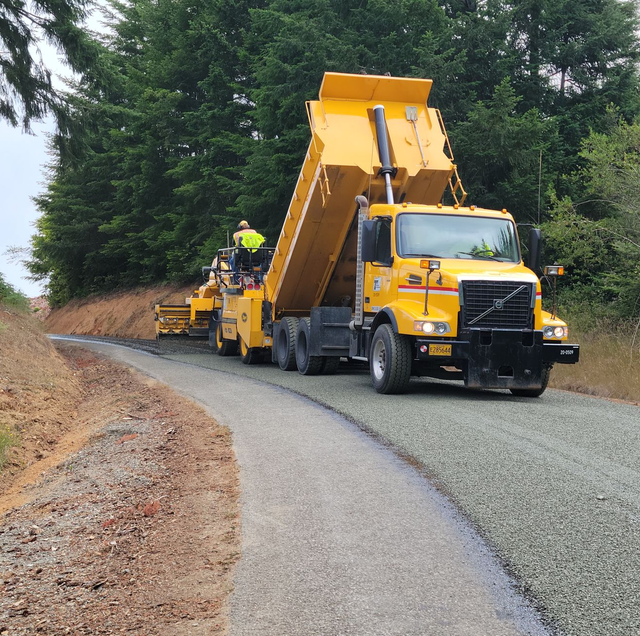
Stand at the edge of your driveway right after the truck dumps and a crew grades the stone flat, and the layer underfoot can look deeper than what you ordered. A base course quoted at 4 to 6 inches compacted might read closer to 5 to 8 inches on a tape measure before anyone runs a compactor over it. That's not a padded estimate or a miscommunication about depth. It's the normal, expected gap between how gravel measures loose on the ground and how it measures once it's locked into place, and understanding that gap is the difference between watching a job go the right way and mistaking a correctly built layer for an overloaded one.
What's Happening Between Loose and Compacted Stone
Gravel dumped from a truck and spread with a rake or box blade sits in a loose, disorganized arrangement. Individual particles rest against each other at odd angles, and the gaps between them, the voids, are full of air. A compactor or roller vibrates and presses that material, and the particles shift, rotate, and settle into the gaps, closing much of that air space. The same weight of stone now occupies noticeably less depth than it did loose, even though nothing has been added or removed.
That shrinkage isn't random. Closing those voids typically costs a loose pile somewhere between a fifth and a quarter of its volume, a range that holds up across most crushed aggregate. A pile that measures 6 inches deep, loose, can settle to about 4.5 to 5 inches once the compactor closes the gaps. That process is simply what happens whenever loosely stacked particles are pressed together by vibration and weight.
Why Installers Spread Past the Target Depth on Purpose
Because that shrinkage is predictable, spreading exactly to the target depth and then compacting guarantees a shortfall. If 6 inches compacted is the goal and loose material shrinks by roughly a fifth to a quarter once it's rolled, spreading only 6 inches loose leaves the finished layer somewhere around 4.5 to 5 inches, short of spec before a single vehicle has ever driven on it.
Installers account for that by working backward: they spread the material to a loose depth roughly a quarter to a third deeper than the compacted target, depending on where that particular material's gradation sits in the shrinkage range, then run the plate compactor or roller over it and watch the surface settle down toward the number they need. The thick-looking pass right after spreading still has to go through that compaction step before it matches the depth the job was designed around.
What a Target-Depth Spread Leaves You With
The mistake shows up most often with an inexperienced installer or a DIY spreader working from stakes or a string line set at the final target depth, then filling loose material up to that line and calling the job done, sometimes without running a compactor over it at all, or running one pass and assuming that's enough.
Either way, the result is a layer that never reaches the structural depth your driveway was supposed to have. A base meant to carry vehicle weight and resist rutting ends up thinner than spec, with less material bridging the soft subgrade underneath it. It may look correct the day it's finished, since loose material sitting at the target line looks like enough to you. Once traffic and weather compact it the rest of the way on their own, unevenly and over months instead of all at once under a machine, the surface drops below the depth the job needed, and rutting or soft spots follow sooner than they should.
Base Layers vs Finish Layers: Different Starting Points, Same Principle
The same overspread logic applies to both layers of a build, just scaled down to a smaller target depth on top.
Base layer: the structural layer of coarser, angular stone is typically targeted at 4 to 6 inches compacted, then spread loose at roughly 5 to 8 inches before the first compaction pass brings it down to spec.
Finish layer: the tighter surface material typically targeted at 2 to 3 inches compacted gets spread loose at roughly 2.5 to 4 inches for the same reason. The margin looks smaller in absolute terms simply because the target depth itself is smaller, but the principle doesn't change: the material's gradation decides whether a given lift lands nearer the top or the bottom of that shrinkage range, regardless of which layer it's in.
What the Loose Depth You See Represents
Watching a load get spread and noticing it sits noticeably deeper than the number quoted for the job can, to an untrained eye, look like more material than was needed. That impression is understandable, but the extra-loose depth is calculated directly from the compacted target using the same shrinkage math above, and it's designed to disappear once the compactor does its work rather than remain as extra thickness after the job is finished. Comparing two different loose piles by eye across two different jobs doesn't tell you much either, since the loose depth that looks right depends entirely on what compacted target and what material the job is built around.
Why Deeper Builds Get Compacted in Lifts, Not One Pass
A base course spread as a single loose pile 8 inches deep and compacted in one pass doesn't densify evenly throughout. A plate compactor or roller transfers most of its energy to the top few inches of material; the bottom of a thick, loose lift can remain undercompacted even after the surface looks tight and firm. That's why base courses are usually built in lifts, roughly 2 to 4 inches at a time, with each lift compacted separately before the next one goes down, rather than dumping the full loose depth in one shot and rolling it once. A driveway that needs 6 inches compacted might get there through two separate loose-then-compact passes instead of one, precisely because the compactor can only reliably reach so far down in a single pass.
How to Tell the Depth Was Verified, Not Just Eyeballed
A properly built layer holds a consistent, even feel underfoot across the width of your driveway, not just down the center where tires travel. Soft give in one spot, a slight dip near the edges, or a section that firms up faster than the rest under weight often points back to a lift that never got its full loose-to-compacted treatment in that area.
Crews confirm depth rather than eyeball it. A probe rod or tape measure is pushed straight down to the subgrade at several points across the width, not just one reading along the centerline. Grade stakes marked with the target depth are common on larger jobs too, since a single center-point check can miss a low spot near an edge or a high spot where loose material bunched up during spreading.
Frequently Asked Questions
Not exactly, though the two are related. A proof roll means driving a loaded truck or the compaction equipment itself slowly across the finished layer and watching for rutting, pumping, or visible deflection under the tires, which tests how the whole system, base and subgrade together, responds to load rather than measuring a single number. A driveway can pass a depth check at every probe point and still show a soft spot on a proof roll if the subgrade underneath has its own weak area, which is why some installers run both checks rather than relying on depth alone.
Yes, though it's a different issue than under-spreading. An excessively thick loose lift run through repeated compactor passes can crush and round off some of the angular particles at the surface, wearing down the sharp edges that let the stone interlock in the first place. That's part of why lifts are kept to a manageable thickness rather than compacting one oversized pile as hard as it takes to get results.
Yes, separately from the loose-to-compacted percentage itself. Stone with a bit of moisture tends to compact more densely and evenly, since the moisture helps fine particles slide into the remaining voids rather than resist one another through friction. Bone-dry material can resist settling as much as expected, while oversaturated material can resist locking together entirely and behave unpredictably under the compactor.
Often as a localized problem rather than a driveway-wide one. A heavy vehicle parked in the same spot repeatedly, a moving truck, a delivery truck, a boat trailer, tends to leave a visible depression in that exact footprint while the rest of the surface stays flat, since that's the spot where the wheel load found the shortfall first.
Yes, on a smaller scale. Even a thin refresh layer over an already compacted base loses some volume as it settles under foot and tire traffic, so it's still worth spreading it a bit past the intended finish thickness. The margin matters less at that scale, since a top-off is usually just raked and hand-tamped rather than run through with mechanical compaction equipment.
Not necessarily. Ordinary traffic and rain produce a small amount of additional natural settling that a mechanical compactor doesn't fully replicate on its own, especially as fine particles keep working into whatever tiny voids remain. A light bit of settling with continued normal use is expected even on a correctly built job. What separates that from an under-built layer is how it behaves afterward: ordinary settling tapers off within the first season, while an under-compacted spot keeps sinking under the same repeated load without ever leveling off.
Get your gravel driveway built to the required depth — we'll spread and compact it to spec, not just to the eye. Polk Services LLC serves Lakeland, Highland City, and Mulberry. Call (863) 344-5806.
