

Fixing a Washed-Out Driveway Edge So It Stays Fixed
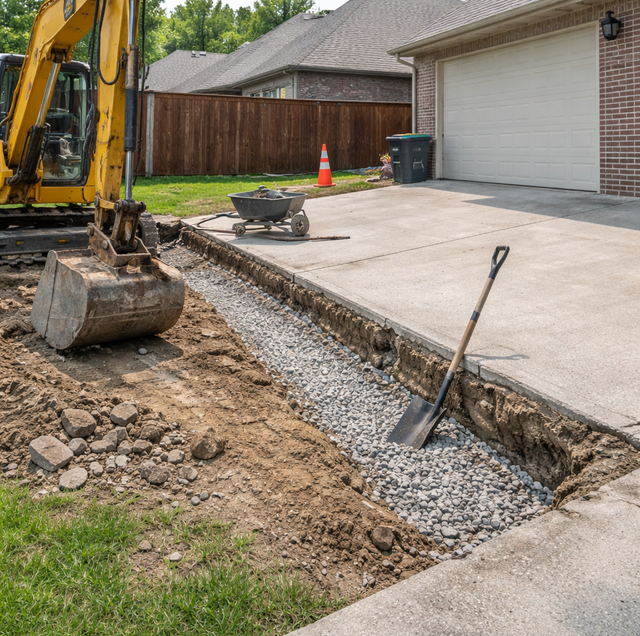
Water cuts the same channel into your driveway's edge after every hard rain, and if you've already filled it in more than once, you've learned that packing fresh stone into the cut doesn't hold on its own. That pattern points to water arriving in concentrated volume at one exact spot rather than your whole driveway losing shape evenly, which calls for a narrower, more targeted repair than pulling a driveway's whole run back to width after years of ordinary tire and mower wear, or patching a margin a delivery truck crumbled swinging wide on a turn. A single channel, whether it cut in one unusually heavy storm or wore back into the same low point rain after rain, needs three things done together: excavate what the water already ruined, deal with where the water is coming from, and rebuild the point so it can take the next storm without cutting again.
Excavating the Channel Back to Firm Material
Filling a scoured channel with fresh stone and grading it smooth looks finished for a while, but flowing water disturbs and loosens material well past the edge of what looks visibly gone. Open the channel wider than the visible cut, until the stone underfoot feels tight and undisturbed rather than loose or muddy. That's what keeps the repair from settling and reopening within a season.
Depth matters as much as width. Excavate past the loose surface gravel and down into firm base or subgrade, not just to the bottom of the visible pocket. Where water has scoured underneath the stone at the sides of the channel, creating a small overhang of intact-looking surface with nothing solid beneath it, cut that overhang back to solid material rather than leaving it in place. An overhang like that collapses under the next vehicle or storm, and it usually widens the channel each time.
An undermined overhang left at the edge of a washout can collapse without warning under the next vehicle or the next storm. Cut it back to solid material before continuing the repair, and keep people and equipment off it in the meantime.
Finding the Water Source Feeding That One Spot
A channel at one edge has a point of origin somewhere upslope, and the repair only holds if you address that source alongside the excavation. Common sources include a downspout discharging near the driveway, an AC unit's condensate line draining onto the same low point, a slope on a neighboring lot shedding onto your property, or a culvert or pipe outlet near the driveway apron.
The most reliable way to find it is to watch the spot while it's raining, not just walk it on a dry day. A dry-day inspection can miss a source that only shows itself once water is moving, and guessing wrong means you rebuild the repair with the same volume of water still arriving at the same point.
Redirecting a Downspout or Tying Into an Existing Swale
Once you've identified the source, the fix depends on what it is. A downspout dumping close to the edge can often be extended with a solid pipe run underground and daylighted somewhere that doesn't concentrate flow back onto your driveway, or redirected with a splash block angled to send water parallel to the edge rather than across it. Where water arrives from a broader slope rather than a single pipe, grading a shallow channel from the low point at your driveway edge to an existing swale gives that water a path to where it's already handled, instead of letting it pool and cut at the edge. A section of buried perforated pipe can do the same job where a surface channel would obstruct mowing or foot traffic. Because a swale, ditch, or drainage easement along a property line can fall under local rules that vary by jurisdiction, any work that touches that shared drainage path is worth checking with your local building department before you dig.
Rebuilding the Point With Fabric, Base, and Matching Stone
With the channel opened to firm material and the water source addressed, the rebuild follows the same layering as the rest of your driveway. Geotextile fabric goes across the exposed subgrade first, extended a foot or so past the cut edges onto undisturbed ground on each side, so fine soil can't migrate up around the patch even where the new base meets the old. Base material goes in on top, built in compacted lifts of roughly 2 to 4 inches rather than dumped in all at once, and tied into your driveway's existing crown or cross-slope so water sheets off the repaired point the same way it does everywhere else, instead of pooling at the seam between old and new.
The surface layer should match what's already on your driveway, but angular, sharp-faced crushed stone is worth favoring at this particular spot even if the rest of the driveway uses something rounder: angular stone locks together and resists being pushed around by moving water better than rounded material, which tends to roll and scatter under flow the same way it shifts more under repeated tire loading.
Breaking Up the Water Before It Cuts Again
At the exact point where the redirected or slowed water first reaches the repaired section, a small amount of larger stone, roughly fist-sized rock rather than the finer surface gravel, acts as a break point that slows the water down before it reaches material fine enough to carry away. This armor stone sits right at the entry point, not across the whole repair, and it's what keeps a repeat storm from re-cutting the same line through freshly compacted base before that base has had time to lock together.
One Storm Event vs a Spot That Keeps Reopening
A channel cut by one unusually heavy storm, with no channel there before and none since, often needs nothing more than the excavation, a basic redirection of the source, and a standard rebuild. A spot that keeps reopening after ordinary rain, even after a first repair, tells you the upstream volume was underestimated, or the redirection wasn't enough on its own. That's usually the point to move from surface grading toward a buried pipe solution, or to add larger armor stone than a first pass called for, rather than repeating the same rebuild a third time.
Frequently Asked Questions
Yes. Where a channel has cut underneath or alongside an existing steel or wood edge restraint, pull the restraint back far enough to excavate cleanly behind it rather than digging around it and leaving the restraint's footing undermined. A restraint left in place over loosened, unexcavated material gives the next storm something rigid to cut around, and it's harder to reset a restraint properly after the fact than to pull and reset it during the same repair.
Often, once you weigh the tradeoff. A buried perforated pipe carries the same water to the same swale without leaving a visible low spot on the surface, but it's harder to inspect and harder to clear if it silts up than an open channel you can just look at and rake out. A surface swale is easier to maintain over the years; a buried pipe is worth it mainly where a visible channel would cut across a mowed area, a walking path, or a spot vehicles need to cross.
Rock in the roughly 3- to 4-inch range is typically enough to break up the flow at a single driveway-edge repair without looking out of place next to finer surface gravel. Larger flow from a larger contributing slope or a wide downspout run may call for stone closer to 6 inches to avoid being displaced by the first hard rain after the repair.
Not always. A single-point repair tied properly into the surrounding crown often holds without restraint, especially once the fabric and compacted base are in place. Restraint becomes worth adding when the repaired point sits on a slope steep enough that gravity alone keeps pulling loose surface stone toward the low side, or when the same spot has already needed a second repair.
Not reliably, and the one case where it gets complicated is when the source sits on a neighboring lot rather than yours. You can excavate, redirect, and rebuild everything on your own property and still watch the same channel reopen if a neighbor's slope keeps shedding water onto the same spot, since you generally can't dig on their land to redirect it at the source. In that situation, the practical fix shifts from stopping the water before it reaches your property to catching and directing it once it crosses your property line, usually with a swale or a buried pipe placed right at the property line rather than closer to the driveway. Property-line drainage work is the case most worth checking with your local building department before you dig, since that's where local rules are most likely to apply.
Generally yes. An open channel keeps funneling every subsequent rain along the same path, widening and deepening it and often undermining a little more of the adjacent surface stone each time. A channel repaired shortly after it forms is usually a smaller excavation than the same channel left through several more storms.
Get a washed-out driveway edge repaired before the next storm cuts it deeper — we'll excavate the channel, address where the water is coming from, and rebuild the point with fabric, compacted base, and matching stone. Polk Services LLC serves Lakeland, Highland City, and Mulberry. Call (863) 344-5806.
