

What Rough Grading Must Get Right Before You Build
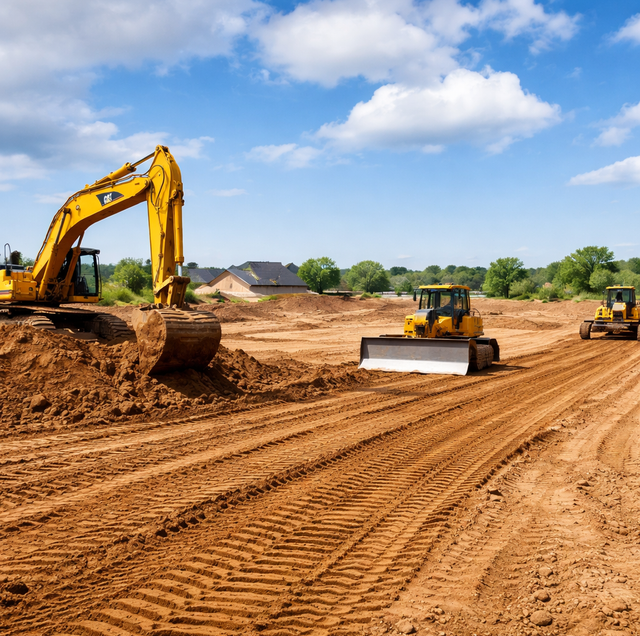
Quick Answer: Rough grading on a new lot has two jobs. First, it sets the building pad at the right elevation relative to the street, so the structure never sits in a bowl. Second, it shapes the ground so water falls away from it.
Rough grading is the stage where a raw lot stops being whatever shape nature and prior use left it in and becomes a site that can actually support a structure. It happens before utilities go in, before forms get set, before a single yard of concrete gets ordered. Done right, nobody ever notices it: the pad just sits where it should, water just goes where it should, and every trade that shows up after grading builds on ground that behaves the way the plans assumed it would. Done wrong, the mistake gets buried under a foundation and shows up years later as a wet crawlspace or a slab that cracked along a line nobody can explain.
Setting the Pad Higher Than What Surrounds It
The first and most basic goal of rough grading on a new build is elevation, specifically, getting the pad itself high enough relative to the ground around it that runoff from the rest of the lot, and from any adjoining property, has somewhere to go besides toward the future structure. A pad that ends up level with or lower than the surrounding grade sits in a shallow bowl by definition, and every storm that follows sends water toward it rather than away.
This isn't guesswork. A site plan sets a target pad elevation before rough grading starts, usually expressed as a height above an established reference point on or near the property. The grading crew then cuts or fills to hit that number across the entire building footprint, not just at one corner. Get one corner of a pad an inch or two off from the rest, and the slab poured on top of it inherits that same unevenness, which then has to get corrected in framing or lived with for the life of the structure.
Pad elevation relative to grade, not just pad elevation on its own: A pad can sit at the exact number called out on the plan and still be a problem if the ground around it wasn't cut or filled to the matching relationship. The pad number only means something in comparison to what surrounds it.
Reading the Lot Against the Street Before the Pad Gets Cut
A street is rarely flat side to side. Most roads are built with a slight crown, higher in the middle than at the edges, specifically so rain sheets off the pavement rather than sitting on it. That crown, and the elevation of the curb or road edge closest to the lot, becomes one of the first reference points a rough-grading plan works from, because a pad set too close to street elevation, or below it, risks water from the road or the roadside ditch working its way onto the lot instead of past it.
The general goal is a pad elevation that stays meaningfully above the nearest point of the street or road edge, with the ground between that pad and the street shaped to carry water toward the street or an approved drainage path, not toward the building. On a lot with a pronounced slope from front to back or side to side, this can mean substantial cutting on the high end and filling on the low end just to get a level pad at the right elevation out of ground that started uneven in both directions.
Neighboring lot elevations matter too. A pad cut lower than an adjacent property's grade can end up as the low point that neighbor's runoff drains toward, even with a perfectly shaped pad of its own.
Positive Fall Away From Every Side of the Footprint
Getting the pad elevation right solves half the problem. The other half is shaping the ground immediately around that pad so it slopes away from the future footprint in every direction, not just toward whichever side faces the street. A pad can sit at the correct elevation number and still fail this second test if the grading around it is flat, or worse, tips back toward the building on one side.
This is where rough grading and the eventual foundation work depend on each other even though they're separate trades handled at separate stages. The rough grade doesn't need to be finished to a finish-grade cosmetic standard; that comes later, but it does need enough consistent fall away from the pad on all four sides that water reaching the ground near the future foundation keeps moving instead of sitting there. A low spot left against one wall of the footprint, even a shallow one, becomes the spot water finds every time it rains for the life of the building.
Loose fill dumped and left without being worked into that shape behaves the way a stack of towels tossed into a closet does: it looks even and full from the outside, but nothing underneath has actually settled into place, and the first real weight or the first heavy rain finds every gap that was hiding under that even-looking surface. Rough grading has to move past "looks flat" to ground that's actually been shaped and compacted to hold the fall it's supposed to have.
Rough Grade Is a Shape, Not a Finish
It helps to separate what rough grading is responsible for from what happens after it. Rough grading gets the site to the correct elevations and overall slope within a working tolerance, not to a finished, planted-and-groomed condition. Topsoil, fine surface shaping, and any decorative grading typically come later, at finish grade, after the structure is up and the heavy equipment traffic that would just re-disturb a finished surface is done.
That distinction matters because a rough grade that's close enough on elevation but wrong on slope direction is a real problem the finish stage can't fully fix, while a rough grade that's a little rough in texture but correct on elevation and fall is exactly on target. The two things rough grading has to get right, pad height relative to its surroundings and fall away from the footprint, are structural. Everything else about how the dirt looks at that stage is cosmetic and gets addressed later.
What Fill Has to Do to Hold That Shape
Where a rough grade requires added fill to bring a low area up to the target pad elevation, how that fill goes in matters as much as how much goes in. Fill placed in thin, compacted lifts, each layer spread and compacted before the next one goes on top, holds its shape and its elevation. Fill dumped in one deep load and graded smooth on top looks identical the day it's placed but has loose material underneath that hasn't been worked, and that material settles unevenly once it's under real weight or once water starts moving through it.
A rough grade that's correct on the day the equipment leaves the site can still fail months later if the fill under it wasn't compacted properly, because the surface elevation the crew measured wasn't stable; it was just sitting on top of material that hadn't finished settling yet. This is one reason rough-graded pads are often left to sit for a period before foundation work begins: to give fill time to settle under its own weight, sometimes aided by a compactor pass or two, before anything permanent is built on top of it.
Cutting, filling, and setting stakes or grade markers on a raw lot all disturb ground that may hide buried gas, power, water, or communication lines. Call 811 before any digging or excavation-grade work starts, even on land that looks undeveloped.
Where a Rushed Rough Grade Leaves Its Damage
The failure mode for a rough grade that skipped one of these two goals rarely shows up during grading itself. It shows up after the slab is poured, after the walls are framed, after the yard is planted and finished out, when water starts pooling against a foundation wall that was never actually shaped to shed it, or when a section of slab settles unevenly because the fill under one corner of the pad was never properly compacted. At that point, the fix isn't a grading crew with a mini skid steer; it's a structural repair, and the difference in scope between the two is the very reason rough grading is treated as a step worth getting right the first time rather than a formality before the real work starts.
Frequently Asked Questions
No, and the two targets aren't held to the same tolerance. Pad elevation typically ranges from a few inches, refined later at finish grade once topsoil, seed or sod, and any decorative shaping are added. Fall direction away from the footprint doesn't get that same leeway: a section of the perimeter that pitches the wrong way, even slightly, is a structural miss that finish grading can dress up but can't actually correct.
It's workable but riskier. Wet soil compacts inconsistently; a plate compactor or roller can push moisture around rather than pack the material, and equipment traffic on saturated ground can create ruts that undo the shaping just done. Crews generally prefer soil at a moderate moisture content, damp enough to compact well but not so wet that it deforms under equipment weight.
No, they typically reference their own target elevations, usually set slightly lower than the main house pad so water draining off the driveway or garage apron doesn't route back toward the living space. A rough grading plan for a new lot usually includes at least two, sometimes three, separate elevation targets rather than a single flat number for the whole site.
Yes, and where two lots don't naturally match at the property line, the fix usually happens right at that boundary rather than across the whole yard. A shallow swale runs along the shared line, a low retaining edge on the higher side, or simply matching the neighbor's grade for the last several feet before the line are the usual ways a rough-grading plan resolves an elevation mismatch between two adjoining lots without pushing water onto either one.
On most new-construction sites, existing topsoil is stripped and stockpiled separately before cutting or filling begins, rather than being mixed into the structural fill beneath the pad. Topsoil is organic and compresses unpredictably, which makes it a poor material to build a foundation on top of; it gets set aside and typically comes back later for finish grading around the completed structure.
It varies with soil type, fill depth, and weather, but a settling period of several days to a couple of weeks between rough grading and foundation work is common where meaningful fill was added, and sometimes longer in wetter conditions. The pause allows compacted fill to settle under its own weight before it takes on the additional load of a foundation and structure.
Rough grading is one of the few stages of a build that almost nobody who lives in the finished structure will ever think about again, which is exactly why getting it right while the ground is still open and easy to correct matters so much. A pad set at the wrong elevation, or a fall that tips the wrong direction around the footprint, doesn't announce itself until long after the equipment has left and the site looks like any other finished lot.
Schedule a grading and ground-leveling assessment — get uneven, poorly sloped ground corrected before it becomes a drainage problem. Polk Services LLC serves Lakeland, Highland City, and Mulberry. Call (863) 344-5806.
